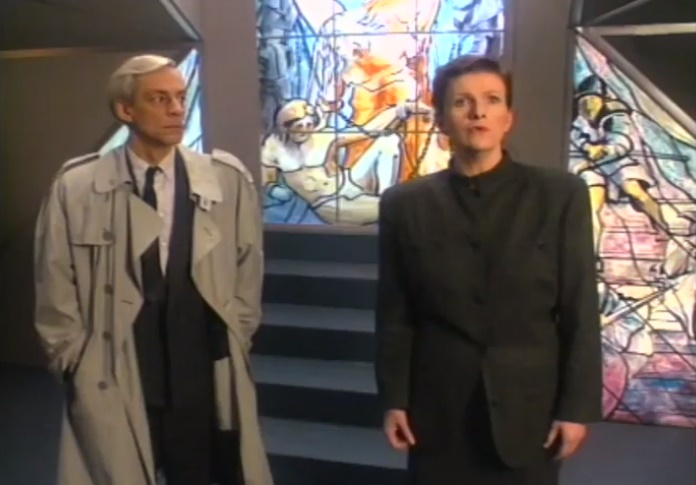
... aka:
Broken Glass
Directed by:
Kristín Jóhannesdóttir
Glerbrot checks a number of boxes that interest me right out of the gate. First, it's Icelandic and, as per my last count, one of just eight genre films produced there prior to 1990. Second, it was made by a female director. Though having a female filmmaker at the helm of a horror film is not an uncommon occurrence nowadays, it was back when this was made. Jóhannesdóttir even went one step further by also co-scripting, editing and shooting this. Third, this features alternative pop star Björk (credited under her full name Björk Guðmundsdóttir) in the lead role back when she was still with her band The Sugarcubes and years before her 1993 solo breakout album, Debut. Prior to this, Bjork had acted in the black-and-white art film The Juniper Tree (filmed in 1987 but not released until 1990), which was witchcraft-themed and also made by a female director, the late Nietzchka Keene.
Unlike Glerbrot, which runs just 50 minutes and was an Icelandic TV movie made for RÚV (basically Iceland's equivalent to PBS), Juniper played in theaters around the world and took home a few festival awards. Still, it was and still remains a film of limited interest due to its art-house-ish-ness and seldom been viewed despite getting a DVD release in 2002 from Rhino and a Blu-ray release in 2019 from Arbelos Films. Glerbot, on the other hand, doesn't even have that luxury. I couldn't find a single VHS or DVD release for this title. The best that's currently available is a copy ripped from TV.
And, finally, this is just plain weird. I couldn't quite figure out what it was attempting to say or why it was even made. It's sort of a mix of women-in-prison film, nunsploitation film (minus nuns if that makes any sense!) and sane (maybe) person locked up in a corrupt asylum film with flashes of horror, torture, surrealism and religious iconography.


An unkempt old man (Helgi Skúlason) with the biblical name of Theofilus is washing clothes in what appears to be a laundromat located inside a cave but just turns out to be a cavernous laundry room (?!) inside their home with TEN stacked washing machines and dryers. The man's bitchy, miserable daughter-in-law, Liney (Margrét Ákadóttir), walks in and starts arguing with him about how much she hates both him and his son. He tells her she has no room to talk because, back in her younger years, she partied a lot and was far from a pristine virgin. When her drunk husband Jon (Pétur Einarsson) comes stumbling home, the two get into an even worse fight with her chastising him for being a drunk and him chastising her for being a whore. It gets a little physical and has to be broken up by Theofilus.
The married couple both want to send Maria (Björk), his crazy-haired teenage daughter from an earlier marriage, away because she's got a foul mouth, emotional issues and is staying out all night doing God knows what. What she's actually been doing, unless it is all being imagined (certainly a possibility given the the rest of the film) is shooting some kind of music video on a massive sound stage with a crashed airplane and lots of swirling fog.


After yet another screaming match, the parents get their way and two stern older women (Kristbjörg Kjeld and Margrét Guðmundsdóttir); a doctor and the director of the asylum (which they call a "boarding school") show up, get the parent's permission to "be rough with her, if needed," and then drag a screaming Maria off. They drive out into the country to the seaside asylum, walk down a corridor and then throw Maria into a cell with just a bed and crosses on the walls. When she starts acting up, they threaten to drug her. They then make her strip naked and one of the women gropes her while asking her to pray to God for forgiveness. In other words, a typical religious establishment.
Maria is haunted by frequent nightmares of a cross being thrust in her face and the doctors coming at her with scissors (probably trying to give her a butch haircut). The staff is entirely female and also entirely lesbian. The lez asylum director tries to grope Maria again; justifying that by informing her that the devil lives inside men and that messing around with them will make her suffer in hell for all eternity. Yet doing it with her is apparently OK. The sin, according to the director, is entirely masculine and she's so dead set in her beliefs that the asylum cat also has to be female. Some of the other inmates start indulging in PG-rated girl lovin', even out in the open, and the staff slip sleeping pills into the milk at night to make sure they don't cause any problems. After her idiot parents stop by for a visit and prove they're still utterly useless, Maria plots to break out with help from her sort-of boyfriend, Vinur (Björn Baldvinsson).


So what is this all about? Well, uh... Fairly early on, Maria is shown overdosing on drugs she buys from some guys on the set. That leads me to believe she's either in the process of dying and this is kind of a delirious jumble of her final beliefs / thoughts / memories or that it's all some kind of drug-induced delusion. Religious imagery is all over the place, and the final scene of her going off into the blindingly bright snow and then lying down to sleep is obviously a death / afterlife metaphor. Making all of the asylum staff predatory, evil lesbians whose chief objective is to turn their young charges against men, and her savior finally coming in the form of a man, is a story point that has me even more befuddled. I doubt they intended this to be offensive, but if anyone decries this homophobic I can certainly see why!


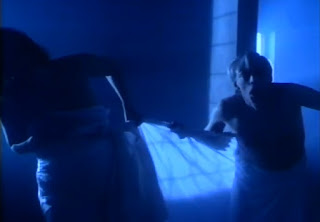


As for Björk, she gets to wear weird clothes, have weird hair, make weird faces, do a little bit of singing and shriek, curse, cry and scream in hysterics most of the time, so nothing out of the ordinary for her. She appears topless during a scene, but that isn't much of a surprise since she'd go on to pose nude plenty of other times. This almost seems like a precursor to when Lars von Trier put her through the emotional ringer playing a death row inmate in Dancer in the Dark (2000).
★★