.
.
.

Monday, February 20, 2012

Ash Tree, The (1975) (TV)

... aka: Ash Tree by M.R. James, The
... aka: Ghost Story for Christmas: The Ash Tree

Directed by:
Lawrence Gordon Clark


As good fortune would have it (or so he thinks), Sir Richard (Edward Petherbridge) has just inherited a sprawling country manor and all of its possessions. Almost immediately upon arriving, strange things begin to happen. Members of the staff repeatedly refer to him as Sir Matthew, he keeps having visions of things that happened there years earlier and animals in the area have been mysteriously turning up dead. As it turns out, Richard has inherited the home from legendary witch hunter Matthew Hopkins (also played by Petherbridge), who himself had died there under very mysterious circumstances. Dr. Croome (Preston Lockwood) explains that Matthew's body was unexplainably toxic and anyone who touched it had swollen arms and hands for weeks afterward. On the same property not long ago, many witches were tortured and killed. When Richard unwisely decides to move a grave belonging to falsely accused "witch" Anne Mothersole (Barbara Ewing) - who was hung along with two others - things take a turn for the creepier, especially in regards to a huge ash tree where strange noises that sound just like babies crying can be heard...


This 32-minute period ghost tale was a BBC TV presentation and part of their popular, long-running annual "Ghost Story for Christmas" series, which were fairly faithful adaptations of M.R. James stories (this one adapted by David Rudkin) shown around the holidays. Director Lawrence Gordon Clark had previously made the excellent and chilling A WARNING TO THE CURIOUS (1972) entry, which is perhaps the best of the bunch, as well as THE STALLS OF BARCHESTER (1971), LOST HEARTS (1973), THE TREASURE OF ABBOT THOMAS (1974), THE SIGNALMAN (1976) and STIGMA (1977). While The Ash Tree carries on the series' reputation for quality and is competently made, it isn't quite as creepy as some of the other tales. The film blends the present with the past, with Matthews' life bleeding over into Richard's; causing him to periodically zone out from reality. The final revelation, which explains both the animal mutilations and why Dr. Croome is insistent the tree be cut down (which - of course - it isn't), seems almost random, though I'm sure it's faithful to the original story.


Witch hunter Hopkins was also the subject of the classic Vincent Price vehicle WITCHFINDER GENERAL (1968; aka The Conqueror Worm). All of the Ghost Story tales have been issued on both VHS and DVD by BBC.

★★1/2

Bluebeard's Ten Honeymoons (1960)

... aka: Bluebeard's 10 Honeymoons
... aka: Woman Killer, The

Directed by:
W. Lee Wilder


Considering the fame of its Oscar-winning lead actor and that it's based on a factual case (there's always a market for true crime), it's strange that this attempt to recount the crimes of infamous French serial murderer / "wife-killer" Henri-Désiré Landru has slipped between the cracks over the years. Then again, maybe there's just not that much interest in Landru. Renowned director Claude Chabrol tackled the same subject matter with a much higher budget and a more professional cast just two years after this one (1962's LANDRU) and no one has seen that film either. Bluebeard's Ten Honeymoons currently has fewer than 50 votes on IMDb and I don't think it's ever officially been released on a home viewing format, though it used to pop up on TV every once in awhile. Good luck finding a copy in either case. It was made by W. Lee Wilder, the brother of famous director Billy Wilder. While Billy was making his classics in Hollywood, W. Lee was on the outskirts trying to cash in on the 50s sci-fi horror craze with such efforts as PHANTOM FROM SPACE (1953), KILLERS FROM SPACE (1954) and THE SNOW CREATURE (1954). This attempt at a more sober horror is - just as all his other films - a mixed bag of the entertaining and inept. George Sanders - admittedly not giving one of his finer performances here; though fine nonetheless - is the film's real drawing card.


Parisian furniture and antiques dealer Henri Landru (Sanders) is a man in love... and he's found the wrong hussy to fall for! The object of his lust is voluptuous blonde Odette (Corinne Calvet), a hard-drinking cabaret singer who's only interested in money. Odette devises a scheme with her shady boyfriend to bilk Henri of 5 thousand franks, claiming her ill mother needs an operation. After sleeping with him, she gets angry when he only gives her half of what she wants and takes no time in informing him she'll soon be looking for "someone who can really afford to have me!" Henri tries everything to get the rest of what she wants, including selling a prized piece of family jewelry. Spotting an ad in the newspaper, Henri goes to meet Madame Vivienne Dureaux (Patricia Roc), a widow who wants to sell three rooms full of furniture before she moves out of town with her sister, Giselle (Ingrid Hafner). Henri meets her, the two go to dinner and Henri ends up accidentally pushing her over a balcony to her death during a struggle. He decides to lay her out on the train tracks to make it look like a suicide and goes ahead and sells her furniture for a tidy profit. Afterward, he's able to shower Odette with the money and gifts, including a ring he removed from Mme. Dureaux posthumously!


Discovering that murder is more profitable than dealing in tables and chairs, Landru starts targeting other lonely women for their money. Using a new identity and claiming to be either a writer or a diplomat, he rents out a secluded villa on the outskirts of Paris, where he romances his victims, gets them to fall in love with him and eventually give him access to their bank accounts. He then poisons them, dismembers their bodies with a hacksaw and burns the pieces in a stove. His next victim is Madame Guillin (Jean Kent), whom he overhears placing a lonely hearts ad in the newspaper for a husband who can match her financial means (40,000 franks). Many others follow. Away from his villa, Henri drowns one of his lady friends in the bathtub of her hotel room. Another is stabbed and her body is buried at a construction site. After claiming many victims and once his wealth is established (he's also able to fleece nearly 200 thousand from a wealthy widow whose husband disappeared while on safari), he's finally able to impress Odette. She finally agrees to marry him but, unfortunately for her, Henri finds out about her other lover on the side and decides to terminate those plans. And her. While all of this is going on, the first victim's sister is busy at work piecing the clues together and trying to locate her missing sibling.


I need to immediately point out that this American-shot film fails hard at its attempt to recreate Paris. The sense of both time and place are incredibly screwy. It doesn't help that the cast consists of a British lead actor, a French lead actress and mostly Americans in the other roles. Most (including Mr. Sanders) don't even bother with attempting an accent. Not much of the art direction recalls Paris either and stock footage of the Eiffel Tower and Moulin Rouge are a poor substitute. While the original crimes took place from 1914 to 1918, this film also doesn't bother with period detail and simply updates the story to 1960. A surprising number of details from the real Landru case make their way into this film. Landru was a furniture seller, did use multiple identities, lured some victims with personal ads and disposed of bodies the same way they are here (one of the reasons it took so long to catch him is because their were no bodies). A sister of one of his victims did indeed hunt him down and her independent research did help convict him... though here, Landru is ultimately brought down by one of his victims' Siamese cat!


Skimpy production values aside, one huge plus here is the amount of dark humor to be found. Landru is very business-like about his murders. He's also very cheap! Immediately upon killing a victim, the first thing he does is raid their pockets and purses. Landru also keeps tabs on all of his expenses in a little black book. In one column he keeps tabs on his out of pocket expenses (dinner, etc.) in ensnaring victims and then deducts it from what his net gross will be upon killing them! He also steals tip money off a table at a restaurant and, when ordering train tickets to his villa, always makes sure to order one a round trip and the other a one-way as not to waste any extra money!


Maxine Audley (the killer's blind downstairs neighbor in the same-years PEEPING TOM) and Greta Gynt (from the 1939 Edgar Wallace adaptation THE HUMAN MONSTER starring Bela Lugosi) play victims and George Coulouris and Sheldon Lawrence (from the director's very fun THE MAN WITHOUT A BODY in 1957) have small roles as well.

★★1/2

Sunday, February 19, 2012

Patayin mo sa sindak si Barbara (1974)

... aka: Kill Barbara with Panic
... aka: Scare Barbara to Death

Directed by:
Celso Ad. Castillo


Immediately after THE EXORCIST (1973) became a huge sensation and one of the highest grossing films of its year, came a wave of copycats, wannabes and the rare few that actually managed to do something interesting with the demonic possession concept. Nine times out of ten, the victim of the possession was an innocent female and most of the films were vulgar, sleazy and cheap. Many were made in Europe, including the medium budget THE ANTICHRIST (1974), BEYOND THE DOOR (1974), THE EERIE MIDNIGHT HORROR SHOW (1974), NAKED EXORCISM (1975), NIGHT CHILD (1975) and others from Italy, DEMON WITCH CHILD (1974), EXORCISMO (1974), EXORCISM'S DAUGHTER (1974) and LORNA THE EXORCIST (1974) from Spain, OBSCENE DESIRE (1976; an Italian/Spanish co-production), DEVIL'S FEMALE (1974) from Germany, SEYTAN (1974) from Turkey, ALUCARDA (filmed 1975; released 1978) from Mexico and so forth. In America, the made-for-TV cult deprogramming drama CAN ELLEN BE SAVED? (1974) included an exorcism, as did another TV movie called THE POSSESSED (1977). ABBY (1974) - a black cast spin with a church singer possessed by an African demon - emerged as one of the brightest efforts, and RUBY (1977), which featured Piper Laurie fresh from her success in CARRIE, did well at drive-ins (and was actually set at a drive-in). Warner Brother sued the makers of *some* of these films, but not all. Despite being one of the better efforts, Abby was one of the victims and had to be yanked from theaters after pulling in an impressive 4 million dollars in less than a month. The makers of Beyond the Door also faced a lawsuit and had to withdraw their film (though it became a modest hit itself - despite being awful).


In addition to the films actually made in reaction to the success of The Exorcist, one made before it were often re-titled and re-released to cash in, even when they had absolutely nothing to do with demonic possession. 1966's NAKED EVIL was reissued in 1973 as Exorcism at Midnight, 1972's DADDY'S DEADLY DARLING became The Strange Love Exorcist, Fulci's DON'T TORTURE A DUCKLING (1972) became The Long Night of Exorcism, TRAGIC CEREMONY (1974) became Tragic Exorcism and new scenes were tacked onto Bava's LISA AND THE DEVIL (1973) and it was re-released in 1975 as The House of Exorcism. One forgotten film in this cycle was the Filipino obscurity Patayin mo sa Sindak sin Barbara (awkwardly translated to "Kill Barbara with Panic"), which was never released in America. And that's a shame because it is far superior to most (if not all) of the ones listed above. It's also never been released on DVD, while such worthless efforts as Exorcismo and Beyond the Door have received restoration and deluxe treatment. Yes, I know. There's little rhyme and reason behind this stuff. Well, aside from what any given distributor assumes is the bottom dollar.


Barbara (Susan Roces) has been away from home for awhile. It takes the unexpected suicide of her sister Ruth (Rosanna Ortiz) to bring her back. After the funeral, she goes to stay with her brother-in-law Fritz (Dante Rivero) and distraught young niece Karen (Beth Manlongat) in the family's large mansion, which Barbara forfeited her rights to after the passing of her parents. Also living in the home are two other women; Karen's nanny Erlyn (Edna Diaz) and Miss Esguerra (Ellen Esguerra), Fritz's personal assistant. Via flashback, we learn that Ruth and Fritz had a very troubled marriage. After hearing from a psychic that her husband is being unfaithful, Ruth confronts him. He denies it but refuses to swear before a cross, so she hits him over the head with it! Frantic, Ruth locks herself into a room, curses him and then starts throwing stuff around, destroying a mirror in the process. She picks up a huge shard of glass and stabs herself repeatedly in the stomach with it. On her deathbed, she tells her husband "I'll never leave you in peace! I will never stop until I get revenge!" and instructs her daughter to keep a particular doll by her side because it'll be just like having her there. And she's right. It is just like having her there since it'll be the portal for her to enter back into our world.


With the back story revealed in the first fifteen minutes, it doesn't take long before ghostly things begin happening. Barbara has a nightmare vision of the doll with glowing eyes and sees a vision of Ruth's ghost at the cemetery. The daughter begins playing the piano just like her deceased mother and shows other signs that her body has been inhabited by her restless spirit. Ditto for her creepy little doll, which walks on its own and pops up all over the place covered in blood. Furniture moves and paintings fall off the wall. The phone rings and the childish voice on the other end tells Fritz "I'm coming. I hate you. I'm going to kill you." (the movie is in Tagalog but for some reason this moment and several others are spoken in English).


Interestingly enough, Ruth is actually wrong about her husband being unfaithful. He simply fell in love with his sister-in-law (and vice versa), though neither party has ever acted upon it. And so, this is not really a case of a woman scorned, it's a case of an unhinged woman who just thinks she's been scorned. But that doesn't stop Ruth from using her own daughter as an instrument for revenge. After Fritz is seriously injured from being knocked down the stairs, Barbara and Erlyn decide to take Karen to the island home of elderly priestess Aling Benita (Mary Walter), who eventually attempts an exorcism with a huge mirrored cross while Ruth's spirit enters and exits young Karen's body. By this point, the malevolent entity is strong enough to cause physical harm without even requiring a host.


A lot is going on here, and therein lies a problem during the first half of the film. One minute little Karen is speaking in her dead mother's voice, the next it's moving the doll around and then a minute after they'll show a random old dead woman outside hanging by a noose. Who the woman is is never discussed. Many things happen that are never discussed, or something horrific will happen and then the characters behave as if it never did by the next scene. The first hour has interesting and creepy moments spread throughout, but it's all a bit jumbled. Thankfully, the second half of the film set on the island really makes up for the clustered and often confusing first half.


Working with a limited budget, the director and whoever did the cinematography show true ingenuity in creating an aura of the supernatural. I'm sure you've heard of the phrase "smoke and mirrors" to refer to using simple tricks to create a certain illusion. Here "light and mirrors" is more applicable because they use both to create some cool otherworldly fx. And if you pay careful attention, the director is even meticulous enough to insert clever things into the backdrop, such as a shadow cutting across the portrait of a once-happy couple. There's a haunting music box theme used at times, and the film gets rather bloody at the conclusion (plus provides one great jump-out-of-your-seat moment). All of the actors are quite good, and most were established stars in the country. Roces is great in the conflicted lead role, Ortiz is intense and menacing as the crazed sister and young Manlongat gives Linda Blair a run for her money in the possessed child category. The latter actually won Best Child Actress at the FAMAS Awards (the Filipino Oscar equivalent). Roces was also nominated for her performance, as was the picture itself.


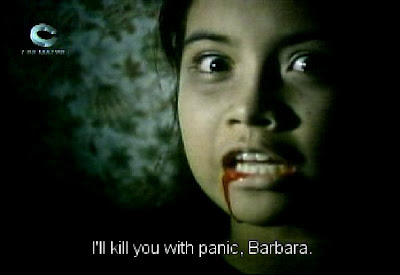

Shame this one's so difficult to find. The print floating around right now is of substandard quality and has a "Cinema One" logo on screen the entire time since it was taped from a long-ago TV broadcast.

★★★

Saturday, February 18, 2012

Más allá del terror (1980)

... aka: Beyond Terror
... aka: Further Than Fear
... aka: Terror Gang

Directed by:
Tomás Aznar


This seldom-watched Spanish supernatural morality tale is vulgar, pretty sick and more tasteless than most. It's so trashy that the man behind the notorious PIECES (1981), Juan Piquer Simón (who co-wrote and backed the film), opted to hide behind the pseudonym "Alfredo Casado" for his contributions. Things begin with an overlong pre-credits sequence of a young woman getting picked up by an older man. He wants to take her to a hotel. Instead, she insists they go out into the woods to a secluded spot where she proceeds to knife him to death and steal his money. The girl - Lola (Raquel Ramírez) - then meets up with her gang of drugged-out, foul-mouthed thug bikers, which includes handsome and charismatic Chema (Francisco Sánchez Grajera) and her brother Nico (Emilio Siegrist). They spend all of the money she's just acquired on some "Moroccan Gum" (some kind of hashish drugs) and decide they need some more cash, so they hold up a diner. Things get a little out of hand when the police arrive. There's a gunfight where everyone in the diner, two police officers and one of the bikers are killed. Chema, Lola and Nico decide to kidnap a wealthy-looking surviving couple; Jorge (Antonio Jabalera) and Linda (Alexía Loreto), to ensure their getaway.

Forcing Jorge to drive them, Chema doesn't even attempt to hide his attraction for Linda and feels her up in the car in front of her lover while the gang sits in the backseat getting high. We learn that Linda is married, Jorge works for her husband and the two have been carrying on an affair but don't even really like each other. No one else knows it, but before Linda took off her little rendezvous, she cleared out her husband's bank account and has a million dollars worth of cash and jewelry in her bag. They end up wrecking the car during a fight and have to walk; eventually deciding to invade a home where an elderly woman (Andreé Van de Woestyne) lives with a young boy (David Forrest). They kill the dog, smack the old lady around (and kick her while she's on the ground), torch the place and steal their car. Jorge and Linda prove to be just as detestable as their kidnappers by doing absolutely nothing to help. He even watches the little boy burn to death and doesn't lift a finger to help!

Little do any of them realize, but the old lady is a Satanist and she decides to curse them with her last dying breath. The next day while driving along, some supernatural force takes control of the car and (in hyper-fast, head-spinning speed) delivers them to a secluded, crumbling church before deciding to break down. There are other abandoned old buildings surrounding them but no one seems to live around there... That's probably because they've all been delivered directly to hell to receive their just punishment.


Characters have visions of those who have died returning to life, ghosts of the old witch, the little boy and the dog show up to haunt (or attack) them and there's a catacomb littered with mummified corpses (which are eventually brought to life) underneath the abandoned village rumored to contain a treasure. Two of them attempt to leave by foot and walk all day but end up getting nowhere in process. There's a hanging and one guy is burnt alive while trapped inside a car (after attempting to run off with the stolen money). The dog rips someone else apart, the mummies take care of another and for a coup de grace we get an exploding head. There's loads of profane, raunchy dialogue, constant insults being hurled around, a little sex (Linda has no issue screwing her kidnapper, despite the fact he likes to slap her around) and a lot of fighting. It's all rather nasty and nihilistic, and the dynamic between the brother-and-sister characters gets really twisted after awhile. He masturbates in front of her into the fire and she (apparently fed up with being denied some action by the gang leader) decides to give her brother head. Yeah, gross, I know. I already warned you this was pretty sick at times!

As you can probably tell from the screen caps, I wasn't able to acquire a very nice copy of this film. However, it's all very atmospheric, with excellent use made of some eerie shooting locations and a few fairly effective horror sequences toward the end. The premise, though ultimately predictable, maintains a certain level of interest as well. If this were a little better distributed (there's no DVD and it was never released in America), it would probably have its fans.

★★1/2
Related Posts Plugin for WordPress, Blogger...