.
.
.

Saturday, October 8, 2011

Ling huan xian sheng (1987)

... aka: Ling wan sin sang
... aka: Mr. Vampire III... aka: Mr. Vampire Part 3

Directed by:
Ricky Lau


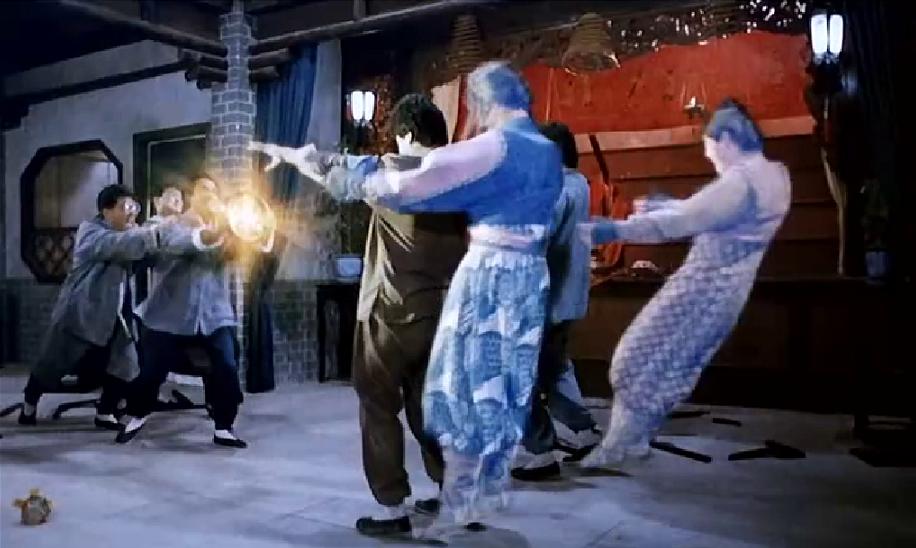
Uncle Ming (Richard Ng), a bogus priest, shows up at a reputedly haunted home and brings along a couple of his ghostly friends; the adult Ta Pao (Fong Liu) and little boy Hsi Pao, to help him make some extra money. His scam involves staging hauntings using his docile otherworldly friends and then accepting a fee for exorcising them (an idea later pinched for Peter Jackson's THE FRIGHTENERS). After discovering that his latest assignment really is haunted by an entire family of angry ghosts, he sucks his ghosts up into his wax umbrella and flees. Upon arriving in the town, the villagers are preparing to ward off some horse thieves headed to the area. As they begin fighting them off, they realize these aren't no ordinary horse thieves, but powerful, blood-drinking magicians who are impervious to steel weapons (unless you doctor up your weapon with your own blood) and travel around raping and plundering. After a long, elaborate fight scene, the villagers manage to capture two of them.


A wise and composed Taoist priest known only as Master (Ching-Ying Lam, returning from the first two films), his very dumb and obnoxious underling Captain Chiang (Billy Lau), the aforementioned con artist, his good ghost pals and a bunch of others at a nearby monastery then have their hands full dealing with the various monsters, ghosts and zombies that pop up along the way. The primary baddie this time out is a flying female demon / sorceress (Pauline Wang) who can become invisible, cures her minions by spitting up maggots and can create storms of cockroaches and bats by waving her cape. In one scene, she pops the head off a lizard and drinks its venom. She also possesses Ta Pao; making him see people dressed as priests are giant eagles (!) Two of her henchmen return as zombies and many people get possessed.


Many unusual ghost-busting techniques are employed here. Aside from the chicken blood, magic mirrors, hopping white rice and yellow spell papers used in many other Hong Kong horror flicks, plus the aforementioned wax umbrella, this has some clever ways to dispatch of or incapacitate ghosts. A medallion tempered during the "Five Elements Ceremony" can be placed on the bottom of a clay pot to suck ghosts inside and trap them there. To kill ghosts, they must be fried (yes, fried) in hot oil. During one sequence, a ghost gets half-cooked and emerges from the oil as a drippy white mess. Other tactics in the ghost fighting arsenal include spreading tar all over your body so ghosts can't see you and using a sword made of coins to hold demons at bay.


After the hokey, pseudo-family-friendly MR. VAMPIRE II (1986), this entry puts the series back on the right track again with its entertaining mixture of action, horror and laughs (though less successful at the latter than the original MR. VAMPIRE). It's well-made, well-edited, brisky-paced and very colorfully photographed. It's also packed with wild special effects, nicely-choreographed action scenes and impressive wire and stunt work. Yes, it can be a bit much at times (and the over-the-top idiocy of the Chiang character is more aggravating than humorous), but there's genuine imagination at work here, a little bit of unexpected heart and, since there's always something going on, you don't even have time to get bored.

★★★

Friday, October 7, 2011

Deadline (1980)

Directed by:
Mario Azzopardi


While not entirely successful, this is one of the more interesting non-Cronenberg Canuck horrors from the 1980s. Horror novelist and screenwriter Steven Lessey (Stephen Young) became rich and famous when his first novel "The Executioners" was turned into a controversial film. It was followed up by more of the same - successful book to film adaptations - including "Anatomy of a Horror," which features a scene where a demon sheep uses supernatural powers to dismember a man with a piece of farm machinery. All of Steven's movies seem to do well at the box office and he's built up a "name" in the industry. While speaking at a college, he has to defend both himself and his art to a group of pretentious students. He's called a "degenerate" and accused of propigating sickness because he sells sickness and being socially irresponsible. His films are brushed off as nothing more than "horseshit horror." Steven informs them that he tries to represent what he sees around him and uses genre conventions metaphorically. But regardless of the front he uses when it front of the firing squad, deep down inside, he's unhappy both at home and with his career.


Though he lives a lavish lifestyle in a beautiful mansion with a wife and three children, Steven is feeling the sting of having neglected his family in favor of his career over the years. His miserable wife Elizabeth (Sharon Masters) more or less hates his guts. She's unfaithful and has a serious cocaine habit. The children typically just get brushed off by both parents as they deal with work and play. They're so busy that while they're off hobnobing with film folk at a party, they forget all about hiring a babysitter to watch them. If that's not bad enough, Steven's work - both the quality and the quantity - is declining. Steven feels his films are getting shlocky and his slimy agent, film producer Burt Horowitz (Marvin Goldhar), is breathing down his neck, demanding a finished screenplay in two weeks on else he'll face a lawsuit. Can Steven deal with all of this, or will he crack under the pressure?


The film cleverly integrates scenes from Steven's completed films, with ideas he's contemplating using on his newest script and what's going on in his real life. As the film progresses and his sanity starts to slip, his ideas become more and more absurd and desperate. He toys with ideas of nuns killing a priest and passing his heart around at communion, suicidal fetuses that implode inside the womb and a Nazi enlisting the aid of a punk band (Carole Pope and Rough Trade) to infuse their music with sound frequencies that'll make those who listen to it literally shit themselves to death. Other macabre footage involves a woman trapped in a blood shower and two little kids tying their grandmother to a bed, covering her with gasoline and setting her on fire.


Deadline also calls into question the effects horror films may have on children. After viewing one of their dad's movies, his two sons decide to play a game with his daughter Sharon (The Brood's Cindy Hinds), which results in her accidentally being hung (and naturally speeds along the writer's decline). Though this may seem to suggest horror films have a detrimental effect on the mind's of young children, it should be pointed out that the tragedy is only allowed to occur because of the absense of both parents in the home. Thus, it could be seen as a cautionary message for parents to be more involved in what their children are doing and seeing.


Though the film contains some humor (Burt at one point suggests Steven relocate to Los Angeles because he claims they don't make good films in Canada!), it's overall pretty downbeat and leads up to a pretty dreary and depressing finale. None of the characters (aside from the children) are the least bit likable. The writer is incredibly self-absorbed, arrogant, neglectful of his children and physically absusive to his wife. The wife forsakes her children in favor of wallowing in her own self-pity and addictions. The film producer is a money-grubbing, prostitute-hiring sleazebag with a bully complex. The only other character with a significant amount of screen time is an actress (Jeannie Elias) and she's a demanding bitch with a diva complex who thinks she's above what she's doing.


Director Azzopardi was born in Malta, but relocated to Canada in the late 70s, where he's found steady work ever since, primarily in television (including directing over 20 episodes of the newer Outer Limits series). He also made the feature Bone Daddy (1998), which again centered around a tormeted writer; a pathologist and true crime novelist played by Rutger Hauer, who's terrorized by the subject of one of his books.


It was filmed in late 1979 and the copyright date in the end credits is 1980, though this doesn't appear to have been released in the U.S. until 1984 (Paragon Video handled the American VHS release). As of this writing, there's been no DVD release.

★★★

Gakidama (1985)

... aka: Demon Within, The
... aka: Gakidama: Kanzen-ban
... aka: Tastiest Flesh, The
... aka: Tasty Flesh, The

Directed by:
Masayoshi Sukita


GREMLINS (1984), a Steven Spielberg production directed by Joe Dante, was hugely successful. In fact, up until recently it was one the five highest-grossing horror films of all time (and might still be when you adjust costs to factor in inflation). As with any other blockbuster, others became interested in cashing in, so we ended up with a new subgenre of deadly diminutive creature horror. Some of the films were even popular enough on their own to spawn their own lucrative franchises. The first of the copies was GHOULIES (1984), which had slimy demonic puppet monsters terrorizing some people at a mansion and was followed by three direct-to-video sequels in 1987, 1990 and 1993. There was also CRITTERS (1986) and its three sequels (the theatrical release CRITTERS II: THE MAIN COURSE in 1988 and two other d-t-v releases filmed back-to-back in 1991), HOBGOBLINS (1987), MUNCHIES (1987), BEASTIES (1989) and more. Beating most to these to the punch, though, was this little-seen Japanese effort (which is also known as THE DEMON WITHIN and THE TASTY FLESH), which turned out to be better than most of the other imitators.


Things begin with two men aboard a train; reporter Mr. Morioka (Kyôzô Nagatsuka) and Kitayan (Ichirô Ogura), a photographer who has built up a reputation for ghost. They arrive in a woodsy area to follow up on "hitodama" (ghost / demon) sightings and camp out there for the evening. They're awaken by sounds and capture a green light floating through the woods. The light rests on Mr. Morioka's shoulder, turns into a worm and crawls into his ear. The next day, he suddenly has an insatiable appetite. Upon returning home, he scarfs down bowl after bowl of rice and is caught by his wife (Kazuyo Matsui) in a trance-like state eating raw meat out of the fridge. Sores appear on his face, he becomes bloated and then vomits up / "gives birth to" a "gakidama;" a little ghoul larva demon creature with sharp claws and fangs. A mysterious man in a top hat and cape (amusingly played by Yôsuke Saitô), whose face is scarred up from giving life to one of these creatures himself, shows up to capture the monster in a bird cage.


The gakidama manages to escape, but sticks close by the Morioka's residence. It eats their pet birds, completely trashes their home and, while the husband is away, terrorizes the wife (who at first feels motherly toward the monster because she can't bear children of her own). She throws it against the TV and tries to drown it in the bathtub, but the little critter keeps on coming. Meanwhile, Mr. Morioka learns from the man-in-black that in order to regain his appetite, he must consume a gakidama. Kitayan also gets impregnated with one of the creatures.


It's a fairly well-made movie with good cinematography, more gore than most others of its type and fun special effects (some of the more charming ones feature the gakidama bouncing around in the street). It runs only 55 minutes and was released to DVD through Geneon Entertainment.

★★1/2

Thursday, October 6, 2011

Kamp tawanan wanita (1983)

... aka: Day of the Escape
... aka: War Victims
... aka: War Victims of Camp Tawanan Wanita
... aka: Women's Prison Camp

Directed by:
Jopi Burnama

I've always defended controversial films like SALO (1975) and MEN BEHIND THE SUN (1988) because I genuinely think they have something important to say. Sure, they could conceivably be much more subtle and still get the same points across, but would those points have the same gut punch of an impact? Probably not. Though some puritanical critics out there would like to state otherwise, sometimes going the graphic route is absolutely the right way to go, especially when you don't have such uplifting things to say about the human race and are aiming to elicit disgust and anger from your audience. Let's face it, subtlety is lost on a lot of people, so sometimes you're better off being explicit. The controversy films like SALO stir up will entice people to see them. The bursts of depravity and violence will cause an immediate reaction. And because the film has implanted uncomfortable thoughts and images in the viewers mind, it will drive people onto the internet looking to affirm their opinion on the film, whether it be positive or negative. Either way, the viewer is almost certainly going to learn about the director's *intentions* in the process. Whether or not they feel the filmmaker has made a good film, or even care about about their opinion on certain subjects is in the first place, is irrelevant. The message has still been delivered.


So what does all that have to do with an exploitative low-budget women-in-prison flick from Indonesia? Simple. Like the two much more famous films I mentioned, it amps up the sadism and violence levels to hammer home its theme. In this case, the theme happens to be 'war sucks.' Unlike many other w-i-p films from the 80s (such as the same year's famously sleazy CHAINED HEAT), this strives for more than just providing cheap thrills. Sure, it provides those too, but its pretensions are front-and-center right from the opening narrated monologue: War is a thrilling and glorious thing only to those who have never experienced it in reality. Those who have never fired a shot nor heard the shrieks and groans of the wounded, or the cries of innocent women and children. War is a barbarian atrocity which reduces all mankind to its lowest animal state. War is misery, despair, hunger, suffering and death cloaked in a shabby disguise of honor and courage. War dehumanizes all; the victor as well as the victim. It is a visitation of hell upon Earth.


While this isn't exactly new territory and it's not always well-executed, I do at least see where they were trying to go with this. And I truly hate slamming sincere, well-intended movies, especially ones where negligible English-language dubbing clearly detracts from the overall effect. With that factored in, I'm giving this a slightly higher rating than some may think it deserves.


Things center around a female freedom fighter named Amelia (Marisa Haque), who witnesses her husband being gunned down, is captured by the Japanese Imperial Army and is thrown into a brutal P.O.W. camp, where she and the other female inmates undergo the usual tortures before the obligatory revolt and escape. The film is violent, bloody and packed with sadistic torture. When Amelia first arrives at the camp she's pregnant. They beat her, strip her naked and force her to ride a donkey around the camp in the buff until she miscarries her baby. She and others undergo constant beatings, are fed "slop," kicked in the shins, forced to do slave labor and are routinely raped, tortured and killed. Well, all except our heroine. She manages to get away with being mouthy and defiant, physically fighting with her captors and helping to stage breakouts, while the extras get filled with lead for simply looking at the guards the wrong way.


The girls plot a daring escape that involves finding out why two of the guards are nicknamed "The Stallion" and "The Love Machine." The attempt is botched, leading to dozens of women being shot, blown up, electrocuted and, in one instance, being eaten by a snake! The ones who don't die are dragged back to camp and tortured. They're whipped, beat, strapped to some contraption that quickly spins them around, forced to stand on blocks of ice, are burned with a torch and some are hung. There's also several instances of hara-kiri, an outbreak of malaria and "sun torture," where the ladies are forced to stand outside all day and are refused water.


Amelia's pal on the inside is Siti, whose father is planning to raid the camp's ammunitions surplus and save her and the others while they're at it. There's another woman named Ita who's jealous of Amelia, but other than that the female prisoners aren't well-definited (if at all). The film concentrates as much time on the mostly-evil male guards than it does on the ladies. Lieutenant Nakamura (Boy Tirayoh), camp commandant, is the only one who seems to have anything of a conscience left. To champion for better treatment of the ladies, he goes to his superior and is informed that women are "prizes of war" and that "In war, the only morality is patriotism." Nakamura eventually falls for Amelia and knocks her up, leading up to an predictably tragic ending.


As much as I appreciate what this movie has to say about how minds of once-good and decent people are warped by war, I've always found it a bit counterproductive how so many anti-war movies resort to exciting action setpieces at the finale. We're told that there are no winners in war and to stop glorifying it all... So why wrap it up with thrilling combat action between the 'good guys' and the 'bad guys...' and screams of "Freedom!" ringing out from all the shots of stuff blowing up real good. The last shot of the film is an interesting one; a Japanese flag is lowered and an Indonesian one is raised. "The Beginning" then appears over top. (Clearly alluding to the Japanese armies invading lesser-developed Southeast Asian countries during wartime.)


Leading lady Haque has had a very full and interesting life. Educated in civil law and education in her home country, she also attended Ohio University in Athens, Ohio (also the alma mater of yours truly) at one point to study film and television. She worked as a model and an assistant lawyer in between acting gigs and went on to produce and direct feature films and TV shows. In 2004, she was elected to Indonesian Parliament as a member of the Indonesian Democratic Party of Struggle. Nowadays, she's still involved in the entertainment industry, teaches hearing impaired children and is a guest lecturer.

Released theatrically by Atlas International. The VHS I watched was from the Dutch company Van Gils Video, who have, for some moronic reason, blurred out all of the nudity (though all of the violence seems intact).

★★

Related Posts Plugin for WordPress, Blogger...