.
.
.
Showing posts with label Jack the Ripper. Show all posts

Monday, February 4, 2019

Terror at London Bridge (1985) (TV)

... aka: Arizona Ripper
... aka: Big Blue
... aka: Bridge Across Time
... aka: Der City Cop (The City Cop)
... aka: Le retour de Jack l'éventreur (The Return of Jack the Ripper)
... aka: Masakra na London Bridge (Massacre on London Bridge)

Directed by:
E.W. Swackhamer

In a pre-credits sequence set in 1888, Jack the Ripper is hunted down, shot and killed by an angry mob on the London Bridge. Since then, the bridge has been moved to the U.S. and meticulously reconstructed stone by stone in the desert tourist trap of Lake Havasu City, Arizona. While the relocation project was mostly completed back in 1971, there was one missing stone that didn't make the trip that has since been found at the bottom of the Thames River, been shipped to Havasu and added to the bridge. On their way to Las Vegas, newlyweds Dave (Michael Boyle) and Alice Williamson (Barbara Bingham) stumble into town late one evening. Alice decides to go check out the bridge on her own, cuts her finger on some scaffolding, bleeds on the bridge and ends up awakening the long dormant spirit of Jack the Ripper himself. She does not return to her hotel that night.


The following day, right after the re-dedication of the bridge's "true and final completion," Alice's corpse is discovered floating in the river by river tour / fishing boat operator Angie (Stepfanie Kramer). Her throat's been cut and she has clothing fragments under her fingernails as potential evidence. The pathologist also discovers a different type of blood mixed in with Alice's, which means the same knife has possibly been used to murder someone else. Samples are sent off to Phoenix to be tested. In the meantime detectives Don Gregory (David Hasselhoff), who transferred there from Chicago only a month prior, and Joe Nez (Randolph Mantooth) are assigned the case. They face hurdles in the form of city councilman Anson Whitfield (Lane Smith), who wants the murder written off as a one-time mugging by a transient as not to effect tourism. Don, a true crime buff, knows better.


San Francisco Dispatch reporter Elaine Gardner (Lindsay Bloom) shows up in town to do a story and gets Don to speak to her, promising it will be off the record. Instead, she prints his theories about the killing in the paper, which infuriates Don's boss, Police Chief Pete Dawson (Clu Gulager), who's more in the city council's corner than his own detectives. When test results from the fabric and second blood samples return, both prove to be over a century old. The reporter then disappears without a trace, with all evidence pointing in the direction that she never even left town.


Meanwhile, a mysterious, sinister-looking British man (David Fox-Brenton) checks into a flea pit run by nosy old lady Alma (Rose Marie). While he doesn't provide a home address, he does sign the register Edward Latting Esq. The following day, yet another British man, the tall and debonair Roger Eddington (Paul Rossilli), shows up at the library looking for books on modern American history. It seems he has some catch-up work to do. Roger claims to be working in the village as a tour guide but expresses how lonely and homesick he is to librarian Lynn Chandler (Adrienne Barbeau). Lynn, a single lady and Angie's best friend, agrees to go to dinner with him. After crossing paths with both Brits, Lynn ends up the next victim and her throat-slashed body is discovered floating in the lake by a group of schoolkids.
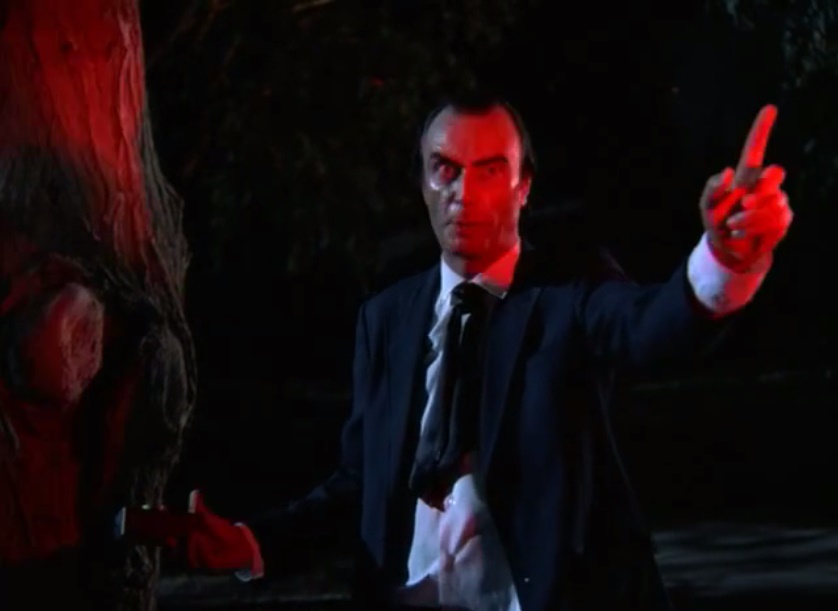


Despite two murders, one disappearance and the ripper going so far as to send taunting letters to the press, Chief Dawson is still reluctant to close down the village until the killer is apprehended, which means Don is pretty much on his own in stopping the psycho. He's able to eventually draft Angie (whom he's - of course! - become romantically involved with) and Joe into helping him out, which involves a pursuit through a horror museum and a slaughterhouse and back to the bridge, where the ripper reveals he's using the blood of victims to return to 1800s. Not sure how that's supposed to work out but, whatever.


This competently directed and produced, though formulaic, NBC TV movie movie seems like it was made to give Hasselhoff and Kramer something to do between seasons of their hit NBC shows Knight Rider and Hunter. And though most of the cast is pleasant or professional enough to keep this at least passable as a "There's nothing else on..." time filler, the plot (devised by Logan's Run writer William F. Nolan) lacks complication and the film is simply too predictable and bland to provoke much interest. The bridge was also used as the centerpiece of Ulli Lommel's (much more entertaining and intriguing) film OLIVIA (1983).


This Charles Fries production debuted on NBC TV right before Halloween in 1985 under the title Bridge Across Time. Most of its subsequent VHS releases (starting in 1990 on the Fries Home Video label) have used the Terror at London Bridge title and restored some blood that had to be cut from TV showings. There are multiple DVD releases as well, including a 2013 one from TGG Direct that pairs it up with Night Game (1989).

★★

Tuesday, January 13, 2015

Man in the Attic (1953)

... aka: Jack l'éventreur (Jack the Ripper)
... aka: L'étrange Mr. Slade (The Strange Mr. Slade)

Directed by:
Hugo Fregonese

Marie Belloc Lowndes' 1913 novel "The Lodger," which centered around the unsolved Jack the Ripper killings in 19th Century London (and hypothesized about the identity of the killer), was a very popular book in its day and went on to be adapted for radio, stage, TV and screen numerous times. To date, there have been five credited film adaptations. The first was The Lodger: A Story of the London Fog (1927), a silent version directed by none other than Alfred Hitchcock. It starred Ivor Novello in the title role and is still frequently-viewed and discussed all these years later, due in no small part to it being the first actual suspense film from the "Master of Suspense" himself. Hitchcock and Novello were both offered the chance to make a sound version five years later but only Novello was interested in the project. Maurice Elvey stepped into the director's chair and the resulting film was 1932's The Lodger (which became better known later by its U.S. title, The Phantom Fiend). Twentieth Century Fox produced a new and quite lavish version in 1944 that was directed by John Brahm, starred the wonderful Laird Cregar and was such a big critical and commercial hit it prompted a loose "remake" (Hangover Square) from the same team the following year. I guess someone took note that there were versions of the book made in the 20s, 30s and 40s, and then figured the 50s needed one as well.


While Attic wasn't made by someone with the filmmaking clout of Hitchcock (Fregonese had previously made some forgotten westerns and crime-dramas), it does have something the other versions do not: a major, internationally recognizable star in the lead role. Jack Palance was reaching a high point in his early career by 1953. The year prior he'd received an Oscar nomination for the excellent film noir / thriller Sudden Fear (1952), playing Joan Crawford's shady, unfaithful husband. He struck gold again playing a supporting role in the western Shane (1953) and received his second Academy Award nomination. One wonders then what the appeal of this medium-budget production would be. Considering the fact Palance's back-to-back Oscar nods were for supporting parts, it was probably something as simple as jumping at the chance to play a top-billed lead role.


As the film opens we're already in the midst of Jack the Ripper's reign of terror. The foggy night streets of London are being heavily patrolled by hundreds of constables and nearly everyone's been warned not to go out at night. Belligerent drunk Katy (Isabel Jewell) doesn't heed those warnings and becomes the newest victim. Later that same evening at a boarding house run by Helen Harley (Frances Bavier, aka Aunt Bea of "The Andy Griffith Show" fame) and her hubby William (Rhys Williams), a knock sounds at the door and a silken-voiced stranger stands on the other side. He announces himself as Mr. Slade and claims to be a pathologist looking to rent one of their rooms. Seeing how the Harley's have fallen on hard financial times and really need the money, Helen accepts the friendly, yet odd, stranger's offer of renting two rooms. Slade wants both the downstairs bedroom to sleep in and the upstairs attic space as a place for him to conduct his "experiments." He warns of having "irregular habits," like sometimes needing to be out until very late at night, and seems to have a strange distaste for actresses.


Helen and William's attractive niece Lily (Constance Smith) is also staying in the boarding house while she tries to make it big as an (uh oh!) actress. She's part of a bawdy Moulin Rouge-inspired cabaret number that includes (corny) singing with a fake French accent, dancing, skimpy costumes, gratuitous underwear exposure and getting into a bubble bath on stage. When she meets the shy, lonely Slade she finds him unlike the other men constantly drooling over her and thus intriguing enough to get to know a little better. Through their talks she discovers that his mother was a callous harlot who drove his father to suicide with her infidelities and becomes empathetic enough toward the awkward boarder that she doesn't want to believe anything bad about him even when all available evidence points to the contrary. Her aunt isn't quite as convinced and begins snooping through Slade's room and personal belongings. A detective (bland Byron Palmer) investigating the crimes becomes romantically interested in Lily himself and begins frequenting the residence.


Man in the Attic is, in a word, adequate. The direction, photography, sets, costumes, production values and the majority of the acting is fine. However, I can't really give this too high of a rating because the same exact film had already been done, and done better, eight years earlier. Instead of exploring the book further or putting a new spin on the theme, this instead opts to lazily recycle the screenplay from the 1944 film. In fact it's so close to that version that the previous film's screenwriter, Barré Lyndon, was also credited for co-writing this one. I'm not even sure what exactly the other credited writer, Robert Presnell Jr., did since there are next to no real changes in the plot or the dialogue. The best thing going on here is Palance himself. He gives an effectively subdued performance and just looks really cool (and creepy) photographed in black-and-white because of how his large cheekbones, protruding forehead and sunken in cheeks manage to capture all of the shadows. He never looked quite as interesting or enticing photographed in color.


Distributed theatrically by Twentieth Century Fox, this has since fallen into the public domain so it's extremely easy to find these days. There are too many DVD releases to even mention and every film archive site seems to have it. Also in small roles are Lilian Bond as one of the victims and Lester Matthews as a police chief.

★★1/2
Related Posts Plugin for WordPress, Blogger...