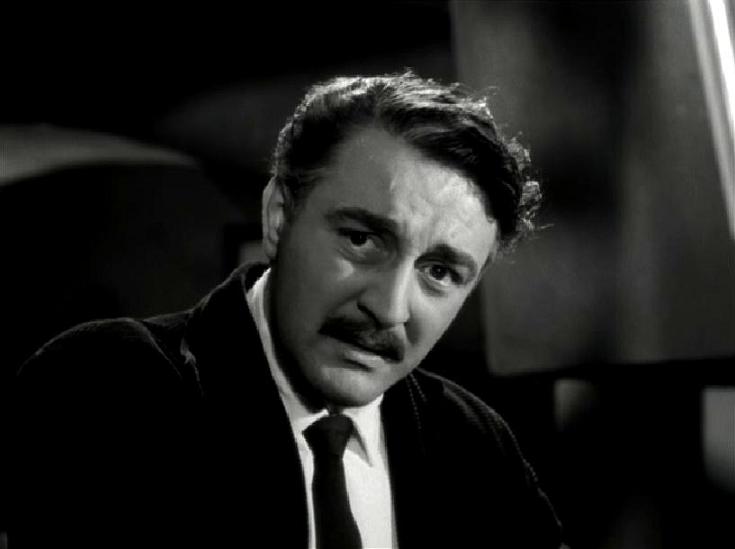
Directed by:
Rafael Baledón
A young woman walking home alone late at night is stalked and then ambushed by a caped, behatted, skull-faced fiend. After she passes out, he carries her into a cemetery and opens the lid on an above ground sarcophagus. Inside is a secret passageway. He takes her down below, carries her through a hallway with mummy-filled caskets lining the walls and then into a room that's hidden behind one of those caskets. There, he lies her down on a table, pulls a boiling cauldron over and then dumps molten wax all over the screaming woman's face. This extremely atmospheric opening credits sequence proves that there are few greater combinations in the horror world than high contrast black-and-white photography, proper night lighting and a little bit of swirling fog. Gorgeous. This latest victim turns out to be the third of such disappearances in the area in the past few months. The police are baffled as there are no witnesses and no clues thus far. However, there is something of a pattern: Each disappearance has been of an attractive young lady in her early 20s and each girl disappeared at around the same time of the evening near the same location.


We next meet numerous characters staying at a boarding house run by the gossipy Doña Leonor (Emma Roldán). There's Luis (Joaquín Cordero), who was once a promising actor until a crippling injury put an end to that career. He now manages a theater and gives tours at a wax museum. Reading about the disappearances in the paper, Luis comments that the missing girls, being young and all, probably either ran off with a guy or split town to go on a little adventure. Not interested at all in the conversation is the grouchy and misogynistic Professor Abramov (Carlos López Moctezuma), who goes on an angry rant about how he despises the "chronic chatter of women" and how "God made a mistake putting tongues in women's mouths!" And then there's Raúl (Julio Alemán), a nice, upstanding young doctor (or so that's what everybody thinks), and Leonor's daughter, Marta (Patricia Conde), a nice young nurse. Raúl, who's known Marta since childhood, is interested in pursuing a relationship with her but she's not quite sold on him.


All three male boarding house residents are set up as the prime suspects. Luis is hoping to secure a grant with his new exhibit on the heroines of art and theater. He has painstakingly molded each of the lifelike wax figures and his museum only features female characters because, in his own words, he holds women in such high esteem. Or does her? Raúl is up to some sketchy things himself. In a Burke and Hare-influenced twist, he pays a pair of drunk lowlifes (José Dupeyrón and Vicente Lara) to rob graves and bring him fresh "specimens" to conduct his secret experiments on. He also has a collection of human heads he keeps in vats of liquid hidden in the hospital morgue. As for the professor, who is seldom seen without a scowl on his face, we've already established what he thinks about women, but he also has a thing for taxidermy and is developing "a new technique for embalming" on top of that.
After getting dropped off at a nightclub (where all of the principle characters happen to be in attendance) by her "papi," prostitute Sonia (Sonia Infante) becomes victim #4 during her late night stroll. Only in this instance, there's a witness: One of Raúl's patients. When he goes to the boarding house to tell the doctor what he's just seen, someone shoots him in the back with a poison dart. That finally brings the police, headed by David Reynoso as the Commissioner, to the home. It's discovered that the poison used to kill the witness was curare and the only person to have a bottle of it on hand is the good professor. Still, that's not enough to pin blame on him. Despite the murder, bosomy blonde nightclub chanteuse Norma Ramos (Olivia Michel), who's sick of the cheap hotel she's been staying in, decides to rent a room there.


In an interesting twist, Marta rejects a marriage proposal from straight-laced Raúl and instead finds herself falling for Luis. While he's older, crippled, less financially secure and more emotionally complicated, there's just something about him she's drawn to. Of course, this infuriates Raúl, who accuses Marta of mistaking pity for him and his disability with love. He also informs her that everything he's done in life thus far he's done to set up a good life for the two of them as a couple (awfully presumptuous, ain't he?) and he's not going to give her up without a fight. However, both Raúl and the professor seem to be fighting off their desires for the attractive singer who's just moved in.
A seldom-viewed film, this was an unexpected surprise. It boasts good performances and a competently-structured (though ultimately predictable) mystery with well-drawn characters courtesy of writer José María Fernández Unsáin, who pinches ideas from a number of other films, namely The Lodger, The Body Snatcher and House of Wax. However, where this really shines is in the atmosphere and visuals, with Raúl Martínez Solares' great cinematography aiding the mood immensely.


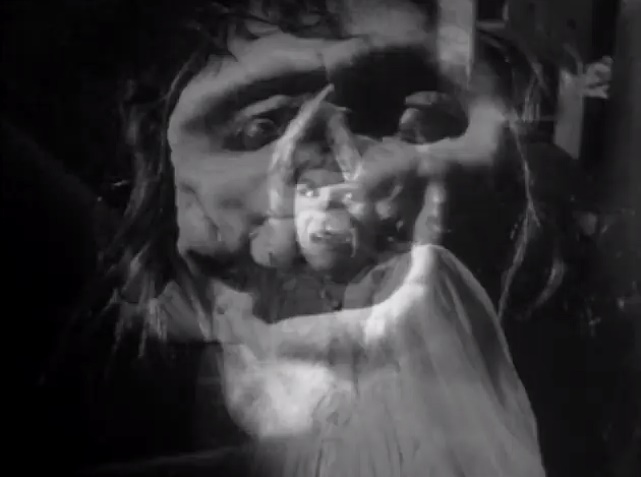


While obviously a low budget production, director Baledón also adds just the right amount of visual embellishments. One standout sequence features one of the proposed victims losing it after venturing out into the underground catacombs as a flurry of images of decaying corpses flash on the screen. There's also a very interesting bit where the grave robbers hit a patrolman over the head with a shovel and then bury him alive, which then segues into a nightmare scene of cobweb-covered zombies rising from their tombs. The shots used for the latter are extremely creepy and look like they come from another film (or films), which makes me wonder just what film exactly. One source claims stock footage from Bava's HERCULES IN THE HAUNTED WORLD (1961) was used.


To my knowledge, this has never been officially released in America. 5th Dimension Films, Creature Feature Videos and DVD Party are just three of the websites that carry this with English subtitles, though I don't believe any of these releases has been sanctioned.
★★★