.
.
.

Friday, January 6, 2023

Ling qi bi ren (1984)

... aka: 靈氣迫人
... aka: 靈氣逼人
... aka: Ling hei bik yan
... aka: Occupant, The
... aka: Tenant, The

Directed by:
Ronny Yu

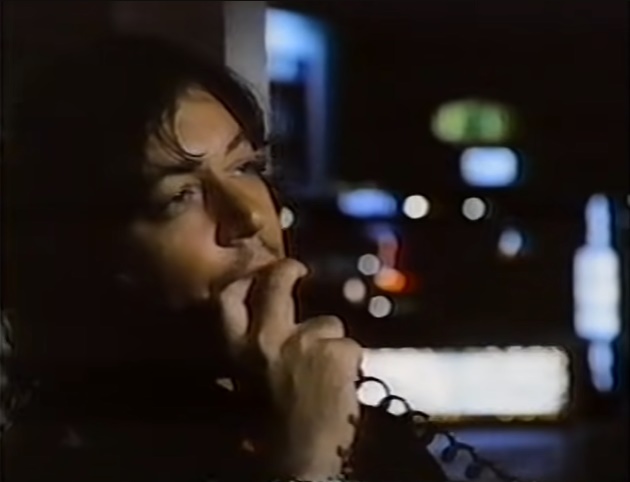
After having spent most of her youth in Vancouver, Canada, college student Angie (Sally Yeh) returns to Hong Kong for a three week visit to work on her Masters of Arts thesis paper on Chinese superstitions. Strapped for cash and unable to afford to stay at local hostels, she's then forced to deal with questionable used car salesman / Realtor Hansom Wong (Raymond Wong), who's one of those cliché "comic" characters in 80s HK cinema who's supposed to be charming in their pushiness, ineptitude at appealing to the opposite sex and complete lack of self-awareness, yet mostly just comes off as grating and obnoxious. He puts Angie up in a fully-furnished tower block apartment that hasn't been occupied in quite some time. The price is... curiously affordable, which is usually not a good sign. 

Angie's first night there, a heavy wooden table keeps moving to the center of the room, she hears a woman singing and a couple arguing through the walls and there's a frequent knock on the door, yet nobody is there. Someone leaves flowers and a weird note outside her door. She assumes they were from Hansom, but he denies it. Also, the strangely emotionless building caretaker Poon (Hao Ren) clues her in on something else interesting: She's the only person currently staying in the building.


After showing her around at a temple and taking her to see a psychic medium (Mama Hung), Hansom invites himself into Angie's apartment and ends up getting thrown out of the window onto a parked car by an unseen force. Though he's (regrettably) not killed or even injured, the police are still called and Inspector Valentino Chow (Chow Yun-Fat), who's recently been busy busting pickpockets, pimps and sex workers, is on the case. Well, actually, he's not officially on the case for very long.

Due to angering a high-ranking politician after catching him with an underage massage parlor worker, the force has temporarily let Valentino go on an extended "holiday" until things cool down, which opens up plenty of free time for him to assist Angie. Naturally, he too becomes attracted to her, which starts up a rivalry of sorts between him and Hansom, though the men are able to put their differences aside long enough to help Angie investigate.


The previous tenant in Angie's apartment was a popular nightclub singer named Linda Law (Kit-Man Mak), who shot her married lover Robert (Melvin Wong) dead and then committed suicide immediately after. Since she died a painful and unnatural death, Linda continues to haunt her apartment. Angie begins subconsciously taking on some of the dead woman's traits, like suddenly smoking and painting her fingernails red, and things are bound to get worse the longer she stays there. However, the non-religious Angie doesn't necessarily believe in ghosts or the supernatural despite all of the odd occurrences in the apartment.

Trying to knock some sense into her, Valentino takes her to his spiritualist friend, Mr. Chan (Lieh Lo), for advice. He talks about how, within a haunted space, the brain waves of both the ghost and the occupant can start to sync if meditation and other spiritual tactics aren't employed. To ward off possession, the person needs to become one with Jesus, Buddha or some other God so that there's no room left inside for an evil force to inhabit them. So what does Angie do immediately after hearing this? She returns home, lights some candles and calls forth Linda's spirit, getting herself possessed in the process. There's an exorcism attempt, but that only temporarily works. Angie's new friends then must try to come up with a way to rid her of the spirit before she goes back to Canada.


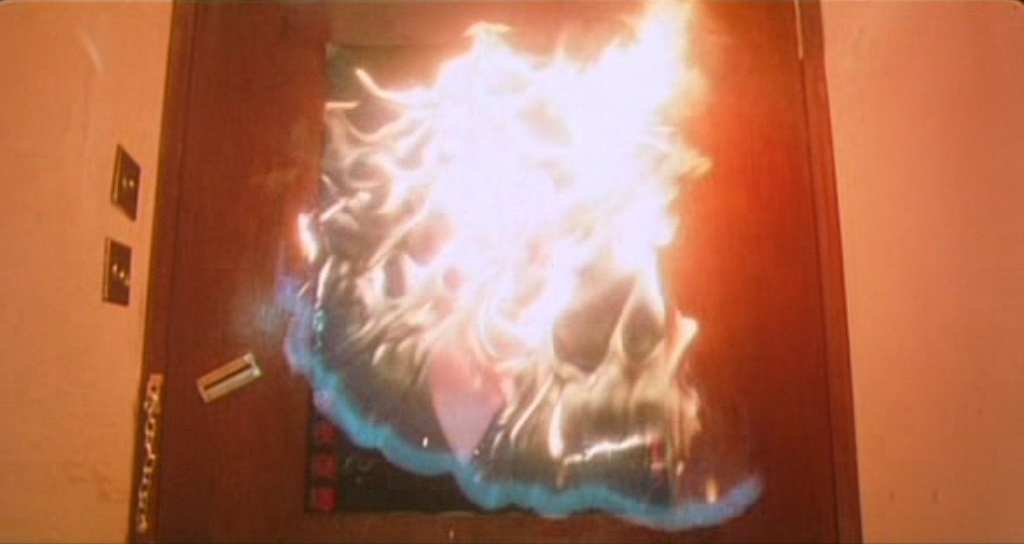
Considering the director and the presence of two charismatic lead actors, all in the earlier stages of their careers, this was a huge disappointment. It's low on action, conceptually and visually unexciting, extremely talky, doesn't feature any decent make-up or special effects (the "best" - and only - real attempt is a single cheap animated ghost) and can't ever seem to find a balance with its disparate genre hopping. The film's dramatic, romantic and supernatural elements all get sidelined as this leans very heavily into the comedy, which turns out to be a fatal mistake.




While Chow and Yeh do have a few pleasant / charming moments together, they're constantly undercut by Wong's endless mugging and camera hogging, which grow extremely tiresome early on, never let up and do the film as a whole irreparable harm. This character should have either been a small part of the film or cut from it altogether instead of becoming the primary focus. Not surprisingly, Wong had a hand in the film's production and financing, and is a "presenter," so that probably explains why he's given the majority of the film's dialogue and is stuck front and center most of the time.


Director Yu made a number of other genre films like The Saviour (1980), THE TRAIL (1983) and Bless This House (1988) in Hong Kong before the international success of his The Bride with White Hair (1993) landed him in Hollywood. There, he's make the horror sequels Bride of Chucky (1998) and Freddy vs. Jason (2003), both of which were successful at the box office, followed by the HK / U.S. co-production Fearless (2006) starring Jet Li, which was also an international hit. This Cinema City release is the worst thing I've seen out of him yet, though it's not exactly terrible either. It's mostly just uninspiring and forgettable.

★★

Sunday, January 1, 2023

Lakeside Killer, The (1979) [TV]

... aka: 11th Victim
... aka: Eleventh Victim
... aka: Víctima de la calle (Street Victim)

Directed by:
Jonathan Kaplan

Any fan of 60s, 70s and 80s grindhouse / exploitation fare is going to be pretty much acclimated to scuzzy big city atmosphere, particularly that of the 42nd Street area of New York City and the less-glamorous areas of Hollywood. You know, drug-pushers, thieves, pimps, hookers, pornographers, nutjobs, runaways and bums hanging out on every corner; strip clubs, porn shops and adult theaters lining the streets with flashing neon lights beckoning all of the lowlifes and perverts, not to mention all of those 'reputable' folks from the suburbs who've snuck down there, inside. Many a low budget exploitation film, most especially urban action and horror films, are set in this exact milieu, as are some more mainstream films, though they almost always soft-pedal the sleazier aspects for a mainstream audience. So how well is a 1979 made-for-TV movie, a production that's going to automatically have plenty of limitations in regards to what it can say and what it can show, going to handle this exact same setting? None too well, I'm afraid.

We can't really talk about this one without first talking about a now mostly-forgotten drama called Hardcore (1979). Directed by Paul Schrader a few years after he wrote Taxi Driver, the film was the first look many in Middle America had at the seedy underbelly of Hollywood and prominent sex film industry. Involving a teen runaway becoming a hooker and porno star in Hollywood while her devoutly-religious father (George C. Scott) tries to track her down, it was considered highly disturbing in its day due to the nudity, frank sexual dialogue and sleazy subject matter exploring everything from porn loops to the S&M subculture to even snuff films. Released in early 1979 to some controversy (it's not nearly as shocking as seen through a contemporary lens, though), Hardcore seems to have been the inspiration behind this particular production. Released about six months later, this explores the same territory in the same setting with the same sheltered central character forced to weasel their way into the unsavory world of the East Coast adult film industry to get answers.


A serial killer lurking around L.A. targeting sex industry workers has just claimed his 11th victim: an adult film actress, stripper, call girl and "model" who went by the name of "Sinful." All the way over in Des Moines, Iowa, fresh-faced news anchor Jill Kelso (appealingly played by Bess Armstrong) has just started a live broadcast when she receives some shocking news: The name of the latest victim she's just had to read off the teleprompter is her very own sister! Jill immediately heads over to Hollywood to look into matters.

Meanwhile, Captain Long (John Hancock) of the LAPD is getting frustrated that his men haven't been able to so much as track down a suspect in the killings. Investigators Andrew Spencer (Max Gail) and Benny Barnett (Harold Gould), who've been put in charge of the latest victim's case, meet up with Jill at the station. It turns out Jill had absolutely no clue what her younger sis - Cindy Lee (Marilyn Jones) - had even been up to. In fact, she initially refuses to believe it. Last she heard she was making inroads toward becoming a serious actress but, like so many others waiting to catch their big break, she still had rent and bills to pay in the meantime. Jill sets out to learn more about her and the double life she'd been leading.


Going against the advice of the cops, Jill doesn't return home and instead moves into her sister's apartment in a dangerous, slummy area of Hollywood. She becomes acquainted with Cindy's 18-year-old friend Sally Taylor (Pamela Ludwig, from the same director's Over the Edge), who first tells her the two of them only did some nude modeling for a German calendar that no one in the U.S. is ever gonna see. Besides, "What's the big deal? I mean look at all the big movie stars, they do nudity!" Sally, who's also an aspiring "real" actress like everyone else in town, starts rooming with Jill, introduces her around, takes her to a "video disco" and even talks her into taking drugs.

Jill's hoping Sally can shed some light on what her sister was up to but, like most teenagers in way over their head, Sally's more than willing to lie to cover her tracks. She's actually been using a bogus modeling agency to hook for money. In an effort to look sleazier, Jill raids her sister's wardrobe of spaghetti strap halter tops and then poses as fresh-off-the-bus-from-Wichita "Kelly" to infiltrate the outcall modeling agency run by Spider (Eric Burdon, yes, the same Eric Burdon from the great British rock group The Animals). Spider's assistant (Annazette Chase) makes "Kelly" strip right in the middle of the office and change into a swimsuit so she can take Polaroids of her, but she gets thrown out after asking too many questions.


Forget about that killer? So did I. Whoever it is is put on the back burner throughout most of the film. They fish murder victims #12 and #13 out of the lake eventually, but the cops still haven't a clue. Now, as a regular presence at the same disco her sister used to frequent, Jill has her own suspects. She becomes acquainted with porn superstar Red Brody (David Hayward), who's as big as "Harry Reems and Johnny Wadd," and begins to suspect it may be him. She even agrees to star in one of his upcoming films ("I did a nudie in college with some guys in my acting class. I dug it.") in an effort to bait him.

I'm used to seeing Armstrong with a short haircut mostly playing mom roles and had no idea she was so sexy when she was younger, so that was a nice surprise. And while it's kind of fun watching her fish-out-of-water character come out of her shell in unfamiliar surroundings, the film itself doesn't really work. Though it presents itself as a police procedural, with much time spent on officers talking about the murders and interacting with our leading lady (Gail's character becomes attracted to her, naturally), there's next to no sleuthing or actual investigating going on. As for the mystery of who the killer is, that ends up being a complete bust too thanks to a frustrating, inconclusive ending. This is also almost completely lacking in action, excitement, suspense and thrills, despite later being sold on the home video market in lurid packaging. 


As a social drama, it's slightly more successful, though this exact same ground has been covered so much more successfully elsewhere. While it hardly paints a positive picture of the sex film industry it also avoids the hysterical moralizing and heavy exaggeration of Schrader's film. Also unlike Schrader's film, which is sordid, dreary, depressing and completely serious, this has some humorous dialogue and more pleasant characters. The seedier elements are very sanitized, of course, as is pretty much to be expected with a TV production.

Like so many other people we cover here, the director had started out with Roger Corman, directing several of his early 70s nurse pictures and appearing in the fun exploitation film parody Hollywood Boulevard. He followed that up with several low-budget hits like Truck Turner and White Line Fever and, by the mid-80s, was directing big budget and, sometimes, acclaimed films like the Oscar-winning rape drama The Accused (1988) and the killer cop psycho-thriller Unlawful Entry (1992). Just a few missteps later (including the poor pseudo-feminist western Bad Girls in 1995) and his big screen career was over. Afterward, he was relegated entirely to TV work. Not sure what he's doing currently but he hasn't worked on anything in about a decade now.


Appearing in small roles are Kaplan's Boulevard co-stars Dick Miller, playing a cop and featured in many of the film's more amusing moments, and Tara Strohmeier, playing a working girl. Also here briefly is a teenage Kasi Lemmons, who went on to co-star in two of the 90s very best genre films; The Silence of the Lambs and Candyman, before stepping behind the camera to direct.


I found just two VHS releases for this title. The first was from MNTEX Entertainment, an extremely obscure Michigan-based distributor. Their video box claims it's rated R, which is almost certainly a lie, and also deceptively uses late 80s / early 90s American B-movie actress Ruth Collins as the lingerie-clad front and back cover model (both images of her were swiped from the Raedon VHS release for Death Collector), though she obviously doesn't appear in the film itself. MNTEX also released an English-language version of the Japanese earthquake drama Deathquake, the early Christopher Walken sci-fi film The Demon Within (originally called The Mind Snatchers) and the Fred Olen Ray films Bio-Hazard and The Alien Within, the used-to-be rare special version of Evil Spawn with new footage added.

The second VHS release (which also appears to be American) is from Electric Productions, claims to be the first-ever home video release for this title and has a 1990 copyright date. There's no DVD nor any decent-quality, restored version floating around out there somewhere to my knowledge.

★★
Related Posts Plugin for WordPress, Blogger...