.
.
.

Thursday, December 29, 2022

Thief in the Night, A (1973)

Directed by:
Donald W. Thompson

Like it or not, this Christian propaganda film is a milestone in independent cinema. Shot in Iowa for around 60,000 dollars, it went on to make millions... and it didn't even have to play in theaters or on TV to accomplish that feat! Instead, the filmmakers made most of their profit touring churches with the film, then sat back and collected their tax exempt windfall in the form of “love donations.” As soon as the video revolution came around, the film was then self-distributed on VHS and sold like hotcakes at both churches and Christian book stores. Legions, and we're talking millions and millions here, of young children were shown this film in church, their bible study classes, youth groups, Christian schools or at home. Apparently it was a standard in Pentecostal and Baptist churches and many evangelicals even owned a personal copy so they could sit back, relax, grab some popcorn and enjoy watching the end of civilization in the comfort of their own home. The film and its subsequent three (!) sequels were also later frequently run on religious cable networks in between segments of the hosts trying to con granny into signing her social security check over to them. It's hard to tell how much money they made off this thing!

The masterminds behind it all were director Donald W. Thompson and producer Russell S. Doughten Jr.. Thompson had sharpened his skills making military propaganda and industrial films. Doughten had formed his own production company and was an associate producer of the drive-in classic The Blob (1958) before ditching Hollywood to go the independent film route. The two men eventually joined forces and created their own production company: Mark IV Pictures Incorporated. The company would go on to produce over a dozen Christian-themed features.


Patty Myers (Patty Dunning) awakens in her bed to a radio news broadcast that "literally thousands, perhaps millions" of people have miraculously disappeared off the face of the Earth. Has an alien force declared war on our planet, or is it the Rapture as prophesied in the bible? Do you even need to ask? The kicker is that Patty is a Christian. She goes to church almost every week, reads the bible, tries to follow the Ten Commandments and tries to help people who are in need. So why was she among those that were left behind? Well, because she was being a wee bit flaky trying to enjoy her teenage years, then a bit preoccupied by her recent marriage, and had yet to officially dedicate her entire being to God. That means how good of a person she'd been is now a moot point and she deserves to be tormented, punished and to rot in hell for all eternity!

A flashback reveals how poor Patty got into her current predicament. She'd been hanging out with two girls from a Christian teen center / summer camp. First, there's Diane (Maryann Rachford). She wears miniskirts, flirts with boys, likes to have fun (God forbid) and is in no hurry to be saved. And then there's Jenny (Colleen Niday), an uptight, self-righteous "golly gee" type who's recently given herself wholly to the lord ("I want you to live in me! Take my life, dear God!") and now can't shut up about it. A guy from her church warns her that now, as a Christian, she has a target on her back and Satan will do everything in his power to try to dissuade her from her faith. She's put to the test during a water skiing trip when Satan, oops, I mean Diane, tries to engage her in sex talk and Jenny is forced to put her foot down ("I just don't want to hear that kind of talk!")


After Diane and Patty meet two guys - Jim (Mike Niday), who's studying to become a veterinarian and works at a zoo, and Jerry (Thom Rachford), an ambulance attendant studying to become a doctor - at a carnival, Patty attempts to tell her newly-converted friend the good news in a hilarious exchange that goes as follows: Patty: "We met a couple of really nice guys!" / Jenny: "That's not too bad. I met Christ!" / Patty: "What?" / Jenny: "I met Jesus Christ! I'm a Christian now!" / Patty: "Well that's great Jenny, I hope it works out well for ya."

As is later revealed, part of the problem is that Patty attends a church with a rather permissive reverend (Doughten) who urges his congregation to (gasp!) engage in critical thinking, while Jenny attends a doom-and-gloom church with a pastor (Clarence Balmer) who's constantly going on about the end times and Satan. As a result, Jenny's leader has prepared her for what's to come, while Patty's has not. After all, the spirit of God is the only thing standing between us and the full force of evil taking over the planet. After the believers go, God will too, leaving behind a fascist Orwellian world where evil will flourish under the eye of the Antichrist. 

This 5-decade-old movie theorizes that Jesus will "probably" be back "within the next 30 years," claims that they are no doubt currently in the end times (... 50 years ago) and that the Antichrist may have already infiltrated our government (again... 50 years ago). I'd imagine waiting around for half a century to get zapped into heaven only to just die of some boring old disease like everyone else must be very disappointing for some of these folks.


After that lengthy flashback (which takes up half of the running time), we finally make it back to post-Rapture present day. Radio and TV broadcasts tell of traffic jams, airplanes crashes and other things we're never shown and Patty's new hubby Jim, who dedicated his life to God after surviving a cobra bite, is now also gone. 

The evil United Nations are fast to create an organization called U.N.I.T.E., which stands for the United Nations Imperium of Total Emergency. The use of imperium, meaning "supreme power or absolute dominion," gives you a good idea of where this is headed. For the record, the conspiratorial, paranoid hatred of the UN (and globalization) by the evangelical community seems to stem from the belief that during the end times a one-world organization will form with the sole purpose of enslaving mankind. Many evangelicals believe that organization to be the UN, who've been a bit slow at the "enslaving us all" bit seeing how they've been around about 80 years now and have done nothing of the sort, though I suppose that's not a preposterous belief for people who've spent their whole life anxiously waiting around to get finger-snapped into the great beyond.

U.N.I.T.E. immediately set up "identification centers" where "true citizens" go to be permanently branded with a strange symbol that turns out to be a "computer readout" of a 666. Soon, "Citizen's Only" signs start popping up on store windows. One must show the mark of the beast, which functions as a "super evil credit card," or else be denied basic services. Those who don't go along with the rules of this new world are then branded traitors and hunted down by gestapo-like soldiers in vans. Refusing to get her 666 tat, Patty finds herself being arrested and thrown in jail ("You are one of those, uh, religious people, aren't you?"). After they murder her guilt-stricken former reverend, she manages to escape; occasionally bumping into seemingly-lobotomized townsfolk while being chased around Des Moines by U.N.I.T.E. agents in vans and helicopters in scenes clearly inspired by Invasion of the Body Snatchers.


As for the purpose of this film, that much is obvious: To traumatize, frighten and indoctrinate impressionable young kids right into Jesus' loving arms forever! Hilariously, this movie even blatantly outlines its intentions during a scene when a young girl learns about Rapture during a sermon and is later seen at home having a shrieking meltdown when she can't find her family, fearing God had taken them away and left her. That turns out to be the incentive little Suzy needed to finally welcome Jesus into her heart. Now that she's been fear-porned into a life of obedience and "servitude," she will no doubt spend the rest of her life forking over significant amounts of cash to people like these filmmakers, or gazillionaire celebrity pastors, who can then put the money to good use buying yachts, private jets, limousines, gold-plated toilets, ten vacation homes and jewelry for their mistresses.






Even accepting the film on its own terms, which I always try to do, this is about as heavy-handed as it gets. The acting, dialogue and editing are all terrible, the material is flatly presented and it's poorly-made in just about every regard... yet that's hardly the worst of the film's transgressions. Much worse is watching the sheer audacity of a bunch of privileged, middle class suburban Christians attempting to fetishize their supposed persecution by comparing themselves to pre-Civil Rights Era black Americans (who were victim to white "Christian" slavery, suppression, terrorism and murder for literally centuries) and Jews during the Holocaust. Gotta love when a group with a long history of persecuting others then turn around and try to play the victim.

That said, knowing this persuasive piece of propaganda somehow worked its no budget spell on countless people over the years makes it an interesting curio if nothing else. Doughten, who did not get raptured and passed away from renal failure in 2013, made the claim that hundreds of millions had seen his film, which probably isn't much an exaggeration knowing how the church circuit operates. It's also true that what he and Thompson, who left this world the old-fashioned way in 2019 and was also not raptured, accomplished was not only extremely influential when it comes to shaping Christian entertainment but also left its mark on fundamentalist culture in general. You'll either believe this, laugh at this or be depressed by this and find it difficult to enjoy knowing the real-world damage this kind of stuff causes.


On the plus side, the gloomy theme song "I Wish We'd All Been Ready," featuring uplifting lyrics about guns, war, dying children, demons and those who are "left behind" getting "trampled on the floor," is a keeper. It's by a Christian band called "The Fishmarket Combo," a sort of doomsridden, manic-depressive Partridge Family, and was written and composed by Larry Norman, who's considered one of the fathers of Christian rock music.

Thief and its sequels; 1978's A DISTANT THUNDER, 1981's IMAGE OF THE BEAST and 1983's The Prodigal Planet, are considered the primary influence behind the hit Left Behind multimedia franchise, which has, to date, spawned sixteen novels, seven spin-off novels, forty kids novellas, a series of graphic novels, video games and six films, including four indie features, a spin-off film and a big budget Hollywood reboot starring Nicolas Cage. Who knew encouraging millions to wallow in their own impending doom could be such a cash cow?

★1/2

Wednesday, December 28, 2022

Lifeforce (1985)

... aka: Fuerza siniesta (Sinister Force)
... aka: L'étoile du mal (The Star of Evil)
... aka: Lifeforce - Die tödliche Bedrohung (Lifeforce: The Deadly Menace)
... aka: Livsfarlig invasion (Deadly Invasion)
... aka: Siła witalna (Vital Force)
... aka: Space Intruders
... aka: Space Vampires
... aka: Tappava yhteys (Deadly Connection)
... aka: Yaşam savaşı - Uzay vampirleri (Battle for Life: Space Vampires)

Directed by:
Tobe Hooper

Despite persistent rumors that producer / co-writer Steven Spielberg actually directed it, or at the very least had a hand in doing so, Poltergeist (1982) marked Hooper's entry into the big time. Made for 10 million dollars, it grossed over 120 million worldwide, became the ninth highest-grossing U.S. release of its year and was nominated for three technical Academy Awards. That became enough of an incentive for someone to throw some major money behind him. Those people ended up being Israeli cousins Menahem Golan and Yoram Globus of the Cannon Group. They put Hooper under a three picture contract and invested over 40 million bucks in him, only for it to backfire when two of the three films bombed. 

The only successful one of the bunch, and just modestly so at that, was The Texas Chainsaw Massacre 2 (1986), which doubled its budget in theaters despite getting ridiculed by critics. Next up was the same year's Invaders from Mars, a remake of the beloved 1953 classic, which attempted to replace the low budget down home charm of the original with expensive updated special effects. The reviews were again terrible and the film only grossed 4.5 million on a budget estimated between 8 to 12 million. At year's end, it ranked #118, lagging behind such films as TROLL, Haunted Honeymoon and My Little Pony: The Movie. And even it wasn't the biggest disaster of all... Meet Lifeforce!


Basically given free reign to do as he pleased on this particular project, Hooper's would-be blockbuster was plagued by numerous script re-writes and went five weeks over-schedule. Despite being one of the widest releases of the year and being promoted as "the cinematic sci-fi event of the 80s," the reviews were dreadful and the film only grossed 11 million dollars domestically on a 25 million budget. For a reference point, the #1 U.S. box office draw of 1986, Back to the Future, grossed nearly 200 million more despite costing 6 million less to produce. Audiences opted instead to get their sci-fi thrills from more heart-warming fare like Cocoon and a re-issue of E.T.. Of course, profit isn't necessarily an indicator of quality, or lack thereof. Great movies bomb and awful movies are hits all the time. Remember that John Carpenter's THE THING (1982), now one of the most popular genre films there is, was also a critical and commercial failure upon release.


Movies like Lifeforce put me in a position where I have to evaluate what positives the inflated budget purchased vs. what positives the primary players brought to the table. We already know this is going to look fantastic and we already know that the expensive special effects are going to be (by the standards of the time) top quality. 

When it comes to technical aspects, I gladly admit to being more lenient with low budget offerings. One of my absolute favorite things about the genre is seeing the various ways talented filmmakers can work around budget limitations, which often force them into a position of being inventive and taking chances. On the opposite end of the spectrum, I place much more emphasis on other things when I'm looking at big budget films. I expect the script, direction and acting to match the quality of the production values. I suppose part of me doesn't want to feel like I'm being 'bought off,' so to speak, by superficial things, but an even larger part of it is that I don't like making excuses for directors who've been given every luxury in the book and then squandered it with uneven / mediocre product when I could be championing underdog films instead.


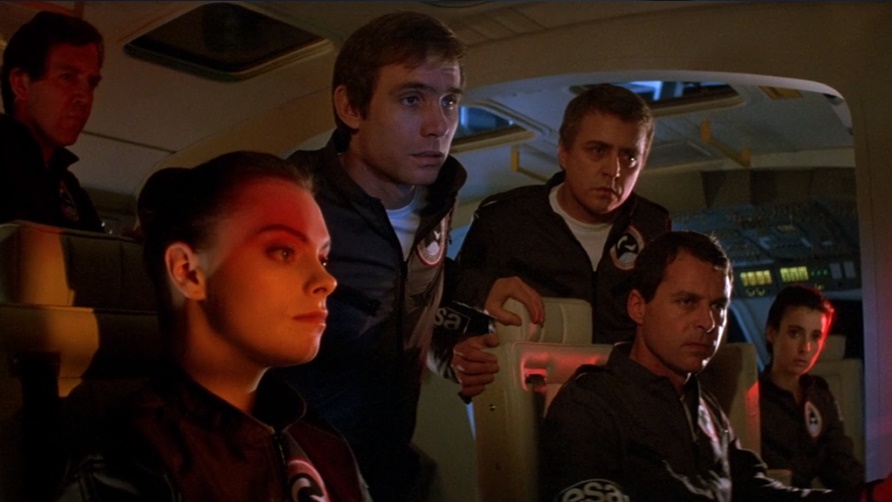
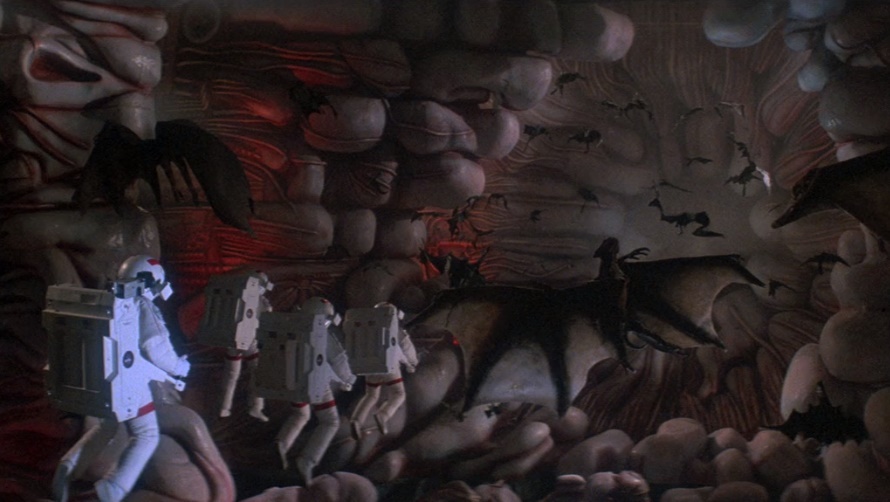
On the spaceship HMS Churchill, a joint U. S. / British space team are planning to "intercept" and study Halley's Comet. As they near it, their radars pick up something truly bizarre at the head of the comet; a huge foreign object that's approximately 150 miles long in length. It turns out to be some kind of alien spacecraft. Not wanting to pass up this once-in-a-lifetime chance (the comet won't be anywhere near the Earth again until 2061), Colonel Tom Carlsen (Steve Railsback) and three of his men decide to board the ship and have a look around. Inside, they discover thousands of dead, prehistoric-looking alien creatures that resemble giant bats. Exploring even further, they enter a separate chamber to find three perfectly-preserved humans (one woman and two men) in glass cases who seem to be in a state of suspended animation.

One month later, radars pick up the Churchill drifting around close to Earth. It appears the crew set their return coordinates shortly after leaving the comet, but haven't updated them since. A rescue ship, the Columbia, is then sent to retrieve them but, upon entry onto the Churchill, discover all that's left of crew people are shriveled corpses. They appear to have been incinerated, along with the ship's interior. As for the three human-looking specimens they retrieved from the alien spacecraft, they're in as good a shape as ever and don't look like they've even been touched. The Columbia crew retrieve the alien bodies and return to Earth.


Analysis on the findings, headed over by Professor Hans Fallada (Frank Finlay) and Dr. Leonard Bukovsky (Michael Gothard) at the European Space Research in Centre in London, reveal the crystal casings are neither metallic nor organic and seem to be made out of a material unknown to man. Furthermore, the female space alien (played by stunning French actress Mathilda May) appears to be alive, though in some sort of comatose state. That all changes when she suddenly opens her eyes, engages the guard in a kiss and sucks out his lifeforce. Not only does this alien possess strong telekinetic abilities, but she also possesses an "overwhelmingly feminine" allure that leaves male victims entranced until she can feed.

After easily taking down several other guards, she escapes the facility... and also happens to be buck naked the entire time and will remain that way through much of the rest of the film. Not that anyone will be complaining. May's face and body are what the phrase "easy on the eyes" was invented for. In addition to her, the two male model-looking aliens (Bill Malin and [Mick's younger brother] Christopher Jagger) also start out the film nude. However, unlike the lingering camera shots showcasing May, the filmmakers go to sometimes hilariously lengths to try to conceal them. There's one hilarious shot of May standing there in all her full-frontal glory while the male alien next to her has blurred out genitalia! After awakening, the male aliens also manage to escape the facility after killing a couple of guards and then inhabiting their bodies to take on their appearance. It appears these life forms have all kinds of amazing powers!


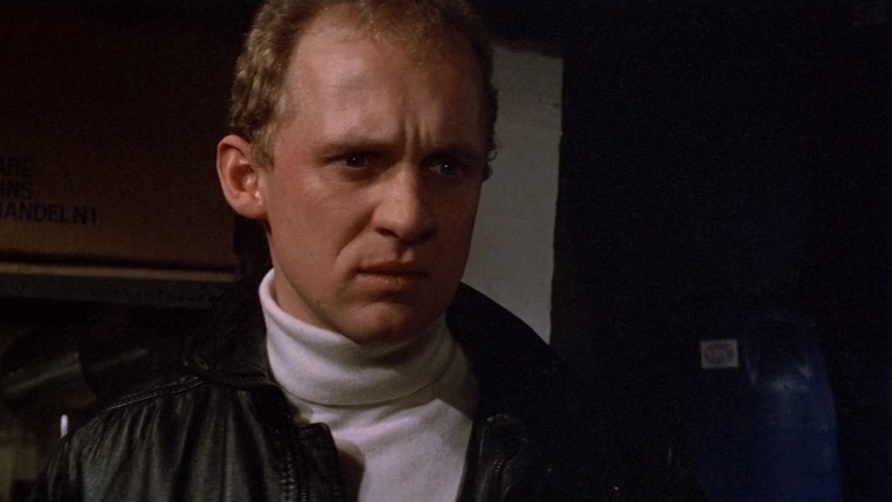
Special Air Service agent Colonel Colin Caine (Peter Firth, a very good second male lead) is soon on the case assisting the scientists as bodies begin to turn up, starting with the drained corpse of a lesbian in Hyde Park. Victims who've been infected actually continue to live for a spell even in a drained state but explode into dust if they're not able to get their lifeforce fix. Meanwhile, an escape pod from the Churchill has landed in Texas. Inside is a still-living Colonel Carlsen, who's immediately flown to the UK to join in the investigation, which now also includes parliamentarian Sir Percy (Aubrey Morris).

But how does one go about stopping aliens that not only have formidable powers but can also change their appearance on a whim and are cunning enough to steal just a little lifeforce from certain victims to sustain themselves and not leave an evidence trail of bodies behind? Well, the script has us all covered there with the return of the Carlsen character. He's plagued by red-lit sex nightmares starring the alien girl and, via a hypnosis session, it's revealed he shares a psychic link with her, which enables him to track where she's at and what body she's using at any given time. Even better, he can tell what body the alien is in simply by touching them. What's led Carlsen to gaining these powers is explained later in the film via flashback but it's mostly just a handy plot convenience.


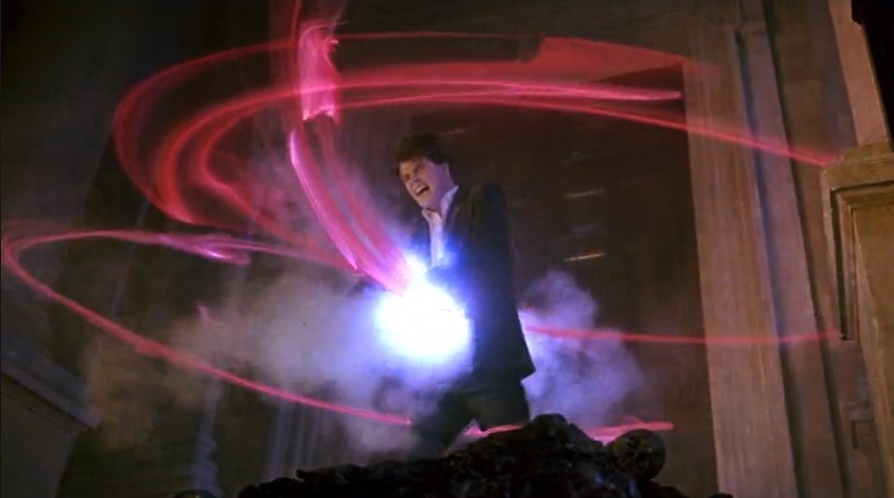
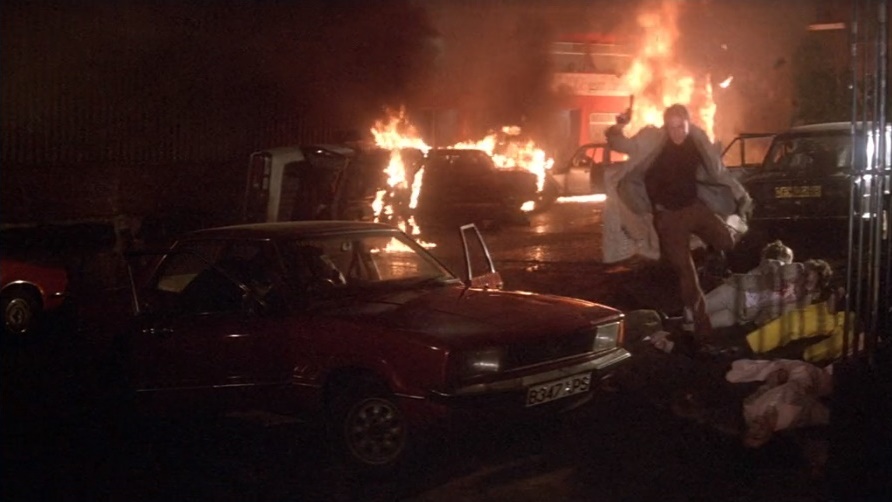
After the alien girl does a bit of Body Snatchers-style body hopping, inhabiting a nurse (Nancy Paul) and then a hospital administrator (Patrick Stewart), our heroes return to London and find it in complete disarray. The 150-mile-long alien craft from Halley's Comet, which (probably not coincidentally) looks like a giant wang, is now hovering above the Earth doing some soul harvesting. Buildings are on fire, people are being turned into zombie-like fiends, who attack and spread the plague to others, and the military are unsuccessfully trying to keep things under control. Can Carlsen overcome the "overwhelmingly feminine" hold the space vampiress has over him in time to save mankind?

If the intent was trying to make me feel like one of the alien's depleted victims by film's end, it has succeeded admirably! I felt like I had the lifeforce sucked out of me trying to keep tabs on this messy plot (which is somehow both confusing and bogged down with exposition) and listening to clunkers like "I am the feminine in your mind" and "The web of destiny carries your blood and soul back to the genesis of my lifeform."


The characters aren't people you give a whit about but instead conduits for relaying / over-explaining various plot points. You may end up just like me and find yourself zoning them completely out while you're waiting for the next fx scene. And then there are the attempts at "deep" meaningful conversation, which all seem like a silly attempt at justify wanting to make a big budget movie about a hot naked alien vampire. All life forms are vampiric in their own way, right? And our life energy is actually our soul and that somehow proves there's life after death or something, ya know? And, well, I really could just keep going here, but I shouldn't, so I won't. This review is already too long as it is.

Let's just say there's a good reason Hooper himself flat out admitted the film “lacked a screenplay” and original source author Colin Wilson, on whose novel The Space Vampires the film is based, disowned the film and said it was in contention as being one of the worst ever made. While the script is credited to Dan O'Bannon (ALIEN) and Don Jakoby (Arachnophobia), uncredited re-writes were done by Michael Armstrong and Olaf Pooley at some stage, so this very likely fell victim to the ole “too many cooks...” idiom.


The cast and solid production values do at least ensure this is somewhat watchable. It's well-shot by Alan Hume, with lots of lovely bold colors, features a commanding score from Henry Mancini (performed by the London Symphony Orchestra, no less) and, best of all, is filled with all kinds of fx work. Admittedly, some have dated better than others, but they're all still a lot of fun. Visual effects are from Oscar-winner John Dykstra (Star Wars) and John Gant and the prosthetics / special make-ups were supervised by Nick Maley, but there's an almost comically long scroll of different fx artists in the end credits.

There have been many different VHS (Vestron, Video Treasures), DVD (MGM), laserdisc (Image), Blu-ray (Arrow Films) and even an "Ultra HD Blu-ray" (Scream Factory) releases for this one, which is now - like nearly every other older, big budget movie that was unsuccessful during its original run - being marketed as a "cult film"™.

In 1985, a 21-minute videotaped promotional documentary called The Making of... 'Lifeforce', which featured interviews with Hooper, Dykstra, Railsback, Maley and others, was aired on HBO and is now commonly used as DVD / BR supplemental material. There's also the 70-minute documentary Cannon Fodder: The Making of Lifeforce (2013), which features interviews with Hooper, Armstrong, producer Michael J. Kagan, editor John Grover, actors Morris, Nicholas Ball (whose role was cut down to almost nothing in the final cut) and more. A "re-imagining" / remake was announced way back in 2015 but has yet to happen.

★★
Related Posts Plugin for WordPress, Blogger...