... aka: Demonia
... aka: Le démon dans la chair (Demon in the Flesh)
... aka: Pikkukylän demoni (The Demon of a Small Village)
Directed by:
Brunello Rondi
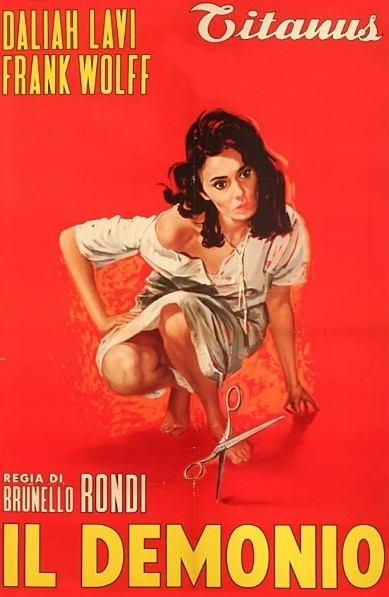
Purificazione (Daliah Lavi), or Purif for short, lives with her parents and two brothers in the small village of Lucania in southern Italy. In an area filled with devoutly religious and highly superstitious folks whose entire identity is steeped in their spiritual beliefs and long-standing traditions, Purif doesn't at all fit in. She's odd, aggressive (sexually and otherwise), sometimes manic and willing to betray her strict religious upbringing if that means getting what she wants. She's also very likely suffering from some kind of untreated and undiagnosed mental illness. Not that the people in this particular area, nor her family, care to get her any actual help. They're the types who believe that complete devotion to God is the only way to cure such ills, just as they believe they can alter the weather if they pray loudly enough. As for the afflicted who don't get better through prayer, that must mean they're made some kind of affront to God, right?
Purif's behavior; erratic, perplexing and annoying as it can be at times, still in no way justifies the harsh treatment she's received from the locals. As a matter of fact, they've only managed to exacerbate whatever issues that were already there through their gossip and ostracism. What exactly would their God think about that? As for her folks, they basically view her as being the family shame. Her mother is stern, unkind and knows just how to wipe a smile off her daughter's face with just a word, while her father, who isn't above viciously whipping her, is up to his nerve's end dealing with her.


Due to her loneliness and lack of human connection and warmth, Purif has fallen for Antonio (Frank Wolff). Though he's physically attracted to her and seems to have had a consensual sexual relationship with her at one point (which is left vague), her strange behavior is a turn off and there's no way he'd tarnish his reputation openly courting her, so instead he's arranged to marry another woman. In a last ditch effort to win him over, Purif turns to witchcraft. Her first ritual involves drawing blood from her chest with a pin, cutting off some of her hair, wrapping it up, burning it in a fire and then crushing it into a powder. She then sneaks the mixture into Antonio's wine and announces to him that he's now been bewitched / cursed by her.
Regardless, Antonio goes through with his wedding. Purif shows up with a flock of sheep causing a commotion and banging on the church doors, but is dragged off the villagers. The elders then have to perform their own ritual; sticking a scythe under the bed, dried grapes in the shape of a cross on the blanket and salt under the pillow, to bless the new couple's wedding bed and keep Satan at bay. Undeterred, Purif throws a dead cat at their home in hopes it will cause their first child to be stillborn. While hiding in a pasture with some sheep, a shepherd ties her up and rapes her. A later confession to villagers that she had a conversation with a sickly village boy who died before she even spoke to him has them all convinced she's a witch. Then, during a religious procession where villagers are whipped and forced to carry heavy rocks a long distance before confessing their sins before the rest of the village, Purif tells everyone what they want to hear: "I have spoken with the devil!"


Purif's family turns to the church for "help." She's taken to religious elder Giuseppe (Dario Dolci), who makes her pray to the sun, take off her clothes and put them on backwards and uses different prayers and "healing techniques" as excuses to paw at her, culminating in him outright raping her on the floor. She doesn't even bother telling anyone. It's not like they'd believe her anyway and, even if they did, they'd no doubt find a way to blame her for it. Needless to say, none of Giuseppe's "remedies" make a difference and Purif wakes up in bed screaming, ripping out her hair, strangling herself and clawing her own skin bloody. She's then taken to Father Tommaso (Giovanni Cristofanelli) at the church for an exorcism, which finds her speaking in a husky voice, spitting at a crucifix and doing a spider walk (later copied by another pretty famous demon possession film) across the church floor.
It isn't long before villagers are blaming the "witch" for things like them having bad weather and mob mentality and group hysteria take hold. Purif's parents dig out a secret room underneath their home and attempt to hide her there but villagers, led by Antonio, show up armed with weapons and tools. After attempting to burn down the house, they eventually find her. She's pelted with rocks, driven from the village and finally ends up in a convent where the nuns are split about what to do with her. Purif becomes fixated on a tree and is even willing to cut herself up going through barbed wire to get to it. When Sister Angela (Anna María Aveta) tries to teach her how to properly pray, she starts strangling her. Other attempts to get through to her fail, Purif has words with the Mother Superior (Franca Mazzoni) and flees back to her village, where seemingly everyone is running around with torches looking for her and the story takes a even more tragic turn.
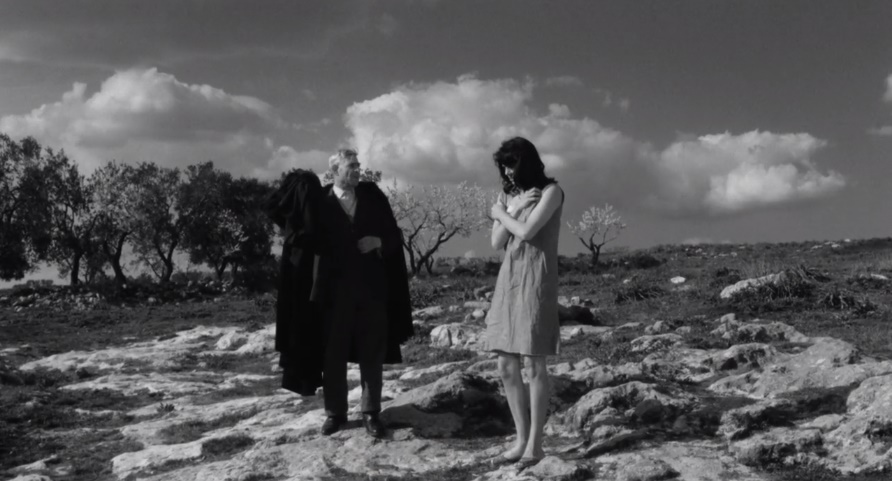


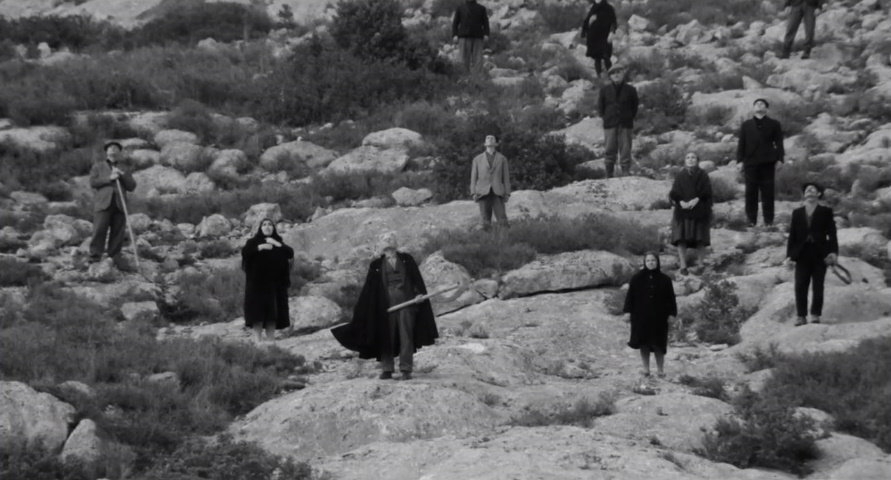

This clearly has a lot of unflattering things to say about the church, especially in regards to female victims whose abuse is downplayed (if not outright tolerated) in societies dominated by heavily patriarchal religions. Lecherous and perverse behavior, greed, violence and astonishing levels of hypocrisy are indulged in by many of the menfolk, who have no issue harming others. And, really, why would they? All they have to do is merely confess it all away and be handed another clean slate from which to sin from again as they so desire. Just take whatever you want whenever you want it without any regard whatsoever for the human lives you damage along the way and then brush it all aside with each new confession. Purif, I feel, is meant to represent all of that damage.
One of the most striking scenes here is the public confession scene. An older woman steps forward and reveals that her big sin was stealing a hen. That's given equal weight to a man confessing to having incestuous designs on their own daughter and another man revealing that he threw his own son out of the home and allowed him to starve to death. However, a woman with obvious mental problems who has already been raped and taken advantage of by some of these same men merely claiming to have had a few words with Satan is worthy of being hunted down and burned alive. Everyone seems to be looking for worse transgressions than their own to elevate themselves in the societal pecking order.


Aside from the script (written by Ugo Guerra, Luciano Martino and the director) giving us plenty of food for thought, this is also a beautiful visual experience, with sumptuous black-and-white photography from Carlo Bellero and some breathtaking location work.
However, the best thing here is clearly Israeli-born actress Lavi, who gives an emotionally-charged, career-best performance in an extremely difficult role. Though Puri is at times frustrating and difficult to get a handle on per the script, Lavi is always able to engage our sympathies and really goes for broke in some of her more hysterical scenes. I actually found her performance quite comparable to the one given by Emily Watson in Lars von Trier's highly acclaimed Breaking the Waves. Actually now that I think about it, these two movies share a LOT of similarities that not many people are probably aware of since Il demonio was difficult to find for so many years. While Watson won many of the industry's top acting awards for her work, Lavi's performance was all but ignored. Unfortunately, she'd be rather poorly utilized throughout most of the rest of her career. Finding herself being typecast in "sexy" roles that didn't make full use of her talents, Lavi turned to singing in the early 70s and had a successful recording career in Germany.


The director had co-written a number of highly-regarded Federico Fellini films, like La dolce vita (1960) and 8½ (1963), both of which earned him Oscar nominations for Best Original Screenplay. That, along with the strength of this (only his second feature as director), makes it surprising he'd spend the following decade descending down the Euro-sleaze rabbit hole with releases like Riot in a Women's Prison (1974) and Black Emmanuelle, White Emmanuelle (1976).


This debuted at the Venice Film Festival in 1963, where it was nominated for Best First Feature. It then went on to play in many other European film festivals. Though there was an English-subtitled British release in 1964 (under the title Demonia), this was never officially released in the U.S. (to either theaters or home video) until somewhat recently.
In 2015, it was unearthed in the Harvard Film Archives for select screenings, which earned it a special award from the Boston Film Critics Association. Then, in 2021, it was included in Severin's must-have "All the Haunts Be Ours: A Compendium of Folk Horror" Blu-ray set, which includes a 20 film sampling of folk horror from around the world, with many of the films making their U.S. debut in the set. Some of the other featured titles include LAKE OF THE DEAD (1958) from Sweden, VIY (1967) from the Soviet Union, Witchhammer (1970) from Czechoslovakia, the British TV productions Robin Redbreast (1970) and Penda's Fen (1974), the Icelandic TV movie Tilbury (1987) and the Polish films THE WOLF (1983) and Lokis: A Manuscript of Professor Wittembach (1970).
★★★