... aka:
Confissões de um Matador (
Confessions of a Killer)
... aka: Crimes of a Drifter
... aka: Exomologiseis enos dolofonou (Confessions of a Murderer)
... aka: Spowiedź mordercy (Murderer's Confessions)
Directed by:
"Mark Blair" (John Dwyer)
Sometimes just plain bad luck plagues an otherwise worthwhile film. There are few better examples of that than Confessions of a Serial Killer, which suffered a series of unfortunate events over a period of several decades that have managed to cripple its reputation in the process. For starters, this happened to be shot at around the same time as another, similar and, it would turn out, ultimately better film: John McNaughton's Henry: Portrait of a Serial Killer (1986). Both were shot on grainy 16mm film on low budgets and both were inspired by the crimes of serial killer Henry Lee Lucas. Lucas had just been arrested in 1983 for several murders and was making front page headlines at the time due to the startling amount of murders being pinned on him. However, Lucas was also a known pathological liar who often took credit for killings he couldn't have possibly committed, recanted confessions to those he could have and at one point was trying to take credit for at least 600 different murders across the country. He was actually aided in his deception by the Texas Rangers working for the Lucas Task Force, who were sharing information and crime files with Lucas in order to help him along in his confessions; presumably just so they could finally get these cold cases off the books!
Despite the lack of credibility of both Lucas and the Texas "investigators" in charge of his case, the press labeled Lucas "America's most prolific serial killer" early on (a title that has stuck despite plenty of information pointing to the contrary) and public fascination with him grew. In other words, it made perfect sense that more than just one film influenced by him and his crimes would be made at around the same time.
Henry Lee Lucas (right), with Ottis Toole
However, a funny thing happened. Henry, which made its debut at the Chicago International Film Festival in 1986 and continued playing festivals over the next few years, went on to become one of the most acclaimed American horror films of the entire decade. Not only did it win the respect of many top critics, even ending up on numerous year end Top 10 lists, but it was also nominated for major awards and gained extra publicity and notoriety due to all of its ratings controversies (it was one of the chief films that encouraged the MPAA to create the new NC-17 rating). Though it would not be widely seen until years after it was made, Henry eventually found a significant audience during a limited major city theatrical run and unrated VHS release in 1990. Meanwhile, Confessions never really did find much of an audience.
As for why Confessions slipped through the cracks, we first need to clear up some false information that's been circulating around everywhere. Instead of putting in a couple of minutes of research, nearly every website has lazily ponied over incorrect data from IMDb, which claims this was released to theaters in 1985 by Roger Corman's company Concorde / New Horizons. I found no evidence (theatrical poster, newspaper ad, reviews...) whatsoever to back up that claim. In fact, aside from a possible small release in Japanese theaters I've seen mentioned but could also not verify, the earliest release I could find was the 1992 New Horizons video. If this did indeed play theaters back in the 80s, it had to have been on an extremely limited basis; something akin to a one-theater premiere in Texas or something. It's also possible that Concorde / New Horizons booked this in a few theaters prior to their VHS release but, again, I can find no evidence of that occurring. Furthermore, I don't see how this could have possibly been released to theaters in 1985 when the copyright date in the end credits is 1987!


As much as I love Corman, his company is mostly responsible for why this film failed. After acquiring the rights, they reedited and removed scenes (odd considering they ended up releasing it to home video unrated, anyway), and then stuck it on a shelf to languish for five years. Curiously, they didn't bother trying to capitalize on the success of McNaughton's film in 1990 despite the similar subject matter and instead waited until Jonathan Demme's The Silence of the Lambs (1991), in which Corman made a cameo appearance, became a runaway success. The subsequent New Horizons ad campaign and box art, stealing a key image from Lambs, was absolutely dreadful and made this look like a cheesy, low-grade rip-off of Demme's film that I'm sure many potential renters passed right up. Then this just kind of vanished, right along with all of the video stores that once stocked it.
If that wasn't bad enough already, moving into the DVD era, this was given a full frame, subpar quality 2003 release by the UK company Prism Leisure, who found it wise to make additional cuts to the film to secure a UK 15 rating. Their version, which ended up becoming the most widely circulated cut online for the longest time, neutered every single one of the murder scenes. Nearly all of the violence was removed and other "questionable" scenes were snipped out in their entirety. That resulted in a flood of negative reviews complaining about how poorly edited and "tame" the movie was. Geesh! This film just couldn't seem to catch a break, could it?

I actually wanted to give this film a proper review years ago, after including it on my list of underrated 80s horror films, but figured I'd wait until something better was made available. And I waited. And waited some more. And then forgot that I was waiting. And then, out of the blue, I decided to check back in and happily discovered that some of the investors managed to get the rights to their film back and have finally issued a fully uncut version running 105 minutes, which was made available on various streaming platforms starting in November 2021. This version was also screened at the Austin Film Festival back in 2017 and at other festivals.


Unlike Henry, Confessions utilizes a flashback framework. As the film opens, our thinly-veiled Lucas substitute, Daniel Ray Hawkins (Robert A. Burns), is already in police custody for several murders. Investigators are then given the unenviable task of trying to pick the brain of the unreliable psycho, who is neither intelligent nor particularly cunning, yet wily enough to know when to use deception as it suits him and his needs. Completely unresponsive to more aggressive pestering from some of the detectives, Daniel finally becomes receptive to the friendly, leisurely, down homey charm of Sheriff Will Gaines (Berkley Garrett) and begins opening up to him about his various crimes. Attention is paid to the fact that in addition to being a killer, Daniel is also a habitual lair. His claimed victim list increases from 50 to 100 to 200, he's sometimes unable to match photos of those he claims to have killed to the actual victim and he's sometimes unable to give proper directions to places he claims to have dumped bodies. However, at other times he's right on the money about the details.

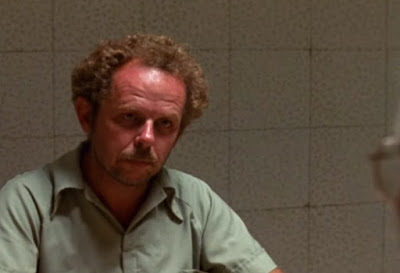


Gaines' effective approach to interrogating Daniel is a mix of non-threatening, non-judgmental, casual conversation and positive reinforcement via various perks. The killer is allowed to have his handcuffs removed, is given all the cigarettes he can smoke, is treated to cheeseburgers, fries and, his favorite, chocolate milkshakes and is able to escape the confines of the prison by accompanying detectives outside to various crime scenes and body dumping sites. Whether or not any of those are actually real or not is of little concern to Daniel. One suspects his recollections often align with his desire to go on a drive, get better food, etc. This is a man who operates on the basest of instincts.
The tone is perfectly set with the chilling opening sequence. A dark country road late at night. A stranded female motorist (Lainie Ferrante) from out of town. A polite, helpful hick pulling over to "help." After secretly sabotaging the carburetor of the woman's car, Daniel coerces her into his vehicle with promises of dropping her off at the nearest gas station. But then he passes right by the station, rolls up the window and quietly, menacingly looks over at her just as she realizes the door handle and lock have been removed from the passenger's side door. Now knowing she's in big trouble, she attempts to appeal to whatever humanity may be left in the man. She's been driving all night, about to start a new job in a new city, about to get married to her boyfriend.... He simply doesn't care. After agreeing to let her out, he pulls a knife, slashes her throat and stabs her to death.


We're given a little insight into Daniel to explain why he turned out this way. In a disturbing childhood flashback, we see how Daniel's prostitute mother used to bring men home and have sex with them right in front of him and his sister, which prompted his war-wounded father to blow his brains out with a shotgun. By age 15, Daniel was ready to commit his first murder; singling out a prostitute. After beating her head in with a board and fleeing the scene, he realized the act of murder had a profound impact on him ("Real excitin' to me... I had to pull over and do sex with myself."). Daniel's subsequent killing spree maintains a strict pattern; sticking to the highway system and constantly being on the move so, in those rare instances when a proposed victim actually manages to get away, he'll already be long gone by the time the police get involved.
Daniel then reveals that he didn't always operate alone. He sometimes had an accomplice in Moon Lewton (Dennis Hill), a slovenly creep who, when he wasn't helping to acquire / kill victims and engage in various criminal schemes, carried on a sexual affair with Daniel himself. The two had an on-and-off again type of relationship where they'd hook up for a spell, indulge each other's proclivities and then part ways. Moon is based on Lucas' real-life accomplice / lover Ottis Toole, who also figures into McNaughton's film, though it does a much better job with the grotesque characterization. Karen Grimes (Eleese Lester), a single woman with a broken air conditioner, becomes the pair's first victim in what is perhaps the film's most disturbingly graphic scene. I'll spare you the gory details and just let you use your imagination in that it involves rope, shaving cream and a kitchen knife and ends with Moon turning to his friend and asking, “Boy, how ya likin' that ride?”


After a convenience store hold-up where two people are gunned down, Moon steals a camera so the duo (soon to be trio) can take Polaroids of victims to replace the porn magazines they usually buy. The photos are stored in shoe boxes in a bus terminal locker and are eventually added to the arsenal of evidence in the investigation. Fresh from working at a massage parlor, Moon's equally demented sister Molly (Sidney Brammer) joins up with the two, enters into a sexless common law marriage with Daniel and assists the two in their killing spree. The new couple eventually settle down for a spell at the home of heavily-religious Dr. Earl Krivics (Ollie Handley), who hires Molly to do light office work and Daniel to work at his electronics repair side business. They even talk Dr. Krivics into letting Moon stay there ("He's a Christian, too!" insists Molly) but they immediately arouse suspicion in both the doctor's unpleasant secretary, Doris (Demp Toney), and his hot, spoiled, college-aged daughter, Monica (Dee Dee Norton). Monica's penchant for sunbathing topless in the backyard and parading around in strapless halter tops and cut-offs ends up moving her right to the top of the killer's 'to do' list.
I'd completely disregard any complaints about this film's accuracy, which, in my opinion, are flat out stupid. There actually wasn't - and still isn't - a very accurate way to tell this tale as the real Lucas never did and never could keep his various stories straight, and was lying up until the day he died in prison in 2001. Toole, who from all accounts was every bit the liar Lucas was, had passed away five years earlier. If it's accuracy you're wanting, check out the excellent five-part Netflix documentary The Confession Killer (2019), which goes into great detail about the incompetence, dishonesty and outright corruption in Texas "law enforcement" that tainted the entire Lucas investigation.
This movie, on the other hand, is mostly a work of fiction that's simply been "inspired by" the killer, as was also the case with McNaughton's film. Approached on its own terms, this is imperfect but still very well done overall and worth watching. It's gritty, dirty, suspenseful, gripping, disturbing and even blackly humorous at times, and its different approach to the material and small town rural flavor make for a interesting contrast to the Chicago-set Henry.
Two very notable scenes that were removed in their entirely from Corman's cut include the gunning down of two little girls walking alongside the road, and the brief discussion of a male hitchhiker being raped and killed. Apparently audiences in the 90s were fine with graphic depictions of women being sexually assaulted and murdered but the mere implication that a man befell the same fate would have been too much for them!
Burns (who sadly committed suicide in 2004 after a terminal cancer diagnosis) was a very talented man who wore many hats, but is best remembered for his effective low budget art direction and production design. His excellent work can be seen in classics like
THE HILLS HAVE EYES (1977) and
THE HOWLING (1981) and, in a fair world, he'd have had an Oscar sitting on his mantle for the brilliant job he did on
The Texas Chainsaw Massacre (1974). Burns, who also did the production design for this film, worked in special effects as well, and even directed a few of his own genre films, like
Mongrel (1982) and the unreleased
Scream Test (1988).
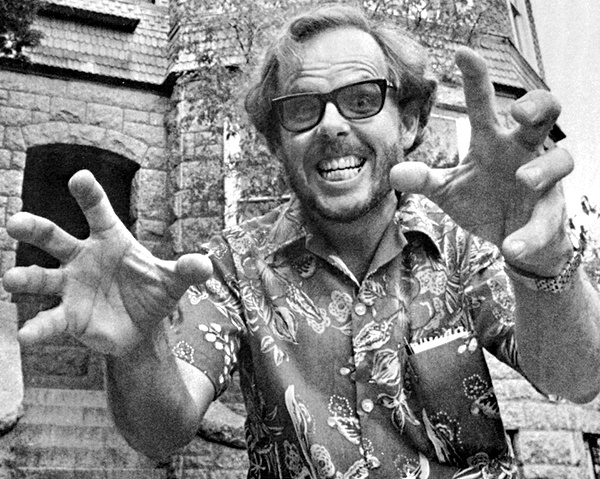
Robert A. Burns on the set of his directorial debut, Mongrel. [PHOTO CREDIT] As far as his acting abilities are concerned, while Burns may not have been a great actor, he does give an effectively understated, soft-spoken, almost deadpan performance here. The only inflections we ever hear in his voice and only gleam we ever see in his otherwise dead, unfeeling eyes is during depictions of, or thoughts and discussions about, rape and murder. According to acquaintances of his, of all his work, Burns was especially proud of this particular film and all the positive notices he received for his performance. It's a shame he didn't live to see the film getting a new lease on life.
According to a magazine article posted on the official COASK Facebook page, director "Mark Blair" died after falling from a mountain in Nepal! However, that appears to be an intentionally planted fake story that was used to shield the identity of the actual director, John Dwyer. Because Dwyer was working on a project for Disney / Touchstone at the time (which would eventually become 1992's Captain Ron), his agent recommended he not take credit for this film. As for why the fake story involved falling off a mountain in Nepal of all things, it appears director John Dwyer may also be prolific travel book writer John Dwyer, who's been published as recently as 2021 and has his own still-active website and blog. One of his books is titled High Road to Tibet.
Since I'm kind of at a loss as to what release year to actually assign this film, for the time being I'm going with 1987 per the copyright and under the assumption it was publicly screened somewhere that same year. That means it will be removed from its long-standing place in my Top 10 for 1985 and moved over to 1987. The good news is that it'll still be making the Top 10 there, as well.
★★★