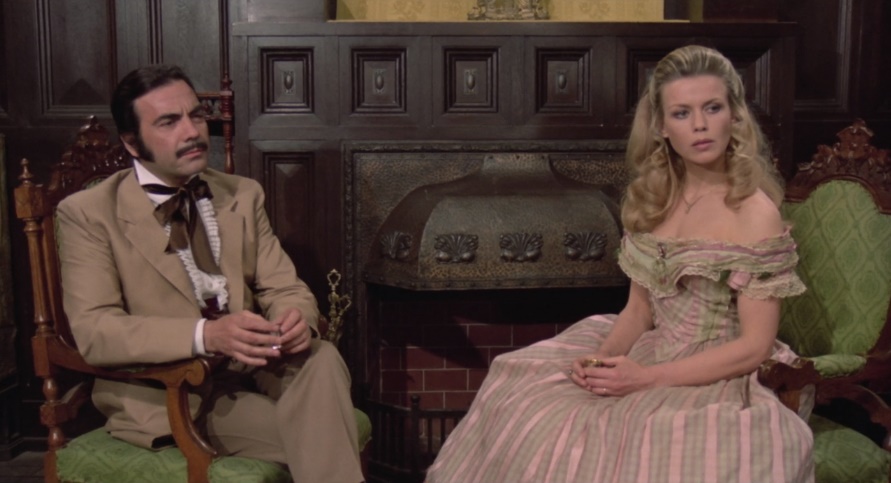
.
.
.
Showing posts with label Klaus Kinski. Show all posts

Saturday, September 16, 2023

E Dio disse a Caino... (1970)

... aka: And God Said to Cain...
... aka: Dödsjakten (The Death Hunt)
... aka: Et le vent apporta la violence (And the Wind Brought Violence)
... aka: Fury at Sundown
... aka: Hevneren (The Avenger)
... aka: Revenge at Sundown
... aka: Satan der Rache (Devil of Vengeance)
... aka: Un homme, un cheval, un fusil (A Man, a Horse, a Gun)

Directed by:
"Anthony Dawson" (Antonio Margheriti)

Former army lieutenant Gary Hamilton (Klaus Kinski) has been stuck in a prison labor camp for ten long years. After slaving away breaking rocks with a sledge hammer in a rock quarry for a decade, and trying to avoid the rattlesnakes in the process, Gary finds out he's finally be pardoned, and by the President of the United States, no less! Now it's time to settle back into normal life. Well, kind of. He's got some other stuff to take care of first. Gary stops by a saloon for a drink and refuses the bartender's offer to stick the prison with the tab. "A man must pay for everything," he solemnly states before heading out. 

Stopping by an old trader's place, Gary purchases a rifle, a horse and enough ammunition to gun down about 500 people for ten bucks, which is incidentally the same amount of money I spent on a cold, shitty hamburger earlier today. He then meets cadet Dick Acombar (Antonio Cantafora, a fine looking chap) on a stagecoach ride. Dick is about to enter his final year at West Point and has come home for a visit. He's still trying to decide what to do with his life: Enter into military service or settle down with a wife, start a family and work at his rich father's mining company. Mr. Acombar (Peter Carsten, also one of the producers) has higher aspirations for his boy and wants him to enter politics. I won't spoil anything, but I will say that Dick's woes about the future will be solved by the end of the film.


It turns out Gary was framed for stealing a fortune in gold and cash during a stagecoach robbery (and the killings associated with the theft), wrongly convicted, given a life sentence (overturned by the government, who gave him leniency and a surprise pardon for his prior military service) and now has vengeance on his mind. The evil schemer who ruined his life is none other than papa Acombar. When word gets back to him that Gary's out and planning on paying him a visit, he puts a bounty out on his head. His primary goons are the Santamaria brothers; Miguel ("Lee Burton" / Guido Lollobrigida), Francisco ("Alan Collins" / Luciano Pigozzi) and Jim (Lucio De Santis), though it seems like 99% of the whole town is willing to do his bidding.

While Gary was away, Mr. Acombar stole everything that was his, including his house, his personal belongings and his blonde, beautiful and backstabbing lover, Mary (Marcella Michelangeli), who helped frame Gary by casting doubt on his alibi. He's also essentially taken over the entire town. Anyone who opposed him fell victim to an "accident" and now most of those left are conspirators or too scared to go against him. There are a couple of exceptions, including saloon / brothel owner Rosy (María Luisa Sala), whose husband had been murdered, and Dr. Jonathan (Giuliano Raffaelli), who has known Gary since he was a child. Both are eventual allies.


The best thing going on here is the wonderfully gloomy atmosphere achieved by Margheriti and the production people, who have set the events on the evening a tornado is passing through town so we get lots of swaying, unreliable lighting and constant gusts of strong wind blowing around dust, smoke and pieces of hay. This is clearly where the director's experience with Gothic horror - he'd previously made HORROR CASTLE (1963), Castle of Blood (1964) and THE LONG HAIR OF DEATH (1964); all of those good efforts, too - is evident. So much of the movie takes place in the dark that our hero ends up riding off into the sunrise, not the sunset, at the end!


While this definitely has merit in the visuals and mood, the simplistic and predictable scripting knocks it down a notch. Almost the entire last hour is spent with Kinski lurking in the shadows, occasionally ducking into some catacombs that once served as a Native American burial ground, and shooting people, which grows repetitive and tiresome. There are no wrenches thrown into the works. No real curve balls. Just a straightforward revenge story with a little minor additional conflict thrown in to fill in the gaps. Most of the drama revolves around Acombar and his son, with the latter oblivious to his father's misdeeds but determined to find out what's going on. In this case, the apple fell very far from the tree as son Dick is kind and actually has some decency while the dad is such a bad dude he thinks nothing of gunning down a preacher in a church for refusing to help him.

Margheriti directs with an extraordinary amount of low angle shots and there are also quite a few zooms right into bright blue eyes, which seem to jump off the screen since the entire cast look like they've been slathered with bronzer prior to filming. He also manages to come up with a visually striking climactic scene, set in a burning room filled with candelabras and mirrors, which seems to have been a big influence on the finale of Argento's INFERNO (1980).


Kinski's fine as the emotionless, quiet avenger, but he's been put to better use elsewhere and this isn't one of his more memorable roles. There's no graphic violence, just a tiny bit of blood, and the only non-shooting deaths are a hanging and someone getting crushed by a church bell, a fate fittingly reserved for Euro horror vet Pigozzi. There's also a cheesy theme song called "Rocks, Blood and Sand" sung by Don Powell.


Reportedly, this is an unsanctioned remake - uncredited rip-off if you prefer! - of a movie released just two years earlier called Uno straniero a Paso Bravo / "A Stranger in Paso Bravo" (1968). Directed by Salvatore Rosso and starring Anthony Steffen, that film has identical character names and much of the same plot, though its writers are not credited here; Giovanni Addessi, who also produced the film, and Margheriti are the only two listed as writers. (For the record, I have not seen that film myself and thus cannot verify any of the plagiarism claims.)


Though a box office success in both Germany and Italy, this was never theatrically released in America. It made its VHS debut here in 1986 on the Unicorn Video label. In the UK it was released on video under the title Fury at Sundown in 1984. There have been quite a few DVD releases since then, though these are all of varying quality. Since the film is so dark, you really do need a proper print of it. That occurred in 2021 when Arrow Video finally got it out on Blu-ray in their four film set "Vengeance Trails: 4 Classic Westerns." The other titles included there are Lucio Fulci's Massacre Time (1966), Maurizio Lucidi's My Name is Pecos (1966) and Massimo Dallamano's Bandidos (1967). This set was followed by a second called "Blood Money" from the same company.

★★1/2

Saturday, June 11, 2022

La mano che nutre la morte (1974)

... aka: Dykhaniye smerti (Shadow of Death)
... aka: Evil Face
... aka: Hand That Feeds Death, The
... aka: Hand That Feeds the Dead, The
... aka: Ölümün nefesi (Breath of Death)

Directed by:
Sergio Garrone

Newlyweds Masha (Katia Christine) and Alex (Ayhan Işık) are passing through the countryside when their stagecoach overturns. The driver is killed and both Masha and Alex sustain minor injuries. Thankfully, there are people nearby who hear the crash, come to their aid and take them back to their large, secluded villa to recuperate. Unfortunately, those people also happen to be Professor Sergei Nijinsky (Klaus Kinski) and his crippled hunchback servant Vania (Erol Taş). Nijinsky is the former assistant to the late Baron Ivan Rassimov (who not coincidentally shares the same name as the Italian actor who starred in the same director's debut feature; the spaghetti western If You Want to Live... Shoot!). Very controversial in his day, Rassimov was considered a madman by some and a genius by others, but he was never quite able to prove his theories since he died in a mysterious fire / lab accident.

Nijinsky is married to Rassimov's daughter, Tanja (also played by Christine), and has since become the heir to the family estate. Though he claims Rassimov took his scientific knowledge to his grave, Nijinsky's secretly carries on his experiments with skin and organ transplants. He has an array of young, unconscious, topless female victims on hand that he's kidnapped and is keeping prisoner in his basement lab, where they're hooked up to tubes constantly circulating their blood. As for wife Tanja, she was also caught up in the accident that killed her father and now has a horrible, fire-scarred face that she keeps hidden behind a black veil most of the time. If you've seen the French classic EYES WITHOUT A FACE (1959), I'm sure you already have some idea where this is going...


There are two other women present in the home. The first is a bisexual prostitute named Sonia (Carmen Silva), who's been invited to come stay there by Nijinsky. After a week of no nookie, she's at a loss as to why exactly she's there. He keeps telling her he'll have a use for her soon enough and, since she's being paid to hang out there, that's good enough for her. There's also Miss Holleroch (Marzia Damon), a writer staying there temporarily under the guise of working on a book about the enigmatic Baron. While she is indeed working on a book, she is also, unbeknownst to her host, using a fake name (her real one is Katya Olenov) and also trying to find out what happened to her sister, who vanished there not long ago. After finding a ring that she believes belonged to her missing sibling, Katya knows she's on the right trail. Fearing for her safety, her boyfriend Theodore (Alessandro Perrella) goes to a police inspector (Bruno Ariè), who agrees something fishy is going on but adds that he lacks the evidence to start slinging accusations about such an "esteemed" family.


The manipulative Tanja exerts a strong hold over her husband. She refuses to make love to him unless he's able to restore her beauty while he proves to be willing to do whatever it takes (no matter how ghastly) to try to repair her and thus their marriage. Using a tuning fork-like device that emits loud sonic vibrations, Tanja is able to control Vania and force him to do her evil deeds, including kidnapping and murder. When she suspects Katya is on to them, she sends the servant out to murder Theodore. For some reason that doesn't really gel with the character (especially since she doesn't even KNOW her boyfriend has been murdered), Katya gives in to the advances of Sonia. The two are surprised in bed by Nijinsky and the servant, who attack and try to kill them. Masha, who plans on leaving in the morning, is also kidnapped and taken to the lab, while Alex finds himself entombed alive with the corpse of the late family matriarch. Things take a few unexpected turns toward the end.


Part of a two film package deal between Turkish and Italian producers, this was shot over an eight week period in both Istanbul and Rome along with Le amanti del mostro / "Lover of the Monster." Both are Gothic horror films with a 19th Century period setting that utilize the same secluded villa for exterior locations and feature most of the same actors, sets, lab equipment, costumes and props. There are plot similarities between the two (starting with the fact both stories involve mad doctors), and they even share some of the same scenes and the same solarized red-and-blue opening credits. In fact, the two are so similar that for years people thought them to be one in the same.

I went into this expecting outright trash (not that one would expect otherwise from the director of S.S. EXPERIMENT LOVE CAMP and S.S. CAMP 5: WOMEN'S HELL!), so the fact this was competently directed, written and performed was quite the surprise. Not that there aren't some problems here, especially in regards to the pacing and the fact it isn't terribly original, but the production values are solid across the board, there's OK set design (of particular interest is the lab filled with bubbling beakers of blood, tubes, wires, high-voltage traveling arcs and gold-painted lab equipment lit with flashing red and green lights) and it delivers the expected female nudity, blood (the mediocre gore effects are provided by Carlo Rambaldi) and well-placed moments of questionable taste (like the rapist manservant continuing the pump away on one of female victims after he believes she's dead!) to keep you interested.


The cast also manage to sell whatever there is to sell here. The biggest drawing card, both then and now, is the presence of Kinski, who was an expert at playing crazed degenerates because, well, he actually WAS a crazed degenerate! Just don't expect much of that here. While he plays a man of questionable morals and sanity, he's rather subdued most of the time until his final scene allows him to emote somewhat. I certainly don't agree with criticisms that he's disengaged, disinterested or phoning it in. His specific character is subservient to the domineering wife and has grown weary trying to please her, which doesn't require him to rant, rave and chew the scenery, even if that's what audiences expect or want out of him.

Most attention will probably be focused on lead actresses Christine and Damon, who not only look gorgeous but also deliver adequate acting performances. Both made numerous other genre films so I'm glad I'll be getting to see more of them in the future. Male co-stars Işık and Taş, representing the Turkish contingent of the film, were two of the most popular and beloved actors in the country at this time and are both good here.


The Turkish version of the film (Ölümün nefesi) is an alternate re-edit supervised by Yilmaz Duru, who is (misleadingly) listed on both the film's poster and in the opening credits as the director. The Turkish print lists additional cast members (Gülen Aygün, Eva Curtis, Turgut Giray, Jahn Colins...) not shown in the Italian credits, though these might just be fake names. Conversely, none of the Turkish actors (not even stars Işık and Taş) are credited on the Italian print. This was held back for release until 1986 in Turkey; bypassing a theatrical release altogether and going straight to video and television. Fifteen minutes were cut for this 77 minute version and, though I only browsed through it, most of what's missing appear to be dialogue scenes.


Ignoring unsanctioned releases from bootleg companies like Cinefear, this was never officially available in the U.S. until somewhat recently. Mya Communication (who carried this under the title Evil Face) first released an English-friendly DVD in 2009 but it was a poor VHS transfer. Full Moon Features then swooped in and released a remastered version on Blu-ray in 2021. They use both English-language titles: The Hand That Feeds the Dead (for the physical release) and Evil Face (for streaming services).

★★1/2
Related Posts Plugin for WordPress, Blogger...