

... aka: Ôkami Otoko Basâkâ (Werewolf Berserker)
... aka: O Vale Assassino (The Killer Valley)
Directed by:
Jef (Jefferson) Richard
"A true pioneer of the independent film movement..." opens the late director's self-penned IMDb bio. He goes on to state his credentials as a graduate of the Cambridge School of Broadcasting and the American Academy of Dramatic Arts, frequent collaborator of Matt Cimber and George "Buck" Flower, employee of Park City Utah's Sunn Classic Pictures and top indie film producer. While patting oneself on the back, especially when most people have never even heard of you before, can come off as delusional and arrogant, this guy more or less has the credits to back himself up. Usually as a production manager, assistant director or line producer, Richard worked on a whole host of films over a 30+ year period, starting with sleazy 70s offerings (ILSA, SHE WOLF OF THE SS, The Witch Who Came from the Sea), then moving up to medium budget genre films (Maniac Cop, Sundown: The Vampire in Retreat) and finally graduating to to bigger budgeted productions starring the likes of Kevin Costner, Sylvester Stallone, Benicio del Toro, Jack Nicholson and Kurt Russell. He also mentions meeting and working with Orson Welles, whom he considered an inspiration, and being part of Flower's touring repertory company The Inspiration Players, who put on "morality-based classical theatre in churches and schools;" a far cry from all of the exploitation film work the two men would later find themselves involved in!
Listed almost as an afterthought toward the bottom of the bio are his two directorial credits; the PG-rated family adventure In Search of a Golden Sky (1984), which he co-wrote and co-produced with Flower (who also stars in the film) and this one, described as a "campy horror cult classic," which has become a synonym for "shitty" as of late. Flower is, unsurprisingly, also in this one and is pretty much the closest thing to a name draw in the mostly amateur cast.


You know the supposed horror movie trope that black people always die first in older slasher films? Well, let's put aside the fact that isn't even true (I personally think the real issue was black people being underrepresented in the genre) and focus on another group: Old folks! If I had to venture a guess, I'd say that far more seniors, regardless of skin color, died first in 80s horror / slasher flicks than any other group. Why? Well, there's probably more than one correct answer here...
I'd say the most obvious reason would be that producers usually wanted teenage or early 20-something leads because they assumed the primary audience was also going to be teenagers and early 20-somethings. And then there's the eye candy factor, as a lot of these films were expected to showcase photogenic, younger, up-and-coming actors. Older folks may be used as early cannon fodder so often because they're viewed as being weaker, more fragile and more physically compromised (poor mobility, hearing, eyesight, etc.), which makes them easy early targets. And then, granted the audience was indeed typically younger, they may get a laugh out of seeing an older person, perhaps a generic stand-in for a repressive authority figure or one with an outmoded or uncool way of thinking, die first. I'd say it's most likely a combination of all of the above.
So the moment we see ol' Homer and Edna (played by real-life couple Oscar Rowland and Beverly Rowland) trudging around at a campsite, we pretty much know they won't last too long. Celebrating their 40th anniversary with a camping trip, the two take a wrong turn while out walking, get lost in the woods after nightfall and are then slaughtered by what appears to be a bear. This 4-minute scene perfectly illustrates why experienced older performers should have been given more to do in these things. There's a moment when Mrs. Rowland breaks down into tears because she's so scared at being lost that's the single best bit of acting you'll see in the entire film. And then she's gone. And then they cart in a bunch of unlikeable, untalented younger actors we're stuck with for the rest of the film.


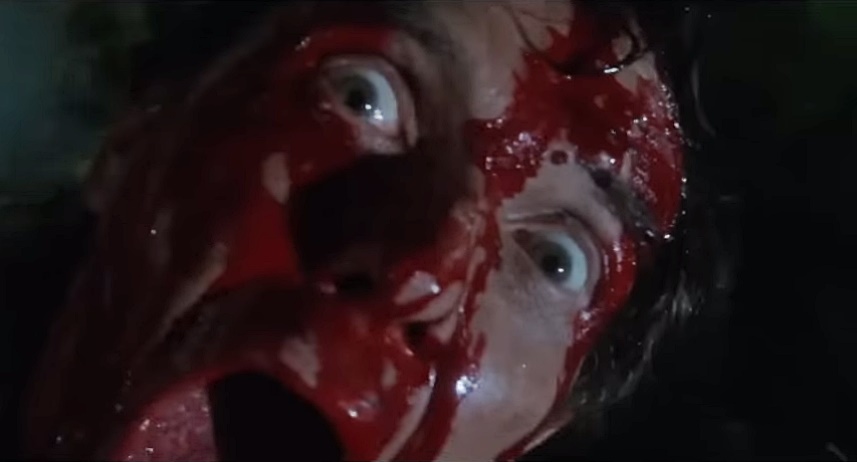


Trust me when I say that no cliché is left unturned in the introduction of the teen characters. There's awful hair metal music, lots of "dude" this and "dude" that, discussions about beer, pot and "humping" and the same stock teen characters we almost always see in these things. Receiving the most screen time is Josh Winter (Greg Dawson), a cocky, smart ass, obnoxious, jag-off-jock who counts belching, drunk driving, suddenly blaring his radio to startle others out of their sleep and losing his shit over the dumbest, most insignificant things among his favorite pastimes. Mike Stone (Joseph Alan Johnson, who was also in the slashers ICED and THE SLUMBER PARTY MASSACRE) is the nice, level-headed, popular one, while Larry Fishman (Rodney Montague) is the nerdy "bookworm" who naturally brings along a book about the history of the place they're about to spend a week at. Someone needs to relay important plot information when the time arrives, eh?
As for the girls, let's just say 80s slashers got a reputation for being sexist for a good reason. And no, it's not because women were often victims (they were also typically the heroes), nor is it because women often appeared nude (what's wrong with showering?), it's because women were often not given actual characters to play. While that's fine in films where their male counterparts are also treated like slabs of meat, it's not fine when a lot of time is set aside defining every single male cast member while every single female is a piece of cardboard. The ladies here may as well be named Blonde #1, Blonde #2 and Brunette but, for the record, they're called Kathy (Valerie Sheldon), Kristi (Shannon Engemann) and Shelly (Beth Toussaint). This even resorts to having the last surviving female literally having to be told what to do and getting yanked around the forest by the guys.


Adventures on their way to their remote destination of Rainbow Valley (also called "Little Norway" because it was settled by the descendants of Norse Vikings [!?]) include getting pulled over by a cop after throwing a beer can out of the truck window and trying to understand what Buck Flower, playing grumpy Scandinavian caretaker Pappy Nyquist, is even saying. After setting up camp, they throw a football, drive a three-wheeler around, pour beer over each other's heads, go swimming and then settle down around a campfire for marshmallows and scary stories.
The nerd plucks an appropriate tale out of his book about vicious Viking warriors called "berserkers," who not only were the most feared of all Vikings but were also rumored to have cannibalized their victims. Typical attire for one of these warriors was a bear-skinned robe with a bear snout mask fashioned from a bear the men killed with their own bare hands as a way to prove their mettle. The warriors who became too unhinged to handle due to their bloodlust were chained, caged, fed raw meat scraps (including human meat) and essentially treated like rabid dogs to unleash upon enemies. Good thing rampaging Vikings are no longer a thing, right? Well, not so fast. Due to all of the massacring and flesh-munching, berserkers don't get to enjoy a peaceful afterlife. Instead, they sit in limbo and occasionally return to Earth by possessing the body of one of their ancestors.
Someone or some thing then starts going around killing the teens, starting with those dumb enough to wander around outside at night alone despite being explicitly told about animal attacks and mysterious deaths in the area. One girls dies after walking a mile into the woods just to take a dump and another is killed after participating in a nude sex scene, yet her boyfriend is allowed to walk away unscathed. As for the presentation of the death scenes, well, you can only see a woolly paw reach into frame to maul a shrieking victim to death so many times before the tedium sets in. And, while we're on the subject of tedium, there are seemingly endless scenes of people walking around in circles in the woods tripping over the same dead bodies over and over again that would be almost comical if they weren't so boring.


From the title and the fact a large chunk of dialogue is dedicated to its mythology, I'm sure you've already guessed by now that a man possessed by a berserker is responsible for the killings, yet each time there's a murder this cuts to an actual bear lurking around doing menacing things like standing up, huffing and growling. Alas, the ferocious forest creature is simply being used as an all-too-obvious red bearing. A scene where Pappy sits down for a chess match with his police officer buddy, Walt Hill (John F. Goff), and they discuss how the father of one of the teens comes from a Nordic bloodline and disappeared in the same area years earlier, is yet another sloppily done diversion attempt. There's a bear vs. berserker wrestling match that should have been a high point but somehow isn't and, while the berserker costume actually looks pretty cool, we bearly (sorry) even get to see it.


I'll give this a little credit where credit is due. There are nice Utah shooting locations and the nighttime scenes are sometimes atmospherically shot (by Sunn Classics vet Henning Schellerup) thanks in part to lots of added fog, but that's about it as far as the good is concerned. Well, the super-hot Toussaint sans clothing isn't a bad thing either. Though it's admittedly not saying much since her co-stars are all dreadful, she's by far the best actor of the younger cast, which also probably explains why she was able to land some roles on known TV shows and films after this.
The biggest star to emerge from the abyss also happens to be the youngest: 10-year old Bart the Bear. This 9-foot-tall brown bear would go on to become something of an animal celebrity soon after, appearing alongside top stars like Anthony Hopkins and Brad Pitt and landing credited starring roles in The Bear (1987), Walking Thunder (1995), The Edge (1997) and many more. His other roles include Bear, The Bear, The Bear, Bear, The Kodiak Bear, The Bear, The Bear and The Bald-Headed Bear. He was clearly a victim of typecasting.

This was given home video releases in the U.S. (well-distributed on the Prism label), the UK, Australia, Canada, Japan, Brazil and Germany. In 2019, Vinegar Syndrome released it on Blu-ray and DVD, which includes on-camera interviews with the director and stars Johnson and Engemann, as well as an audio interview with Mike Riley, who plays the title character. 80s slasher enthusiasts should probably still check this out regardless of my comments. Everyone else can safely give A Norwegian Cannibal Viking in Utah a pass.
★1/2


