.
.
.
Showing posts with label Gérard Tichy. Show all posts

Saturday, April 16, 2022

La cara del terror (1962)

... aka: Face of Terror

Directed by:
I.M. (Isidoro M.) Ferry
William J. Hole Jr. (credited on English print)

Very little info is available for this title online but there are a number of things we can figure out from what is available. For starters, there are two distinctly different versions of this one floating around. The first is the Spanish-language version La cara del terror, which was theatrically released in its home country in 1962, runs a little over 85 minutes and has I.M. Ferry credited as the director. The second version is the U.S. and UK release, which was released theatrically in 1964 with a running time of 79 minutes and is solely credited to William Hole Jr. This English-language version was also part of a syndication package sold to TV by AIP in 1965. As you can likely gouge from the run time discrepancies, the original Spanish version naturally has additional footage. However, I skimmed through it and it doesn't appear that anything of real significance (as far as the plot is concerned) was cut. The opening credits in the Spanish version are different, much longer, much cooler and feature an original song not heard in the U.S. version, plus the very first major scene (a board meeting) goes on for several more minutes in the longer cut, but that's mostly it. Many sources claim that the English version had new / different scenes filmed by Hole specifically for the U.S. release but a side-by-side comparison shows that to not actually be the case. The "new" stuff is limited to credits, dubbing and editing cuts.

Another thing that seems likely (yet a bit odd at the same time!) is that this has an almost entirely Spanish-speaking cast (aside from the American leading lady), yet most of the primary actors appear to be speaking English. Credits match the theory that this was at least partially filmed in English as most of the actors have been dubbed in the Spanish version, while only a few (most noticeably the policemen) appear to have been dubbed in the English one. Also supporting this theory is the fact both versions of the film credit Monroe Manning (a U.S. TV writer) with the screenplay, which was almost certainly written in English. I'm just guessing here, but I'd say the main stars were all speaking English and the Spanish actors filling the less significant parts were not.


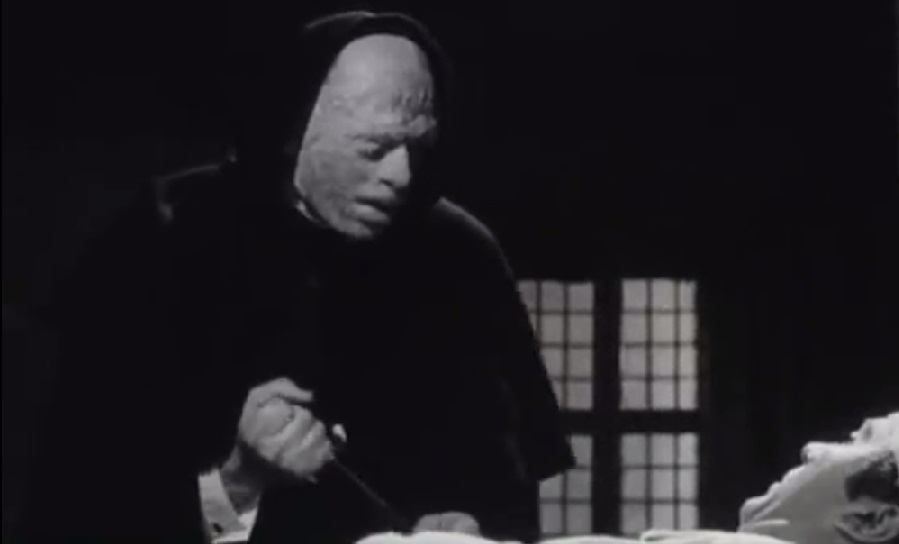
Dr. Charles Taylor (Fernando Rey) shows up at the Institute of Neuro-Science to discuss his "new approach to plastic surgery." Taylor has developed a process involving heat-impervious, moldable plastic that adheres perfectly to human flesh, which will not only result in a more complete and lifelike reconstruction but can also be done in a fraction of the time it would take to perform regular surgery. He hopes to use the institute's facilities (and one of their patients) to conduct his first transplant, but is rejected by Dr. Chambers (Gérard Tichy) and most the rest of the board on ethical grounds once he reveals he plans on patenting his technique in order to personally profit from it. Outside at an opening window, one of the patients is listening...

Norma Borden (Lisa Gaye), the asylum patient in question, sneaks into the back of Taylor's car and hides out until he arrives home. After his lab assistant / girlfriend Alma Woods (Concha Cuetos) leaves for the evening, Norma finally makes her presence and intent known. Four years earlier, an oil lamp exploded in her face, hideously scarring her. Norma conceals the fact she's a patient from the doctor, instead claiming she's simply too poor to afford plastic surgery. When Dr. Taylor tries to explain a series of tests must be performed before the operation and it will take some time, Norma threatens suicide if he doesn't work on her right then and there. Taylor relents. Norma heals amazing quickly and the operation is a success... or at least it appears that way at first.


Meanwhile, at the institution, Dr. Chambers and Dr. Reich (Carlos Casaravilla) discover that Norma has escaped and reveal that she's unstable, prone to violence and considered extremely dangerous. After being admitted by her own mother, Norma was diagnosed as a manic depressive with paranoid tendencies and a major persecution complex. Dr. Chambers calls up police detectives Mandel (Eduardo Sancho) and Alec (Pepe Martín) to help, but lies to them and tells them Norma is harmless and walked away from a minimum security wing of the hospital. They don't exactly buy his story, but they get a photo and start searching, soon joined in their investigation by Inspector Hopkins (Emilio Rodríguez).


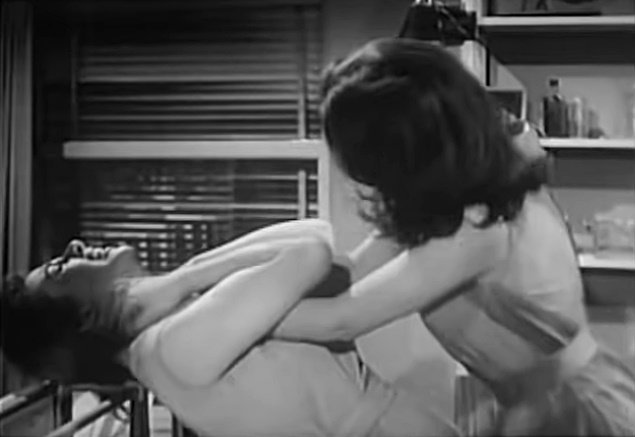
After Dr. Taylor discovers who Norma really is and threatens to send her back to the hospital, Norma breaks a bottle over his head, steals some money, his car and a special moisturizer needed to keep her new plastic grafts from drying out and deteriorating and heads for the city. Her first stop is a boutique to buy clothes and make-up, and then a beauty parlor for a fashionable new hair cut. With her transformation now complete, she's a beauty that turns heads everywhere she goes. Knowing the police will be out looking for her, she answers a classified ad and takes a bus to a resort hotel twenty miles out of town, where she's able to easily secure work as a waitress.

Now going by the name "Nora Black," Norma quickly attracts the attention of several men, starting with her sleazebag boss, Mr. Polack (Jacinto San Emeterio), who comes on to her in none-too-subtle fashion and then tries to blackmail her into a friends-with-benefits type scenario. Much more useful to her is Matt Wilder (Virgilio Teixeira); a thrice-divorced playboy whose bad reputation proceeds him, but he also happens to be good looking, filthy rich and willing to marry her. When the cops show up at the resort and start snooping around, Norma takes Matt up on his offer of marriage, with hopes of running off to Paris with him. Things don't go quite as planned and several murders follow.




Interestingly, this was released the same year as Jess Franco's THE AWFUL DR. ORLOFF; often considered the first pure Spanish horror film (which I suppose would make this the second pure Spanish horror film), and both obviously used the same source; Georges Franju's EYES WITHOUT A FACE (1960), as inspiration. While this is miles away from the quality of Eyes, it's also not the schlock-fest I was anticipating either. Spotty dubbing and a little time padding (namely a musical number and flamenco dancing) aside, this is fairly well-made for what it is. 


While the story is entertaining and well-paced, and the make-up is surprisingly good, the real star here is the talented leading lady. Thanks to Gaye's excellent and emotive performance, and some thoughtful moments in the script, the Norma character never comes off as an over-the-top cartoon loon or a one-dimensional evil seductress. As both a victim of the medical community in her "monster" form and a victim of self-involved men who view her as little more than a disposable object of lust as the beauty underneath all the scarring, we're given an unexpectedly well-rounded and sympathetic anti-heroine in the central role.

This sat out much of the VHS era and has not been well-serviced on DVD either. The only legitimate English release I'm aware of is from Sinister Cinema. A decent-quality, widescreen version also exists, but the only one I could find was with Spanish audio.

★★1/2

Thursday, May 5, 2016

Horror (1963)

... aka: Blancheville Monster, The
... aka: Démoniac
... aka: Edgar Allan Poe: Horror
... aka: Edgar Allan Poe's Horror
... aka: Horror: The Blancheville Monster
... aka: Le manoir de la terreur (The Mansion of Terror)

Directed by:
"Martin Herbert" (Alberto De Martino)

A week before her 21st birthday, Emilie De Blancheville (“Joan Hills” / Ombretta Colli) returns to her family castle in England for the first time in many years, bringing along her best friend Alice Taylor (Irán Eory), who she met in college in America, and Alice's brother John (“Richard Davis” / Vanni Materassi). Since her father was burned to death in a fire while she was away, or so she's been told, Emilie's brother Rodéric (Gérard Tichy) has taken over and there have been a number of big changes made in the interim. For starters, all of the staff members Emilie remembers from her childhood are gone and they've all been replaced by a mysterious and shady new group of servants. The new housekeeper is Miss Eleonore (Helga Liné) who, despite being gorgeous and not the old crone usually seen in these films, is so solemn and sinister she manages to give Emilie a fright by just standing there, and new butler Alistair ("Frank Moran" / Paco Morán) isn't much better. The family physician, who'd treated the past three generations of the De Blancheville family has also been replaced by a newer / younger model in Doctor LaRouche (Leo Anchóriz).


During dinner, the visitors hear some strange noises that Rodéric tells them are dogs. Later that night, Alice wakes from her sleep to go on a midnight stroll, only to stumble upon some strange goings-on in the tower involving Eleonore, a syringe and a wailing, disfigured “monster.” Alice passes out, wakes in her bed and is told it was all in her imagination. Later, Rodéric gathers everyone together and finally spills the beans. The father wasn't actually killed in the fire; only severely disfigured and turned into a raving maniac in need of constant sedation. After Alice interrupted Eleonore giving him his treatment, he escaped into the woods and is now haunting the grounds. Carved on the headstone of the family tomb is a prophecy that states that the De Blancheville bloodline is set to end during this generation when the last female descendant reaches the age of 21. Now that her father is a grotesque madman, some believe he'd like to make the prophecy come true.


A search party is organized to scour the woods looking for the father but they can find no trace of him. That night, he pays a visit to Emilie, hypnotizes her and leads her outside to the family tomb and tries to temp her to crawl into her grave to experience “the sweetness of death.” Luckily for her, both the butler and the doctor saw her leave the castle and followed them there, which sends the father running off before he can complete his task. The next day, Emilie wakes up with a muddy nightgown feeling very peculiar, disoriented and with no idea what had happened the night before. She's not quite the same after that, starts having fainting spells and falls into a depression. Alice and her brother John (who's fallen in love with Emilie) attempt to find out just what's going on. Is her father really lurking around trying to fulfill the family prophecy? Is she being driven mad? Is she being slowly poisoned? Is someone making good use of Franz Anton Mesmer's book Hypnotism and Magnetism?


I consider myself a pretty patient person, but this dreary little mystery takes so long to really kick into gear it's going to make most people check out long before any of the better sequences even occur. Instead of the moody Gothic horror we all came to see, for a good hour we are treated to something more akin to a Gothic soap opera. It's talky, set bound and filled with the usual shady characters played by actors attempting to give off an ambiguously suspicious vibe. The numerous romantic entanglements get to be a bit much as well. Of course, Emilie and John have their thing but then we have the doctor falling in love with Alice who's already in love with Rodéric who already has a thing going on with Eleonore who's also got something going on with... Yeah, you get the picture.


Not that this doesn't have its moments. There's good, high contrast, shadow-filled black-and-white photography courtesy of Alejandro Ulloa, decent art direction, lots of candlelit strolls down dark corridors and all of the expected atmospheric Gothic accoutrements. At around the hour mark, there's a pretty good Corman-esque nightmare sequence shot on blank sets with lots of fog and use of superimposition. The last fifteen minutes are pretty solid, with all of the story threads getting adequately tied together. It helps that some of these later scenes take us outside the dreary castle to an amazing old crumbling church that looks identical to the main shooting location used in the first Blind Dead film. Hell, it may even be the same exact location. That place is far too cool not to show up in other horror films shot in Spain.

Shades of Edgar Allan Poe abound, as this pinches ideas from several of his stories, most obviously The Fall of the House of Usher, but also a little Premature Burial toward the end. Interestingly, Poe's name is nowhere in the film's actual credits but was used extensively in the advertising, with many posters placing his name right above the title.


The cast is fairly decent in this one and there are a number of lovely actresses on hand. Former beauty queen Eory (who was born Elvira Teresa Eory Sidi and took her stage name from her country of birth) and Colli, a frequent presence in peplum and sci-fi films for a number of years before becoming a singer and eventually a politician, are nothing to sneeze at. Hell, Colli even does the late night corridor shuffle at one point clad in a sheer nightgown that doesn't leave much to the imagination. However, it's the presence of a completely buttoned-up Liné (in her first genre role) that garners the most attention. Like Barbara Steele, this woman was absolutely perfect for these kind of films so it's no wonder she landed many other similar roles throughout her career. She's pretty much matched in the sinister department by Anchóriz in what was sadly his only horror role. How this man never got cast as Satan at least once in his career is beyond me.


Though a cut English-dubbed version was distributed by AIP for TV showings, this took forever to get a home video release here in America. That wouldn't occur until a rather shoddy print (the same dubbed AIP-TV cut) popped up on numerous cheap sets distributed by Alpha and Mill Creek in the mid 2000s. There are differences between the various releases but only minor ones, including a different opening sequence depending on which version you see. The British theatrical cut (which has the alternate opening not seen in the U.S. version) was made available on DVD by Retromedia in 2013, which was the best-quality version of the film up to that point. In France, they got a sepia-tinted VHS release in the 80s under the title Démoniac (Delta Video) and, in 2015, a widescreen remastered DVD under the title Le manoir de la terreur. Unfortunately, the latter doesn't come with an English option but the Retromedia release was just fine by my standards.

★★
Related Posts Plugin for WordPress, Blogger...