.
.
.
Showing posts with label Daria Nicolodi. Show all posts

Saturday, November 13, 2021

Schock (1977)

... aka: Al 33 di Via Orologio fa sempre freddo (It's Always Cold at 33 Clock Street)
... aka: Beyond the Door II
... aka: Beyond the Door #2
... aka: Les démons de la nuit (The Demons of the Night)
... aka: Schock (Transfert-Suspence-Hypnos)
... aka: Shock
... aka: Suspense

Directed by:
Mario Bava

Many years after her drug-addicted, "half-crazy" husband Carlo (Nicola Salerno) died by suicide, Dora (Daria Nicolodi), her 7-year-old son Marco (David Colin Jr.) and her (frequently absent) new husband Bruno (John Steiner) move back into her Dora's former home. It was the same home she had once shared with her late husband and has been unoccupied since his passing. Thanks to Bruno's busy job as a pilot and the home's close proximity to an airport, Dora has decided to move back in and try to adjust to all of the bad memories associated with the place as she goes. She almost immediately begins to regret that decision.

It doesn't take long for Marco to start behaving strangely. He frequently asks, "Are we going to stay here forever?" and is caught talking to himself... or perhaps an imaginary friend... or an invisible entity that no one else can see. He wakes up late at night and starts growling "Pig! Pig! Pig!" as Dora and her new husband make love downstairs. He spies on her in the shower, steals her panties, crawls on top of her and starts thrusting and grunting in a decidedly non-childlike fashion. And let us not forget the unnerving casual asides like "I have to kill you mommy." All rather disturbing changes in the young boy, I'd say! And it only gets worse from there.


After a series of minor "accidents," which find Dora falling and bruising her arm when the lights suddenly go out, slicing her finger with a razor blade hidden between piano keys, cutting open her hand on an exploding pill bottle and slicing her leg open with a strategically placed rake, she begins to fear that she's going crazy. Again. She'd already spent six months in an asylum after the death of her first husband in what we can assume was an abusive, tumultuous relationship. If that's not bad enough, she's haunted by terrifying nightmares involving someone trying to break into her bedroom late at night and a floating utility knife slicing at her, plus flashbacks to her terrible first marriage. And if that's not enough, she also has daytime hallucinations like a bloody hand emerging from the ground to claw at her ankle. New husband Bruno, who ignores her frequent pleas to move out, resorts to secretly drugging his increasingly more hysterical wife.


Shock falls into a number of different popular horror subgenres. We get a haunted house film (complete with doors opening by themselves, furniture moving, creaking floorboards, etc.), an evil kid movie (complete with lots of shots of the boy glaring at his once-beloved mama and gleefully laughing at his various evil deeds), a ghostly revenge / possession flick and a psychological horror all wrapped into one. Hell, this even incorporates a little voodoo black magic into the proceedings, including the little boy using a voodoo doll, plus a photo fastened to a swing that almost brings an airplane down!

The multi-layered plot offers up a few distinct possibilities. Is Marco really possessed or just showing signs of psychosis himself due to having been raised by mentally-imbalanced parents? Is his late birth father using his child to try to return to life? Is Dora simply going insane? Is the ghost of the former husband out for revenge and, if so, why is he out for revenge? Bava manages to neatly tie it all together by the surprisingly downbeat finale whilst leaving a trace of ambiguity behind.


I completely disagree with those who've claimed this is "lesser" Bava or a disappointing final feature for the director, and anyone out there who claims this is less stylish than Bava's previous films doesn't have a clue what they're talking about. While it may be less colorful, less elaborate in regards to production design and lower-budgeted, there's more than enough visual style, great camerawork and directorial cleverness (especially good use is made of image distortion and out of focus shots) on display to satisfy, plus a highly effective score, great use of sound, some genuinely creepy moments and one of the best-executed jump scares you'll see in any film.

The camera swoops into a hole in a wall and then rises back up looking out the other side, the son uses a flashlight and a cutout from a photo to cast a spectral figure on a brick wall that may or may not house a corpse and ghostly hands made of light strip sheets off a bed. Those are just a few of the cool little touches found herein and the movie is filled to the rafters with other such moments.


Nicolodi is almost entirely known for her work with director Dario Argento, whom she dated on-and-off for years and had a child (actress Asia Argento) with, but was never technically married to. That relationship worked as something of a double-edged sword for her career. While it got her involved with some of the most famous Italian horror films of the period (notably SUSPIRIA, which she also wrote), Argento barely ever gave her a decent acting role in any of the films, with PHENOMENA perhaps being the lone notable exception. Here, however, she's given a central role and an actual character to play with some dynamics (not to mention hysterics!) and this is clearly the best role she ever got to play in a horror film. Annoying dub aside, little Colin Jr. is also very effective as the son. Genre regular Ivan Rassimov (MAN FROM DEEP RIVER) also shows up in a small role as a doctor friend, though he's not given anything interesting to do.


Shock was in pre-production stages as early as 1972, starting with a screenplay by BAY OF BLOOD writers Dardano Sacchetti and Gianfranco Barberi called Al 33 di via Orologio fa sempre freddo ("It's Always Cold at 33 Clock Street"), which was based very loosely on American mystery writer Hillary Waugh's 1971 novel The Shadow Guest. The script ended up sitting around for several years while Bava was working on other films but was later reworked by two new writers: Alessandro Parenzo, co-writer of Bava's great Rabid Dogs (1974), and the director's son, Lamberto (also the assistant director). The film finished up its five week shooting schedule at the end of June and was already playing in Italian theaters later that same summer.


Because there were no big bankable names to American audiences attached to the film, distributor Film Ventures International cooked up a new plan. Hey, since one of the actors was in another hit film, why not make this a bogus sequel to that film? The film in question was the Exorcist wanna-be BEYOND THE DOOR (1974), which became an international surprise hit despite being a piece of shit, so Schock then became Beyond the Door II. While I'm sure this did alright business under that title (there's also a bogus Beyond the Door III, after all), it didn't do nearly as well as the "original" despite being infinitely better. In the UK, it played (under its original title) on a double bill with The Blood-Spattered Bride (1971).


This title has always been much easier to find here in the States than most of Bava's other films. The initial VHS distributor was Media. It was then re-released on VHS by Video Treasures (who just recycled the Media poster art). DVD releases followed in the early 2000s from Anchor Bay and Blue Underground. Arrow (out of the UK) is going to handle the Blu-ray release, which is currently slated for a January 2022 release. My screen caps were taken from the Anchor Bay DVD and, as you can see, there's still a lot of room for visual improvement here.

★★★

Sunday, July 12, 2020

Opera (1987)

... aka: Dario Argento's Opera
... aka: Terror at the Opera

Directed by:
Dario Argento

There are a lot of differing opinions about this film and just what it meant for Argento's career. Many believe this is his last really good film and that it's all downhill from here. Others believe the film itself is substandard and was the beginning of the director's downward spiral. And then there are those super-fans who both love this film (I've even seen “masterpiece” volleyed around a bit) and continue to love many of Argento's later offerings. In my humble opinion, nothing Argento has made after this point would be quite as good, though that doesn't mean this is quite on par with some of his better earlier offerings either. Still, who wouldn't take something creative, well-made / produced, delightfully bonkers and boasting some of the most inventive camerawork of the entire decade over the vast majority of comparably unimaginative slasher flicks and endless sequels that dominated this decade? I know I sure would. Despite having a fair amount of issues with the narrative, this is still a good notch or two above the norm any way you slice it.

Things center around an operatic theater version of Giuseppe Verdi's Macbeth that's being staged by famous blood n' guts horror film director Mark (Ian Charleson). Bitchy star diva Mara Czekova is accidentally (maybe) struck down by a car while storming out of the opera house due to the director's insistence on using real ravens and other such annoyances with the avant-garde production. Wide-eyed understudy Betty (cute Spanish model Cristina Marsillach), whose mother was also a famous singer, is then drafted to take her place. Knowing that the opera is rumored to be cursed and to bring back luck, Betty is apprehensive about taking on the lead Lady Macbeth role but relents due to optimistic pressure from her agent, Mira (Daria Nicolodi), and the show's producer (Antonino Iuorio). Successfully overcoming her jitters, Betty's debut performance ends up being a smashing success. Unfortunately, a stage hand is murdered upstairs while the performance is underway and Betty appears to have somehow already managed to pique the interest of an obsessive fan / stalker. This man also may be somehow tied into her past.


The horrors continue for poor Betty whenever the psycho starts terrorizing her over the phone, sneaks into the theater to slash up her costume and a few of the ravens (who apparently have really good memories and a taste for vengeance!) and then forces her to take part in his vicious slayings. He accomplishes the latter by ambushing her, tying her up, gagging her and then taping a line of needles beneath her eyes so if she tries to close them she'll rip her eyelids apart; thus forcing her to witness each of his bloody crimes. After he dispatches Betty's would-be stage manager lover Stefano (William McNamara), she calls the police to report the murder but, curiously enough, hangs up the phone whenever they ask for her name. She does however confide in Mark (who also doesn't bother involving he cops) and confesses that it all seems to tie in with a recurring nightmare she's had since childhood, which centers around a man wearing a black hood, a distinctive-looking dagger, a dilapidated building, kinky sex, pulsating brain matter and murder-voyeurism. An investigation led by Inspector Alan Santini (Urbano Barberini) is soon underway.


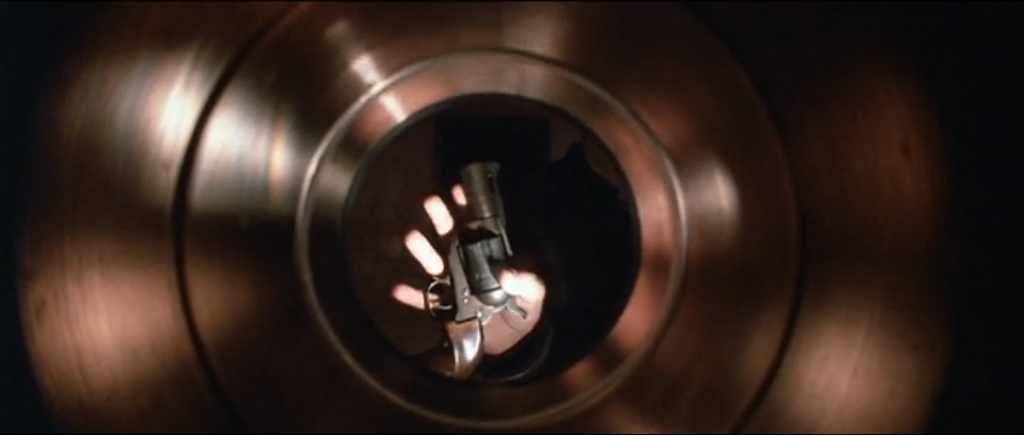
During an excellent sequence, Betty again finds herself tied up and forced to watch as brassy wardrobe mistress Giulia (Coralina Cataldi Tassoni) is strangled, stabbed and then has her throat cut open to retrieve a piece of evidence she accidentally swallowed. This time Betty is confronted by Inspector Santini on the way back to her apartment and spills the beans. He tells her to lock her door and wait for his assistant, Daniele Soave (second unit director Michele Soavi in an uncredited cameo), to show up. Agent Mira stops by long enough for another great scene where she's shot through a peephole, with the bullet shown traveling through the hole, shattering glass, flying through Mira's head and then destroying the telephone behind her in slow motion.


Mark and animal trainer Maurizio (Maurizio Garrone) then devise a "genius" (i.e. utterly absurd!) plan to weed out the killer, with all of the red herrings and the actual killer all in attendance at another Macbeth performance. That results in a raven pecking out an eyeball, followed by a blazing fire that burns down part of the opera house. Then, in a very polarizing second climax, the film retreats to the Swiss Alps for a handful of admittedly amusing PHENOMENA (1985) in-jokes and another appearance by the psycho. How he managed to pull the wool over the investigator's eyes, fake his own death and escape the opera house is, for lack of a better word, dumb. But, hey, at least the scenery is great.

Aside from a handful of showstopper murder set pieces, smooth scene transitions (especially a shot disappearing into the darkness of an air vent and then emerging in an orchestra pit) and some fantastic camerawork (like a raven POV circling way above the audience and then swooping down upon them), this also boasts a soundtrack that has no qualms going from opera to ambient (Brian Eno and Roger Eno) to bursts of metal from obscure acts like the Italian band Gow (who use the alias "Steel Grave" in the credits) and the Swedish group Norden Light ("No Escape") during the more horrific moments. There are also contributions from Bill Wyman and Goblin's Claudio Simonetti. Viewers will either love this eclectic mix or be completely turned off by it but that's par for the course with Argento.


Despite doing some truly head-scratchingly-stupid things at times, the main character provides a somewhat interesting focal point. Betty is an aloof, tentative young woman sabotaged on both a personal and professional level by insecurities brought on by her traumatic past. She's a self-proclaimed "disaster in bed," recoils from touch, seems incapable of having a real romantic relationship and almost spoils her own chances at success by trying to back out of a star-making role. So, in a way, the core of this film is really about her character overcoming her past to reclaim her life. One of the final images at the finale is of her freeing a trapped lizard. The last line is "Go free."


Though Marsillach is serviceable in the lead here, Argento apparently hated working with her and originally wanted Phenomena star Jennifer Connelly to play this part instead. Vanessa Redgrave was also originally cast as the bitchy opera star but backed out at the last minute so her role was reduced to POV shots and a voice-over done by another actress. Antonella Vitale (THE CHURCH), who has a small role as Mark's model lover, was Argento's real-life girlfriend at the time. He also gave her the lead in his short-lived series Turno di notte before the two split up. Also appearing in small roles are Barbara Cupisti (STAGE FRIGHT) as the producer's assistant, Carola Stagnaro (TENEBRAE) as Betty's tarty neighbor, Peter Pitsch and Karl Zinny (both from DEMONS, along with Barberini) and real-life conductor / Hungarian opera director György Gyõriványi.

The director of photography was Ronnie Taylor, a Brit who'd won an Oscar just a few years earlier for shooting Gandhi (1982), which also featured the late Charleson (an acclaimed theater actor, though you'd never guess that here). Taylor went on to shoot Argento's rather crappy Phantom of the Opera re-do in 1998 and the giallo Sleepless in 2001.


With an 8 million dollar budget, Opera was Argento's most expensive film to date. Though it was fairly successful in Italy, release in other countries was delayed, sometimes by years. It wouldn't show up on VHS here in America until 1991 when Southgate released two separate videos: an R-rated cut and an unrated / uncut version. The former had 11 minutes removed. Naturally the subsequent DVD and Blu-ray releases from companies like Anchor Bay, Scorpion Releasing and Blue Underground have all been the uncut 107 minute version.

★★★
Related Posts Plugin for WordPress, Blogger...