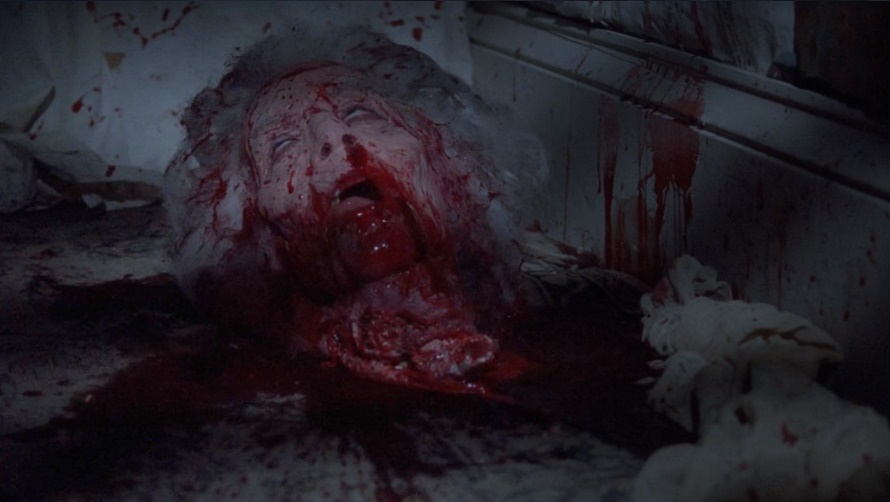
... aka: Cute Devil
... aka: Lovely Devils
Directed by:
Nobuhiko Ôbayashi
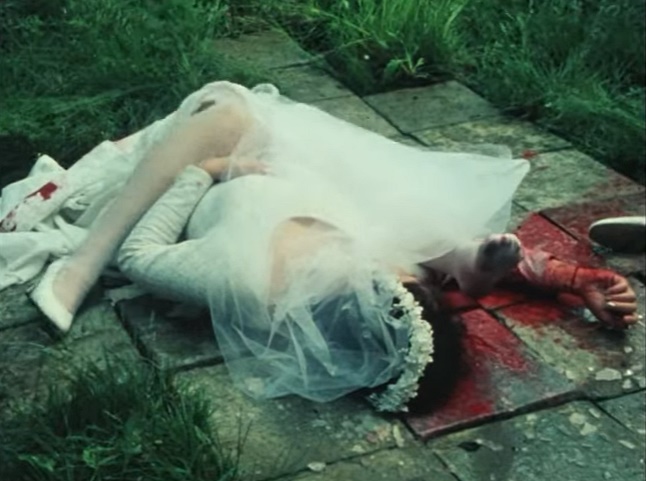
Made for Japan's Nippon TV / JOAX-DTV / Channel 4, this is widely described as a Japanese take on The Bad Seed, though writing it off as just that isn't quite capturing the full essence of the film and those expecting another frenzied HAUSU from director Ôbayashi also need to keep their expectations in check. Things begin at a lavish, fairy tale-style wedding ceremony between young groom Koji (Hiroyuki Watanabe, who sadly committed suicide just last year) and his bride Kuyuko (Nao Asuka). After they're whisked off to the reception by a horse-drawn white carriage, Koji's cute little 5-year-old niece Alice becomes infatuated with Kuyuko's veil and repeatedly asks if she can have it. Fuyuko finally puts her foot down and explains that she plans on keeping it until the day she dies as a memento of the wedding. "Until you die?" returns Alice. Fuyuko shrugs and runs into the house to fix her makeup as the photographer is gathering everyone outside. Suddenly, the new bride comes flying out of an upstairs window and dies a twisted, bloody mass on the ground below. Approaching the body, Alice then turns to her mother and asks if she can have the veil now.




We then jump to Vienna, Austria at the "same day, same time," where Fuyuko's sister, Ryoko (Kumiko Akiyoshi), a music student and accomplished pianist, is in the middle of a heated lover's quarrel. As her boyfriends walks out of the door, she angrily whispers "Die!" Suddenly, there's the sound of a car crash. She looks out of the window to see that her ex, having been struck by the car, has indeed died. Blaming herself for the accident, Ryoko has a mental breakdown, starts beating her head against the wall, attempts suicide and has to be taken to a mental institution. It seems they've finally gotten through to her after three long years, at least to the extent where she can return to society.


Koji decides to take Ryoko back to his beautiful oceanfront mansion to work as a governess and tutor. Though he doesn't have a child of his own, Koji lives with his widowed sister, Keiko (Miyoko Akaza), and her daughter, Alice (Tina Jackson). You remember her? The little girl who got her veil? She's now slightly older (8) but, it turns out, hasn't changed much otherwise. In fact, her initial fear of Ryoko staying in the home stems from paranoia that she's there to take the veil back! Once she finds out she can keep it, Alice reverts back to cute little girl persona.
Ryoko's first night there, she's woken in the middle of the night when the veil is tossed over her. Keiko comes in, tells her not worry and that Alice likes to play jokes. The following morning, Alice denies playing the joke and Keiko denies either knowing about it or even coming into her room and having a conversation with her at all. Ryoko then starts seeing visions of her deceased sister, clad in her veil and wedding gown, lurking around the mansion grounds late at night. This casts a shadow of doubt about her actual recovery from her mental break. Or perhaps it could all be by design...
Keiko, an alcoholic who isn't the picture of sanity herself, may intentionally be stirring up trouble and has a variety of different possibly motives for doing so. She could be trying to make Ryoko lose her mind again. She could be trying to make her out to be an unreliable witness so the validity of everything she claims to hear or see in the future will always be in doubt. Or she could be trying to drive her out of the home for her own safety, to protect her against her sociopath daughter. Either way, she's been picking up on the fact that there's some mutual attraction between Ryoko and her brother and wastes no time running to tell Koji all about Ryoko's various incidents, suggesting he consult her former doctor immediately and send her somewhere else to convalesce.


Little Alice soon starts showing her true colors again in scenes that ARE quite obviously swiped from the 1953 classic this is often compared to. When she loses out on a doll prize during a singing competition, her teacher who awarded it to someone else mysteriously falls to her death from a bridge... after being bludgeoned in the head with a metal instrument... after Ryoko had already caught Alice up late at night hammering metal onto the bottom of her shoes. Alice later suggests the death was "divine retribution" for her not giving her the doll she so rightfully deserved.
This also has a Henry Daigle (groundskeeper from the original Seed) substitute in the form of a scumbag drug addict / sex predator / yo-yo aficionado who lives in a shack by the river and happens to witness Alice cleaning blood off her shoes after the teacher's death. Instead of going to the police, he attempts to use it as blackmail to get "favors" from both Ryoko (whom he first suspects is Alice's mother) and even little Alice herself ("I'll hand them over if you give me a kiss"). Ryoko attempts to leverage her position with the creep; sex in exchange for him getting Alice on tape admitting to her crimes, but he meets a fiery end instead thanks to some spilled gasoline and a firecracker. As all of this is going on, Ryoko tries in vain to convince Koji of Alice's true nature, but will he or anyone else believe a "precious" 8-year-old could be responsible for such ghastly crimes?


Seeing how I don't agreed with the general consensus that Hausu is a masterpiece, I'm not one bit surprised I also found many of the same exact strengths and weaknesses from a film made by the same guy just five years later. While this is nothing like the spastic, colorful pop art fx bonanza Hausu, it does share a similarity in that its greatest strengths lie in its visuals. The shots here are well-framed and frequently imaginative, the art direction is nice, there's decent use made of matte paintings for seaside landscapes, neatly-done flashback scenes with centralized color and sepia edges and some slightly surreal dream / hallucination sequences thrown in. That all helps to somewhat spruce up the middling script.
Where this didn't sit so well for me was how simple plot revelations are delivered to us with zero nuance. This is filled with so many comically unsubtle, soap opera-esque zoom shots and blaring music cues any time something peculiar is happening it almost reads as some kind of parody of old Gothic melodramas. At times I suspected that may have been an intentional angle the director was working, but that doesn't entirely appear to be the case. Instead of going for the over-the-top, theatrical histrionics that are a staple of classic Gothic films (and also the work turned in by Nancy Kelly and Eileen Heckart in the original Seed), he has the cast pitch their performances in a more mannered fashion.
The Ryoko and Keiko characters are saddled with various mental issues, neuroses and secrets, which work early on as a way to cast suspicion on multiple characters, but it's ultimately just a distraction that eventually gets cast aside for a basic final reel psychoanalysis of Alice, delivered to us in heavy-handed fashion. She suffers from something called "abnormal attachment" syndrome after losing her father to suicide and is now compulsively fixated on getting whatever she wants whenever she wants it. Killing is just a means to an end for her. Alice has similarly leeched onto her uncle as her new father figure and will lash out at anyone who threatens to come between them. Quite a complex psychological makeup for the little peanut, huh?


The level of exaggeration eventually becomes a bit of a turn off here too, especially considering the film spends 90% of its time trying to be plausible only to then do a 180 into bonkers territory right at the end. The finale features such silly moments as the young psycho tipping a large glass vase over some upstairs railing and having it fall directing and snugly on top of someone's head without shattering, suffocating them to death. Alice also rigs a bunch of booby traps around the house, like fastening a fountain pin to a mouse trap, which somehow rockets it across the room with such force it sticks into a wall 20 feet away. The tiny 8-year-old menace also flings a large scythe all the way across a lawn at our protagonist as if she's suddenly been granted superhuman strength. An ambiguous final scene is then trotted out that may (or may not) explain all of this.
Playing small roles here are Shin Kishida (best known for playing the vampire in both LAKE OF DRACULA and EVIL OF DRACULA) and Tôru Minegishi (also in the director's Visitor in the Eye and The Aimed School). To my knowledge, this has never been released here in America. The Japanese DVD from Dimention (not to be confused with Dimension) isn't English friendly, though fan-made English subs are available. It's worth a look for the stylish directorial touches and isolated moments of interest. Just don't expect to be blown away.
★★1/2