.
.
.

Sunday, October 23, 2022

La morte vivante (1982)

... aka: Lady Dracula
... aka: Living Dead, The
... aka: Living Dead Girl, The
... aka: Scare: Dead or Alive?

Directed by:
Jean Rollin

It's been a few years since I last logged a Jean Rollin movie here and I now remember why it's taken me so long to get back around to him again. My last Rollin ftv, FASCINATION (1979), which is widely considered one of his best films, left me completely bewildered as to how something so aimless, plot-less, blandly presented and poorly-made could be viewed by anyone as good let alone great. It did get me some hilarious hate mail from admirers of the director, though, informing me that I had terrible taste, was a moron and had no appreciation for art, so there's at least that. Admittedly, the movie wasn't without some merit. Yes, the house they shot it at was kind of cool. Unfortunately, this isn't HG-Fucking-TV here. I could also say a redeeming feature was the hot-bodied Brigitte Lahaie frequently naked, but there are a hundred other films providing the same exact thing and a lot of those feature much more of Lahaie with the added bonus of being generally better-made. So seeing how Rollin's supposed "masterpiece" did not do much for me, and the fact he's never been accused of being a "substance director" anyway (which actually made Fascination's minimalist visual merit feel almost depressing), I wasn't in a big hurry to see a generally-consensus'd "lesser" film of his.

However, I'm also aware by now that I'm simply not a fan of one type of Rollin film. His meandering and near plot-less vamp-erotic flicks do nothing for me. That said, I do enjoy some of his other work. He's proven he could deliver his usual exploitative and erotic elements while also making an otherwise decent genre film. Where I really conflict with a lot of others is that the films I prefer also happen to be the films the director's more hardcore fans usually slag off as being "too commercial." The Living Dead Girl is generally considered one of these "commercial" (i.e. coherent) efforts so I'm not one bit surprised that I enjoyed this a bit more than his usual. 


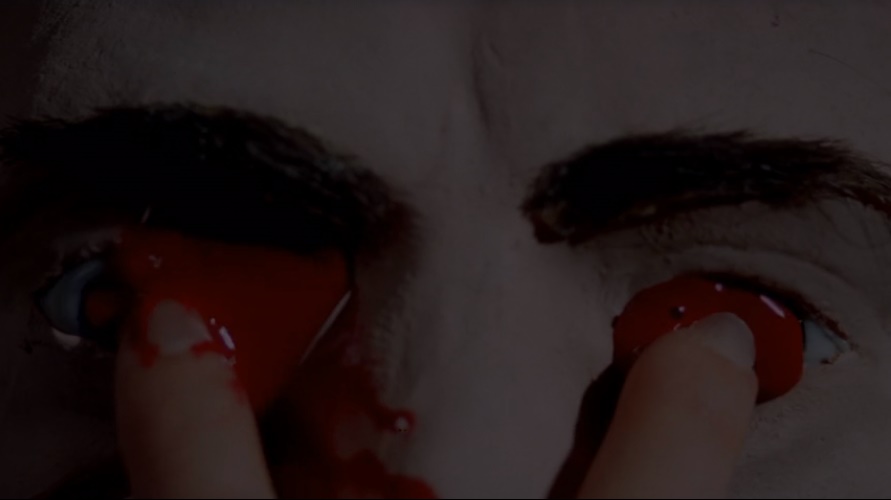
Three sleazy men are hired to find a place to dump some drums of chemical waste and choose a series of catacombs underneath an old home. Hey, it's dark, cold, forgotten and, while they're down there, they can do a little grave robbing. After cracking a couple of caskets and snatching a few pieces of jewelry off one corpse, a tremor and rock slide overturn one of the drums. Chemicals leak into the ground, fumes are released into the air and the amazing well preserved (consider she's been dead for two years!) corpse Catherine Valmont (Françoise Blanchard) is resurrected. After poking out the men's eyeballs and ripping out their throats, Catherine wanders above ground and makes her way to her former castle home, which is now in the process of being sold.



Even though she's a hot blonde, Catherine is basically a "creature" in the same spirit as the ghouls that usually populated 1930s creature features, believe it or not. She has a history and a tragedy about her and views her renewed life and bloodlust as a curse. In her teen years, Catherine was in love with her best friend Hélène. Whether that was platonic or romantic love and, if the latter, whether or not that was reciprocated love on both ends, is left unclear. The two close "friends" even made a blood pact that whomever of the two died first, the other would take their own life to join them. Of course, the now-grown Hélène (Marina Pierro), though heartbroken over her friend's passing several years earlier, did not hold down her end of the bargain and moved on with her life. Still, her heart has always remained with her late friend. That's why when she calls the castle to talk to Catherine's mother, unaware that she had recently passed away herself, and hears a familiar music box melody, she rushes to the castle.


Upon arriving, Hélène is greeted by the bloodied, nude corpses of both a Realtor (played by Patricia Besnard-Rousseau, who was also a hardcore porn actress under the name Patricia Bouvier) and the woman's lover. She then finds her bloody friend sitting nude playing the piano. You know, the same one who should be dead and buried. Inspecting the underground crypt, Hélène puts two and two together after discovering the corpses of the three slain grave robbers as well as Catherine's open casket. He beloved gal pal is actually a LiViNg DeAd GiRl! And like any good lover or friend, when you discover your amore has turned into a tormented vampire-zombie thingy with a thirst for blood, you're going to put them out of their misery as soon as possible, right? Right? Apparently not if you're Hélène, who cleans up the murder scene, hides the bodies and then offers up her own blood to Catherine.

Seeing how there's only so much blood in one human body, Hélène then tries to give her friend a dead bird to feast upon, but she refuses. Only human blood will suffice so the human half of the duo sets about procuring victims to satiate Catherine's blood hunger, starting with a motorist (Fanny Magier) who gets her guts ripped out after being lured into the crypt. Meanwhile, a couple consisting of American writer Greg (Mike Marshall) and his (English-speaking) French girlfriend Barbara (Carina Barone) are visiting the area. The dissatisfied Barbara wants to be an actress but has been roped into doing photography work by Greg, who - for some reason - is portrayed as being a complete douchebag. Barbara snaps a photo of Catherine wandering around in a field, becomes fascinated with her, discovers from locals that the girl in her photos died two years earlier and then sets about investigating the matter.


Can't say this film did anything to sell me on Rollin's rep as one of the genre's top visual artists. I've no clue why he even has that reputation in the first place to be perfectly honest! Like most of his other efforts I've seen, this is neither heavy on directorial flair nor visual imagination. Not that this looks bad or anything. It actually looks quite nice and is technically well-photographed (by Max Monteillet) and lit, plus benefits from good shooting locations and interior art direction. It's just that discernibly creative or artistic presentation of the material isn't something that just leaps out at you like it does with other notable horror stylists.


What is most surprising is that it takes the director almost 30 minutes before he gets around to squeezing in the first gratuitous nude scene. And, while there's ample nudity on display from there on out, it's incorporated into the film in a way where it never brings the story to a screeching halt like in many of his other films. While fairly amateurish (you can even see the tubes pumping out blood at one point!), the gore fx are adequately grisly and there are plenty of them. These were done by a 17-year-old Benoît Lestang, who'd move on to bigger films like The City of Lost Children (1995), Brotherhood of the Wolf (2001) and Martyrs (2008). Sadly, Lestang took his own life in 2008 at the age of just 43. Though the acting is highly variable, Blanchard (who starts out as a passive, aloof mute but eventually gains a more aggressive voice and presence) easily makes the strongest impression.


Though I've never even seen this pointed out before, LDG is actually a French / U.S. co-production produced by American Sam Selsky, who also appears in a cameo as a potential home buyer alongside another older lady who may have been his real-life wife. That probably explains why a number of the characters are American and also why a number of the actors also speak English. Supposedly, an entirely English-language version was simultaneously made by director Gregory Heller, who is only credited as a writer on the French version, but it was never released as is now presumed lost.


Despite the American connections and despite the fact his received a video release nearly everywhere else, the film completely bypassed the VHS era here and wasn't released until Image put it out on DVD in 1999. There has since been a number of other releases (including a Blu-ray) from companies like Redemption / Salvation and Kino Lorber.

★★1/2

Saturday, October 22, 2022

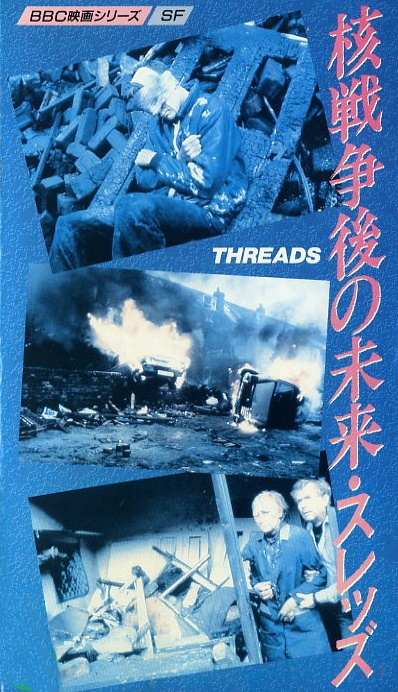
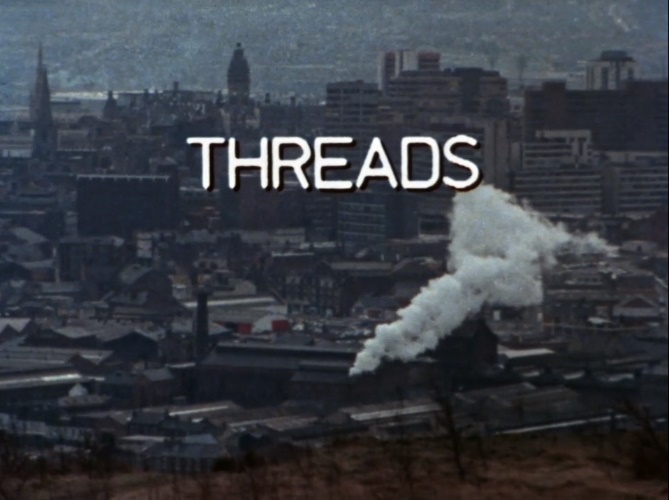
Threads (1984) (TV)

... aka: Catástrofe Nuclear (Nuclear Catastrophe)
... aka: Ertesi Gün-2 (Next Day 2)
... aka: Ipotesi sopravvivenza (Survival Hypothesis)
... aka: Threads by Barry Hines
... aka: Threads - Tag Null (Threads: Day Zero)

Directed by:
Mick Jackson

"In an urban society, everything connects. Each person's needs are fed by the skills of many others. Our lives are woven together in a fabric, but the connections that make it strong also make it vulnerable."

It's pretty interesting how nuclear technology (and the very real threat of nuclear war) has informed certain eras of genre cinema. Hell, we have hundreds of sci-fi / horror movies from the 1950s alone as a result. It's impossible to say just how many films since have involved atomic bombs, nuclear weapons, nuclear waste and / or nuclear radiation, but the numbers are pretty staggering. In the early 80s, international tensions and nuclear threats were on the rise again, and a handful of filmmakers decided that they wanted to say something about it, resulting in three major 'nuclear' films produced around the same time.

The first and most famous of these was the made-for-ABC-TV movie The Day After (1983) from director Nicholas Meyer. It set its action in Lawrence, Kansas, was heavily-promoted, widely-viewed here in America by over 100 million people when first broadcast (and still holds the record for most-watched TV movie ever) and ended up winning several Emmy Awards. The second film was the somber, quiet and extremely depressing Testament (1983), which centered primarily around the effects of nuclear fallout on a small town and presented the material in a more low-key fashion with no action, violence or special effects. Star Jane Alexander was rightfully awarded with an Oscar nomination for her performance. The third and final film was Threads (1984), which was written by Barry Hines and co-produced by the BBC (UK), Western World Television (USA) and the Nine Network (Australia). It went more the Day After route, but with even more graphic depictions of the wide-scale devastating effect of nuclear war. It's also by far the best and most potent of the three films.


Threads really puts into question what should and should not be considered a horror film. It's debatable either way and I fully understand where both sides are coming from. What tips the scale for me personally is evaluating a film's intent. Why exactly was it made? First, I'd say to be informative. Albeit sometimes speculative, it's clearly very well-researched per the information available at the time, with about as many doctors and scientists listed as program advisors in the end credits as there are actual crew members. It's also expansive in scope. Things begin months before the bombs are dropped and then we're shown how things pan out over the course of thirteen long years. Nearly every possible aspect and angle is covered. This goes beyond the immediate death and destruction caused by the blasts; touching upon future health, societal, psychological, physiological, agricultural, political and environmental concerns that many similar films neglect. But when all is said and done, this was made to scare the hell out of its audience to function as a rallying cry against nuclear armament, utilizing horror imagery to drive its message home.


In Sheffield, the fourth largest city in Britain, we're introduced to two average working-class families. Teenage daughter Ruth Beckett (Karen Meagher) has just found out she's unexpectedly pregnant by her boyfriend, Jimmy Kemp (Reece Dinsdale). The two decide to fast track marriage and moving in together, Ruth's parents (Henry Moxon, June Broughton) meet Jimmy's parents (David Brierly, Rita May) and the cycle of life and love play out as the young couple prepare for their future together. All this normality is undercut by international tensions; various countries (primarily the U.S. and the Soviet Union) are at each other's throats and a full-scale nuclear war appears to be on the horizon.


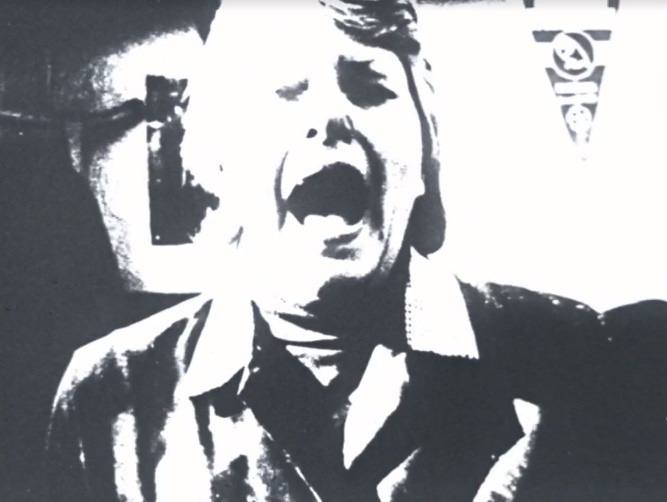
TV programs and newspapers attempt to keep the public informed, fighter jets regularly fly overhead and anti-war protesters fill the streets. As the threat seems like it will become a reality, the government half-heartedly advises the public on what to do, but how can one really prepare for something like this? Some citizens attempt to flee to the country, others stay and barricade their homes and all of the local stores are flooded with people, resulting in massive food, water, fuel and resource shortages. And then numerous bombs are dropped on Sheffield. Those not immediately killed by the explosions then have to face a whole host of other problems in a grim, bleak new world.


Neighborhoods are reduced to rubble, modern conveniences are a thing of the past, rats and stray dogs crawl around feasting on the charred, smoking corpses littering the streets and hospitals are packed with sick, injured, deranged and / or dying people without the resources to really help any of them. Nearly everyone is weak and hungry from lack of food, or radiation sickness from all the fallout. Dust lifted into the sky causes a constant overcast sky and temperatures to drop to freezing, claiming the lives of the very young, the very old and those already sick or injured.

Those who've lived past this point must simply fight for their own survival. Money means nothing. Food is everything. Most must become thieves and criminals. Primitivism is the norm. The best the government can do is post armed military men around to guard dwindling food stocks and divvy out resources to those willing (or able) to work, and taking it upon themselves to execute the looters or put them in detention camps. As for those unable to work, they're allowed a ration of food so small it can't possibly sustain their lives.


After the build up to and immediate aftermath of the nuclear holocaust, the events then begin to focus on the pregnant Ruth. With her boyfriend and family dead, she's reduced to stealing, gnawing on raw dead sheep meat, pimping herself out for dead rats and slaving away doing field labor for diminishing returns in order to carry her pregnancy and then raise her daughter (Victoria O'Keefe), who's born with clear developmental issues.

What's obvious from the outset is that the filmmakers are forced into a potentially hazardous place themselves due to budgetary restraints, which force them to employ cost-cutting measures at every possible turn. The material is presented as a partial documentary with both narration and text scrolls pointing out various facts and concerns. It also relies heavily on both stock footage and black-and-white stills. Given the motley narrative structure and visual presentation, it's quite remarkable just how well they managed to pull it all together. The grimy production design of filth and decay is very well-done, the extremely grainy photography is a major plus and the film is well-cast with talented yet little-known actors (lead Meagher is especially impressive) that don't inhibit the film's realism in the slightest.


Director Jackson eventually ended up in Hollywood where he'd direct big budget films like the Whitney Houston vehicle The Bodyguard (1992) and the corny disaster movie Volcano (1997) but he'd do much better on the small screen and win numerous awards for his work.

In the UK, Threads debuted September 1984 on BBC Two to high ratings. It was nominated for seven BAFTA Awards (winning four, including Best Single Drama) and was also well-serviced on home video and DVD there. Here in the U.S., it premiered on the TBS cable channel January 1985 (with a personal introduction by Ted Turner) and then was occasionally shown on PBS. It made its VHS debut through World Video in 1985 and laid dormant for awhile until renewed interest in the film prompted DVD and Blu-ray releases by Severin in 2018. The film has rocketed in popularity in recent years. On one hand that's nice to see because it's deserving of a large audience. On the other it's not considering said interest is largely due to renewed nuclear threats.

★★★★
Related Posts Plugin for WordPress, Blogger...