.
.
.

Sunday, September 20, 2020

Manden der tænkte ting (1969)

... aka: Czlowiek, który wymyslil zycie (The Man Who Invented Life)
... aka: Dr. Holst fantasztikus esete (Dr. Holst's Fantastic Case)
... aka: Mannen som tenkte ting (The Man Who Thought Things Through)
... aka: Man Who Thought Life, The
... aka: Mies joka pohtii elämää (The Man Who Reflects on Life)

Directed by:
Jens Ravn

Renowned brain surgeon and psychiatrist Dr. Max Holst (Preben Neergaard), who works at a state mental hospital and specializes in the central nervous system, receives a phone call from colleague Robert Klausen (Lars Lunøe). An older man was found wandering around a bridge and behaving like a madman so he was picked up by police and then involuntarily committed to the hospital. Robert informs Max that the man - who goes by the name of Steinmetz (John Price) - claims to know him and refuses to talk to anyone else other than him. The name doesn't ring a bell, but he assumes it's a patient from long ago that he's forgotten about. Upon arriving at the hospital, he realizes that's not the case. He has no clue who this man is.

Steinmetz has already broken hospital rules by sneaking in cigars and cognac (both forbidden there) but just how did he possibly sneak that stuff past the hospital staff? He claims that he's been following Max and his work for awhile but refuses to give any further details. And he claims to be perfectly sane and tries to coerce Max into signing his release; promising to show him "a new science" and "a world you could never even have dreamed of" if he helps. Dr. Holst instead decides to keep Steinmetz right where he's at until he can examine this man further.

Soon after, the bizarre patient manages to vanish from his room despite his door being locked and there being bars over the windows. Nothing seems to have been tampered with. The cigars and cognac which were taken away from him earlier are back on the table. A mysterious duplicate key that has to no reason to really exist is found hanging from the lock. A note is left behind for Max. Steinmetz urges him to meet him at a bridge at dusk. And to come alone. Max decides to take him up of the offer and finds Steinmetz waiting for him on the bridge with a chauffeured car.


During the ride, Steinmetz reveals that he knows all about Max, including when he was born, that he's an orphan, that he was part of the Resistance during his youth, that he studied in America and that he's divorced from his first wife, has no children and is now dating young actress Susanne Plesner (Lotte Tarp). Steinmetz takes him to his home, where he finally shows him some of what he was blathering on about in the hospital. Max sees with his own eyes how Steinmetz is able to create a box of cigars simply by concentrating and willing it to happen. In other words he has created a tangible object using only his mind.

However, the rational, stubborn Max is a little difficult to convince. He initially assumes Steinmetz is a hypnotist who has somehow put him in a trance. Steinmetz promises to prove otherwise, but on two conditions: One, he's never to tell anyone else about any of this. Two, he's to perform brain surgery on him. He's even "willed" himself the most high tech operating room imaginable, which is tucked away in his home; hidden behind a secret door in the wall. Max's refusal to cooperate soon has Steinmetz tossing niceties out the window ("You'll do what I tell you to!") but things will get much worse than Max ever could have imagined.


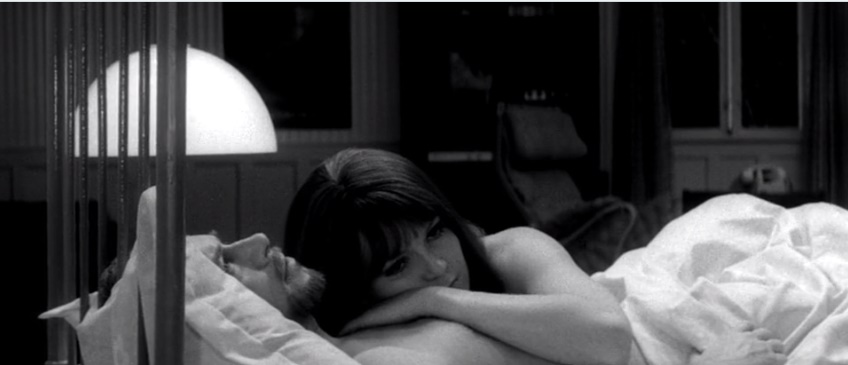


Steinmetz has managed to unlock parts of his brain that the rest of us cannot access. However, his ultimate goal is to be able to use his mind to produce organic matter; life itself. His sights are especially set on creating a human being. He's already managed to create three mice, but each of them has dissolved into thin air after a short while because he can't maintain the level of concentration necessary to keep them. Hence his desire for the surgery. Max remains resistant, prompting Steinmetz to start stalking him and using his powers to mess with both his mind and his memory, which starts to have a detrimental effect on his career, studies and relationships.

Steinmetz's approach to coercion is so abstruse yet so potentially devastating, Max has to no choice but to keep dealing with him on a continual basis. He arranges for him to get a new apartment, which gets Max out of his tiny hospital apartment, gets Susanne away from her nosy, bitchy landlady and finally allows them to live together. However, word keeps getting back to Max about things he's said, things he's done and interactions he's had with various people that he has no memory whatsoever of. As it turns out, Steinmetz is mind-creating a doppelgänger of Max to cause chaos and confusion in his life... and the copy is actually much more agreeable than the real thing! His "better half" if you will.


The double cashes his paychecks, takes his identification and belongings, does his job better, gives more passionate, persuasive speeches, starts wearing suits, puts on a more "respectable" clean-shaven face for the world at large and even has a healthier relationship with his girlfriend! Soon enough, everyone thinks he's the impostor and the double is him, which gets him arrested for "stealing" his own car. Max breaks out in time to crash the wedding reception only to realize that no one, not even his former lover, believes he is who he says he is. They prefer the new and improved Max. Steinmetz also informs him that he no longer needs his assistance as he's managed to sustain the length of his creations long enough to just have the double do the surgery. Max now finds himself without a job, money, a home, friends, a girlfriend... Will there be any way for him to get his life back again?


This was a Palme d'Or nominee at Cannes in 1969 and then fell into obscurity almost immediately afterward. So how in the hell does something this good just get swept under the rug and then forgotten? Doesn't anyone care? If I had to venture a guess I'd say this all boils down to the sci-fi and horror elements both being very understated and the absence of marketing gimmicks. It's simply easier to sell an audience special effects, fantastical creatures and more overt horrors than it is to woo them with technical proficiency and subtle psychological mindfuckery. There's no violence, no monsters, no elaborate visual effects (the only effect is a split screen used so Max and his double can share a single shot) and no overt shocks in this one.

Instead, we get an intriguing story that hooks you right from the start, an understated creepiness and superb direction, production design, lighting and grainy black-and-white photography. The art direction is purposeful, amazingly uncluttered and quite striking in its restraint. The architectural designs are very eye-catching throughout. Parallel lines, various geometric shapes and symmetry are all used creatively within shots to arresting effect. There's tasteful use of zoom shots (often pulling back from mirrors, windows and doorways) and blurred images plus lots of pans, tracking shots and gliding back and forth between people and things. From a visual standpoint, this maintains total interest throughout but it's also very interesting content-wise. There's plenty of food for thought in the strong, thought-provoking script plus excellent acting from the two male leads.


The cast also includes Kristen Rolffes (The Kingdom) and Elith Pio (Häxan). This was based on a 1938 novel of the same name by Valdemar Holst. The English-language title ("The Man Who Thought Life") seems more than a little bit awkward at first but makes perfect sense once you watch the entire film. Translations of the other European release titles give us slightly altered versions of that like "The Man Who Thought Things," "The Man Who Thought Things Through" and "The Man Who Pondered Life." There was a digitally remastered DVD release through Palladium Film.

★★★1/2

Saturday, September 19, 2020

Films by country: Denmark


DANISH HORROR [1950-1990]

When I think of Danish horror, the first film that pops into my mind is Häxan ▼ (1922; aka Witchcraft Through the Ages), one of my all-time favorite silent films. Controversial and frequently censored upon release, this atmospheric, inventively structured and meticulously made partial witchcraft documentary directed by Benjamin Christensen was way ahead-of-its-time and is still pretty dazzling and incredibly bizarre even by today's standards. Häxan is also noteworthy as the most expensive Nordic film of any genre made during the silent era. It wasn't long before Christensen was courted by Hollywood. He ended up directing seven films in the United States, including three horror movies: The Haunted House (1928), House of Horror (1929) and Seven Footprints to Satan (1929). All of those starred ill-fated actress Thelma Todd, whose death at the age of just 29 under bizarre circumstances became the stuff of Hollywood legend. Of Christensen's U.S. horrors, unfortunately only Footprints still exists. Warner Bros. even has a record of destroying their nitrate print of Haunted House back in 1948!


Mention also has to be made of Danish-born Carl Theodor Dreyer (below, left) despite the fact he only made a handful of genre films and most weren't even produced in Denmark. Though his The Passion of Joan of Arc (1928) is roundly heralded as the crown jewel of his filmography and is hardly ever absent from critics' "Top 100 of All Time" lists (often accompanied by his later Ordet [1955] and Gertrud [1964]), he also made a handful of memorable genre films. While his Leaves from Satan's Book (1920) and much more highly acclaimed witch hunt drama Day of Wrath (1943) both have their horror elements, his most noteworthy pure genre film is undoubtedly the nightmarish Vampyr (1932), which was a French / German co-production. Similarly, Dreyer's earliest horror film, The Parson's Widow, wasn't produced in Denmark, but was a Swedish production. That technically takes these films out of contention when discussing Danish horror, though I believe they should still at least be mentioned. That leaves Dreyer's De nåede færgen / "They Caught the Ferry" (1948), an 11 minute short, as his lone horror effort actually produced in Denmark.

During the silent era, short early versions of Dr. Jekyll and Mr. Hyde and The Picture of Dorian Gray (both 1910) were also made, but both are lost and probably gone forever. The earliest surviving film with genre elements appears to be Hævnens Nat / Blind Justice (1916), another of Benjamin Christensen's (below, right) films. And if you're noticing that I'm spending a little more time here than usual discussing pre-1950 films that's because from 1950 up to 1990, very little of note genre-wise was produced in the country.


America Sidney W. Pink, who had helped kick start the brief 1950s 3-D revival as one of the producers of the jungle adventure Bwana Devil, returned in the 1960s to direct two genre films in Denmark. Neither of these were of much count. There was Reptilicus (1961), Denmark's first (and still only?) giant monster movie and a later target of ridicule, and then Journey to the Seventh Planet (1962), a mediocre sci-fi film about an alien brain on Uranus causing problems for American astronaut John Agar and a host of badly-dubbed Danish supporting players. Two versions of the former were even filmed; one in Danish credited to director Paol Bang and a second English version credited to Pink. Both of these were well-distributed throughout the world and probably made money but they were ripped apart by critics.

Just a few years after Pink's twin terrors were released, sex films started to dominate Denmark's film industry thanks to the huge international success of films like Mac Ahlberg's I, a Woman (1965). After a spate of soft-core titles, Denmark would then become the very first country to legalize hardcore pornography in 1969, which quickly turned it into the porn epicenter of the world. The incredibly sleazy (and incredibly entertaining!) The Sinister Dwarf was, fittingly enough, one of the only genre films produced while the porn craze was at its height and even had hardcore inserts added to it later on. The other notable film from this period was Whirlpool (1970); the debut of Spanish director José Ramón Larraz, which had British, Danish and American producers and, just like Dwarf, was filmed in the UK. Hitting right at the beginning of the hardcore takeover was Jens Ravn's beautifully-made Manden der tænkte ting / "The Man Who Thought Life," a surprisingly subtle, thoughtful and restrained sci-fi / horror tale that was a Palme d'Or nominee at Cannes.


The only Danish genre films to really make much of a dent in the 80s were both from Lars von Trier: the stylish serial killer film The Element of Crime (1984) ▼, another Cannes favorite and a Best Film winner for several of its countries top awards, and the very polarizing Epidemic (1988), which, to some, was an indictment of how Denmark's film industry was controlled and corrupted by the Danish Film Institute. Von Trier and his back-to-basics Dogme 95 collective (artists being artists! natural lighting!) was supposedly formed as a revolt against the DFI-dominated system. Lars would go on to an internationally acclaimed career sporadically returning to horror with films like Antichrist (2009), which incorporated strong gore and even hardcore sex and was another Cannes hit, and The House That Jack Built (2018).


Ole Bornedal's Nattevagten / "Nightwatch" (1994), which was popular enough to spawn a U.S. remake just a few years after its release, was a highlight of the 90s. Denmark has become far more prolific in the horror genre in the last decade, particularly as a co-producer on recent films like The Neon Demon (2016), Thelma (2017) and Vivarium (2019).


__________________________________________________


1950s

- Eaten Horizons (Spiste horisonter) (1950; Wilhelm Freddie, Jørgen Roos) [short]


1960s


- Journey to the Seventh Planet (1961; Sidney W. Pink) [co-USA]
- Reptilicus (1961; Poul Bang, Sidney W. Pink) ▲

- Trip in the Night (Tur i natten) (1968; Ole Roos) [short]

- Man Who Thought Life, The (Manden der tænkte ting) (1969; Jens Ravn) ▼


1970s

- Whirlpool (1970; José Ramón Larraz) [co-UK, USA]

- Sinful Dwarf, The (Dværgen) (1973; Eduardo Fuller) ▼

- Ghost Train (Spøgelsestoget) (1976; Bent Christensen)


1980s

- Time of the Wolf (Ulvetid; Vargtid; Wolf Hour) (1981; Jens Ravn) ▼

- Parallel Corpse, The (Det parallelle lig) (1982; Søren Melson, Hans-Erik Philip)

- Trapped at Boarding School (Attrap-1980) (1983; Heini Grünbaum) [short]

- Element of Crime, The (Forbrydelsens element) (1984; Lars von Trier)

- Epidemic (1987; Lars von Trier)

- Baby Doll (1988; Jon Bang Carlsen)

- Hov! (Famous Last Words) (1989; Knud Vesterskov) [short]

- Widow, The (Enken) (1990; Nicolas Barbano)


__________________________________________________


TOTAL FILMS:
16

NOTES:
-

___________________________________________________


Anything to add? Drop me a note down below.

Friday, September 18, 2020

Films by country: Finland


FINNISH HORROR [1950 - 1990]

A Wiki page dedicated to Finnish horror has an index containing six titles, only two of which were made before 1990. IMDb does a little better job, turning up six pre-1990 feature films and two TV movies. Poking around I was able to turn up a few more for a grand total of ten films made between 1950 and 1990. 

Tracing back Finnish horror to its roots, we first have to go all the way back to 1927 with the silent Noidan kirot (“Curses of the Witch”) from pioneering director Teuvo Puro. Puro had previously made 1907's Salaviinanpolttajat / "The Moonshiners"; a 20-minute comedy short that was also Finland's very first feature film, as well as Sylvi (1913), which was Finland's first full-length feature film. While his lone genre effort is widely considered the first Finnish horror by historians, a previous 1923 fantasy film, Rautakylän vanha parooni (“The Old Iron Baron of the Village”), is sometimes also considered. These were also the only genre films out of Finland for awhile. There wouldn't be another until the ghost film Linnaisten vihreä kamari ("The Green Chamber of Linnais") two decades later.


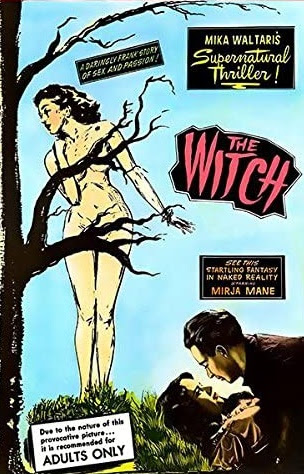
Moving on to 1952 we have a pair of horror films. First and foremost is the brilliantly-shot and wonderfully Nordic The White Reindeer, which is filled with dark imagery that practically leaps off the screen since it's set against a snowy white backdrop and became an unlikely cross-over success that won the Best Foreign Language Film Golden Globe and a major award at Cannes. And then there was Noita palaa elämään (aka The Witch, or Return of the Witch) which may have been less artistically accomplished but was still adequately atmospheric. It was also a hot export due to its sexually frank nature and the fact it contained numerous nude scenes from its female star, which eventually got this booked in U.S. theaters as an "adults only" skin flick (center image below) with the tagline "See this startling fantasy in naked reality!" I'm forever grateful that this pair of films exist because 1952 is, globally, pretty slim on horror films otherwise. Two years later there was a ghost comedy (Kummitus kievari / “Ghost Tavern”) and then... barely anything... for decades. In fact, the countries entire film industry hit a slump for awhile. Many blame the rising popularity of TV for this dry spell.


It wouldn't be until the mid-80s that a few other genre features emerged. The Finnish commercial TV network Mainostelevisio made the ghost tale Yöjuttu: Merkitty (1984) and the four-part miniseries Painajainen / "Nightmare" (1988), which involves an amnesiac uncovering horrifying secrets about his life. The same year as the latter came the theatrical release The Moonlight Sonata from Olli Soinio, which is highly derivative of American slasher movies (most notably The Texas Chainsaw Massacre) and unfortunately filled with forced camp comedy. Soinio had previously made the 23-minute short Transvestijan tarinoita ("Tales of Transvestia"), a monster movie parody, which is thus far the only Finnish horror from the 1970s I've been able to unearth. 

There were around a half dozen 90s releases, including Soinio's Sonata sequel Kuutamosonaatti 2: Kadunlakaisijat (1991), which was called Army of Zombies in the U.S. and Germany. More recently, well-received genre films like Sauna (2008), Rare Exports: A Christmas Tale (2010) and Euthanizer (2017) make the occasional ripple, though The White Reindeer remains the major highlight here.

__________________________________________________


1950s


- White Reindeer, The (Valkoinen peura) (1952; Erik Blomberg) ▲
- Witch, The (Noita palaa elämään) (1952; Roland af Hällström)

- Ghost Tavern (Kummitus kievari) (1954; Lasse Pöysti)


1960s

- Galgmannen (Gallows; Hirsipuumies) (1961; Carl Mesterton) [TV]


1970s

- Tales of Transvestia (Transvestijan tarinoita) (1975; Olli Soinio) [short]


1980s

- MP - I'm Afraid (MP - Minä pelkään) (1982; Pekka Hyytiäinen)

- Marked (Merkitty; Yöjuttu: Merkitty) (1984; Ismo Sajakorpi) [TV]

- Folk Artist (Kansantaiteilija) (1986; Risto Rumpunen [short]

- Moonlight Sonata, The (Kuutamosonaatti) (1988; Olli Soinio) ▼
- Nightmare (Painajainen) (1988; Ismo Sajakorpi) [4 part TV miniseries]


TOTAL FILMS:
10

NOTES:
- Galgmannen is based on a(n apparently popular) play by Finnish writer Runar Schildt. There were two other adaptations made in Sweden; a theatrical release in 1945 and a TV movie in 1969, as well as a Norwegian TV version in 1983.
- Seitsemän hirtetyn tarina / "The Seven Who Were Hanged" (1982) - Possible psychological horror. Made for Finnish television. Directed by Jarmo Nieminen.

__________________________________________________


Got any more for the list? Let me know below.
Related Posts Plugin for WordPress, Blogger...