.
.
.
Showing posts with label doppelgänger. Show all posts

Sunday, March 17, 2024

Medium (1985)

... aka: Ling yu an jian (Supernatural Cases)
... aka: Mediet
... aka: Медиум
... aka: Mysteria replica di un omicidio (Mystery - Replica of a Crime)
... aka: Un misterio llamado Aleksander Orwicz (A Mystery Called Aleksander Orwicz)

Directed by:
Jacek Koprowicz

Setting: 1933, Nazi-occupied Poland. Greta Wagner (Ewa Dałkowska), the powerful psychic sister of veteran parapsychologist / occultist Ernst (Jerzy Nowak), tunes into strange visions that are actually the current activities of another unknown medium. The medium is using his or her powers to control four different people, entrancing them and leading them all somewhere to do different tasks. Andrzej Gaszewski (Jerzy Zelnik) travels from Warsaw to the autonomous city-state Sopot / Gdańsk via train and has no idea how he even got there, but vows not to leave until he finds out. Schoolteacher Luiza Skubiejska (Grażyna Szapołowska) walks right out on her students mid-class, goes to a museum, steals a turn-of-the-century dress and then ends up in a park with no clue how she got there or why she has the dress. She then immediately returns the garment to the museum. Since this hasn't been the first time this has ever happened, she's on the radar of the police and could potentially lose her job. Likewise, out-of-town banker Georg Netz (Jerzy Stuhr) keeps waking up in a strange house, despite the fact he's simultaneously paying for a hotel room in town. He has no idea how he got there, why he's there or why he's been writing gloomy lovelorn poetry while entranced.


Superintendent Selin (Władysław Kowalski) is not only in charge of investigating the above weirdness but also happens to be directly involved. Every night after work, he mysteriously ends up on a beach, where he gets drunk and goes to sleep. When morning comes he doesn't remember the evening before and then turns up at the office every day unbathed, unshaven and reeking of alcohol. His young assistant Krank (Michał Bajor) is something of a sadist who worships Hitler ("it's logical to side with the stronger," he claims) and is conspiring against Selin behind his back. He secretly goes to their higher-ups to report the superintendent's bizarre behavior but they refuse to fire him for it. At least for now.

The strange home that appears to be the centerpiece of the action belongs to a Polish man named Aleksander Orwicz, who suffers from diabetes and is later found in a diabetic coma. While in his hypnotized state, Georg had been showing up there to give him shots of insulin and claims there was another guy present at the time... a guy who looks suspiciously like Selin.


Everything links back to a love triangle (square?) gone wrong that occurred in the same house 36 years earlier. In the late 1890s, extremely rich forty-something banker Stefan Orwicz married beautiful 22-year-old Zofia. He built her a luxurious Italian-style home and the two soon welcomed a son named Aleksander. Things then took a turn for the worst when Stefan went blind due to his diabetes. A live-in doctor named Malicki moved into the home to care for him full time. Soon after, he and Zofia began an affair. That arrangement would soon came to a bloody end when Wiktor Arlt, Stefan's hunchbacked secretary and personal assistant, went crazy and murdered all three of them with an axe. See, he too was in love with Zofia, and would often write her poems about how grueling his unrequited love for her was. After the murders, Wiktor committed suicide, and history may very well repeat itself in the present day unless our heroes can stop it.


This is often cited as one of the best Polish genre offerings from this time, which very well may be true. That's not an endorsement of its quality so much as it is the simple fact that not many horror films were produced in Poland in the 80s and two of those were THE SHE-WOLF (1983) and I LIKE BATS (1986). Some of their other genre films from this time sound promising so this may even end up on the lower half of the scale for me by the time I see the rest. Nevertheless, being slightly better than the two middling films mentioned above doesn't mean Medium is inspiring or noteworthy itself. It's not. Things open well and the intrigue is maintained until about the midway point. That, combined with the competent directing, acting and production values, keep everything watchable even after it starts becoming something of a mess. The true undoing of the film is that it's never able to make its myriad plot threads work together harmoniously.

Slow and talky most of the time, this attempts to dress up its average mystery plot with various needless complications. The script makes room for psychic powers, doppelgangers, leech treatments, telekinesis, spontaneous combustion, human lives linked to sea turtles (?), immortality, physical regression to childhood, horoscopes that combine astrology and math (birth dates and times) to predict the exact time and day of death and a solar eclipse that's somehow needed to bring the bad guy's plot together. Why? You got me! There are a LOT of ideas crammed in here; too many, and this doesn't do an adequate job explaining most of them. The overcast cinematography, funeral pacing, lack of personable characters and humor and Nazi era setting also gave me bad flashbacks to Luca Guadagnino's tedious SUSPIRIA remake from a few years back.


Stripped down to its bones, what this really is is a rehash of the mediocre Aussie film PATRICK (1978), which was a big hit in much of Europe a few years earlier. Both involve a coma patient who's fully conscious inside their unresponsive body and using their telekinetic abilities to strike out against others. There a number of other similarities between it and this one, only this opts to gum up the works with numerous ill-explained supernatural detours.


Outside of its home country, this was given a theatrical and VHS release (on the Penta Video label) in Italy under the title Mysteria replica di un omicidio ("Mystery: Replica of a Crime"), but that appears to be it as far as 80s international distribution was concerned . A West German co-production, it may have also played in some other European cinemas, or on TV, as well. It's now pretty easy to find with English subtitles and is on Youtube, Daily Motion and other websites free to view, and was even available on Netflix for a spell, though I don't know if it's still there or not. Studio Filmowe Tor / Studio Blu offer region free Blu-ray and DVD versions with English subs.

★★

Sunday, September 20, 2020

Manden der tænkte ting (1969)

... aka: Czlowiek, który wymyslil zycie (The Man Who Invented Life)
... aka: Dr. Holst fantasztikus esete (Dr. Holst's Fantastic Case)
... aka: Mannen som tenkte ting (The Man Who Thought Things Through)
... aka: Man Who Thought Life, The
... aka: Mies joka pohtii elämää (The Man Who Reflects on Life)

Directed by:
Jens Ravn

Renowned brain surgeon and psychiatrist Dr. Max Holst (Preben Neergaard), who works at a state mental hospital and specializes in the central nervous system, receives a phone call from colleague Robert Klausen (Lars Lunøe). An older man was found wandering around a bridge and behaving like a madman so he was picked up by police and then involuntarily committed to the hospital. Robert informs Max that the man - who goes by the name of Steinmetz (John Price) - claims to know him and refuses to talk to anyone else other than him. The name doesn't ring a bell, but he assumes it's a patient from long ago that he's forgotten about. Upon arriving at the hospital, he realizes that's not the case. He has no clue who this man is.

Steinmetz has already broken hospital rules by sneaking in cigars and cognac (both forbidden there) but just how did he possibly sneak that stuff past the hospital staff? He claims that he's been following Max and his work for awhile but refuses to give any further details. And he claims to be perfectly sane and tries to coerce Max into signing his release; promising to show him "a new science" and "a world you could never even have dreamed of" if he helps. Dr. Holst instead decides to keep Steinmetz right where he's at until he can examine this man further.

Soon after, the bizarre patient manages to vanish from his room despite his door being locked and there being bars over the windows. Nothing seems to have been tampered with. The cigars and cognac which were taken away from him earlier are back on the table. A mysterious duplicate key that has to no reason to really exist is found hanging from the lock. A note is left behind for Max. Steinmetz urges him to meet him at a bridge at dusk. And to come alone. Max decides to take him up of the offer and finds Steinmetz waiting for him on the bridge with a chauffeured car.


During the ride, Steinmetz reveals that he knows all about Max, including when he was born, that he's an orphan, that he was part of the Resistance during his youth, that he studied in America and that he's divorced from his first wife, has no children and is now dating young actress Susanne Plesner (Lotte Tarp). Steinmetz takes him to his home, where he finally shows him some of what he was blathering on about in the hospital. Max sees with his own eyes how Steinmetz is able to create a box of cigars simply by concentrating and willing it to happen. In other words he has created a tangible object using only his mind.

However, the rational, stubborn Max is a little difficult to convince. He initially assumes Steinmetz is a hypnotist who has somehow put him in a trance. Steinmetz promises to prove otherwise, but on two conditions: One, he's never to tell anyone else about any of this. Two, he's to perform brain surgery on him. He's even "willed" himself the most high tech operating room imaginable, which is tucked away in his home; hidden behind a secret door in the wall. Max's refusal to cooperate soon has Steinmetz tossing niceties out the window ("You'll do what I tell you to!") but things will get much worse than Max ever could have imagined.


Steinmetz has managed to unlock parts of his brain that the rest of us cannot access. However, his ultimate goal is to be able to use his mind to produce organic matter; life itself. His sights are especially set on creating a human being. He's already managed to create three mice, but each of them has dissolved into thin air after a short while because he can't maintain the level of concentration necessary to keep them. Hence his desire for the surgery. Max remains resistant, prompting Steinmetz to start stalking him and using his powers to mess with both his mind and his memory, which starts to have a detrimental effect on his career, studies and relationships.

Steinmetz's approach to coercion is so abstruse yet so potentially devastating, Max has to no choice but to keep dealing with him on a continual basis. He arranges for him to get a new apartment, which gets Max out of his tiny hospital apartment, gets Susanne away from her nosy, bitchy landlady and finally allows them to live together. However, word keeps getting back to Max about things he's said, things he's done and interactions he's had with various people that he has no memory whatsoever of. As it turns out, Steinmetz is mind-creating a doppelgänger of Max to cause chaos and confusion in his life... and the copy is actually much more agreeable than the real thing! His "better half" if you will.


The double cashes his paychecks, takes his identification and belongings, does his job better, gives more passionate, persuasive speeches, starts wearing suits, puts on a more "respectable" clean-shaven face for the world at large and even has a healthier relationship with his girlfriend! Soon enough, everyone thinks he's the impostor and the double is him, which gets him arrested for "stealing" his own car. Max breaks out in time to crash the wedding reception only to realize that no one, not even his former lover, believes he is who he says he is. They prefer the new and improved Max. Steinmetz also informs him that he no longer needs his assistance as he's managed to sustain the length of his creations long enough to just have the double do the surgery. Max now finds himself without a job, money, a home, friends, a girlfriend... Will there be any way for him to get his life back again?


This was a Palme d'Or nominee at Cannes in 1969 and then fell into obscurity almost immediately afterward. So how in the hell does something this good just get swept under the rug and then forgotten? Doesn't anyone care? If I had to venture a guess I'd say this all boils down to the sci-fi and horror elements both being very understated and the absence of marketing gimmicks. It's simply easier to sell an audience special effects, fantastical creatures and more overt horrors than it is to woo them with technical proficiency and subtle psychological mindfuckery. There's no violence, no monsters, no elaborate visual effects (the only effect is a split screen used so Max and his double can share a single shot) and no overt shocks in this one.

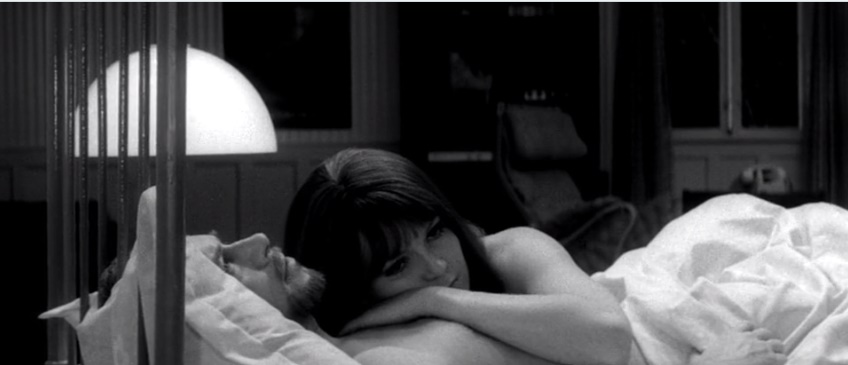
Instead, we get an intriguing story that hooks you right from the start, an understated creepiness and superb direction, production design, lighting and grainy black-and-white photography. The art direction is purposeful, amazingly uncluttered and quite striking in its restraint. The architectural designs are very eye-catching throughout. Parallel lines, various geometric shapes and symmetry are all used creatively within shots to arresting effect. There's tasteful use of zoom shots (often pulling back from mirrors, windows and doorways) and blurred images plus lots of pans, tracking shots and gliding back and forth between people and things. From a visual standpoint, this maintains total interest throughout but it's also very interesting content-wise. There's plenty of food for thought in the strong, thought-provoking script plus excellent acting from the two male leads.


The cast also includes Kristen Rolffes (The Kingdom) and Elith Pio (Häxan). This was based on a 1938 novel of the same name by Valdemar Holst. The English-language title ("The Man Who Thought Life") seems more than a little bit awkward at first but makes perfect sense once you watch the entire film. Translations of the other European release titles give us slightly altered versions of that like "The Man Who Thought Things," "The Man Who Thought Things Through" and "The Man Who Pondered Life." There was a digitally remastered DVD release through Palladium Film.

★★★1/2
Related Posts Plugin for WordPress, Blogger...