.
.
.

Saturday, April 2, 2016

Dark Romances, Vol. 1: Born Evil (1990)

... aka: Dark Romances
... aka: Dark Romances: "Born Evil"
... aka: Dark Romances Vol. 1

Directed by:
Mark Shepard

It's the winter of 1888 at the Charenton Asylum for the Insane, just outside of Paris. Some madwoman is in possession of a black box that she claims can unleash evil unto the world. Some man wants to take it from her, so she explains why he shouldn't in our first tale “The Black Veil,” based on a story called The Seventh Door by John Strysik and Patricia Miller. Unlike most shorts in anthology features, this isn't a short at all but a full-blown feature film clocking in at 75 minutes. Young, naive and well-bred Meg Hexley (Elizabeth Morehead) goes to Paris to settle the affairs / estate of her late husband, a psychiatrist mentored by none other than Freud himself. While in town, she hooks up with former college friend Justine (Julie Carlson), who's now working as an actress at the famed Theatre du Grand Guignol, run out of an abandoned cathedral. There she bears witness to music, blood, death, whipping, torture, breasts and images from George Melies' silent films (including A Trip to the Moon) projected onto the walls. She also meets some of Justine's acting company, like creepy mime Demetrius (Robert Rothman), the strikingly beautiful but strange and distant Diana (Brinke Stevens) and a female pinhead who merrily stirs up all the stage blood in a pot. Meg wonders how her friend has managed to go from one of the most expensive and exclusive girl's schools in Europe to this kind of life.


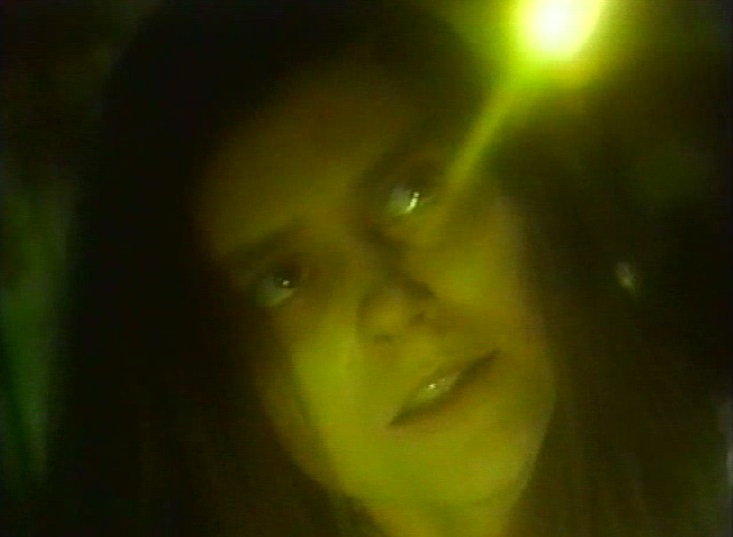

Justine is crippled with headaches, hooked on a booze and opium cocktail, living in poverty in a run-down building with some of her fellow actresses and obsessed with sick and twisted thoughts. Fearing for her friend's life, Meg goes and fetches a black box belonging to her late husband. Inside is a “hypnosis device,” which she's hoping will draw back “the black veil” clouding over her friend. The device, a spinning wheel placed in front of a candle, is used to put Justine under. She's then asked to go to “the hiding place” in her mind and is soon revealing things like seeing a singer being skinned alive... and enjoying watching it. Further sessions reveal a dark family history involving an adulterous forger of a father who frequently visited prostitutes and sold children into prostitution and slavery, a drug addict and rapist of a brother and a crazy, murderous mother who eventually had to be hauled off in a straight jacket. Justine's past pretty much is the Grand Guignol.


The treatments may uncover some things about what makes Justine tick, but they don't stop the blood lust nor the madness. During the next show, she really slashes Demetrius' throat in front of a live audience and then coerces a hysterical Meg into drinking one of her opium drinks, which results in a trip out and lesbian sex. Diana comes back into the picture to lure Meg out of bed and to some blood ceremony she and her female followers are conducting. They slice open Meg's hand and she bleeds all over some lump of Playdough that (I think) is supposed to be a heart or brain. She returns to Justine and is instructed to crack open the heart / brain thingy and then there's a long and rapidly-edited montage of green smoke, lightning bolts, flashing lights, a slimy puppet monster and shots of Stevens brandishing vampire teeth and looking sultry as she captures Justine's “essence” in a little jar. Does any of this make sense? Well, kind of.


Giving credit where credit is due, this is extremely ambitious for a SOV film and is perhaps the most ambitious film of this type that I've seen from this era. There's an attempt at a period setting with appropriate costumes, props and sets clearly constructed just for the film, plus actors actually trying to do accents (note I said trying) and give decent performances. Some of the actors (namely Carlson, Rothman and Stevens, the only known performer in this cast) are actually pretty decent in their roles. The lighting is extremely stylized and colorful and there doesn't seem to be a single frame that isn't doused in blue, red, purple, green and / or yellow light. That said, the video format simply does not work all that well with this particular approach. The low key lighting on tape just doesn't look like it does on film, resulting in murky clarity and shots that are often blurry and difficult to make out. The shots themselves are frequently amateurish, with few establishing, wide or even medium shots used; just lots of in-your-face close-ups. Even worse, this entire thing is edited like a music video and the constant flash cuts are not only excessive but also extremely irritating at times. When this all works, certain moments look striking, but it's mostly just annoyingly flashy and “artistic” to make up for a slim story that's needlessly drawn out to the point of tedium.


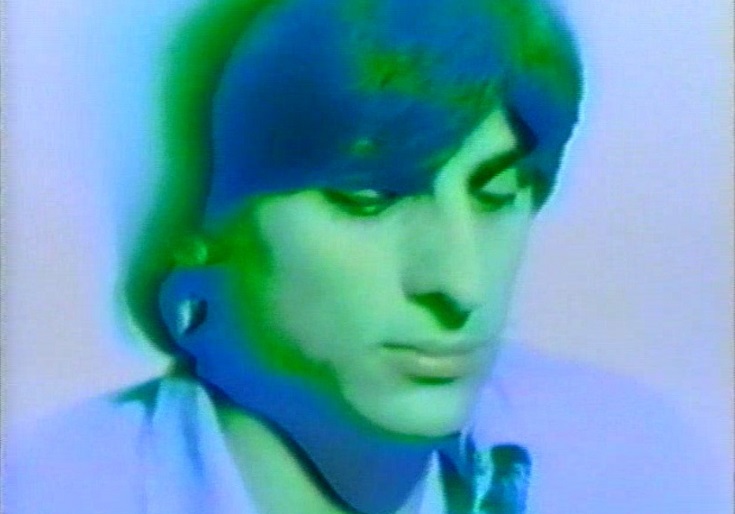


Our second story, titled “Listen to Midnight,” starts with a quote from JFK's diary and is set in modern day Los Angeles, where alcoholic, suicidal, misogynistic (“Women are all pushovers.”), dragonfly-obsessed photographer Tod (Ron Roleck) narrates his own boring little story. After having a lengthy nightmare where he's mocked by a snobby model (Stevens again, who also plays the role of a radio DJ later on) and a man in sunglasses (Michael Sonye), who eventually smash him into a wall with their car, he wakes up to a bitchy, pill-popping model in his bed chewing him out for waking her up. Such is the life of Tod. After an argument over some pictures he owes her of their sexual tryst, he calls her out for being a “lousy lay” and she retorts that his love making skills merely “made the Earth budge” on her way out the door. Tod claims he drinks because of all the nightmares he keeps having. That and having to shoot “annoying little cockroaches” (children) just to make ends meet.


Deciding to end it all, Tod puts a pistol in his mouth and pulls the trigger but the chamber is empty. He then hits the streets with his camera looking for bullets and snapping pictures of whatever interests him along the way. A convenience store doesn't have what he's looking for but a strange woman with long fingernails and dressed in a black veil reminds him that “The sleep of reason breeds monsters” in between munching on Twinkies and Bubble Yum. He sees a bum (Larry Hankin) drinking Drain-O and then steps into a bar for a drink where Carol (Dawn Wildsmith), an ex-girlfriend he screwed over, lays into him. He talks to the bartender about all of the other ladies he's humped and dumped, meets a new wave-looking, multi-pierced bimbo named Ginger (Anita Coleito) and takes her home, thinking she'll be an easy lay. He turns out to be correct, but it all ends up being a little messier than he was probably expecting.


Like the first story, this has continual colorful pseudo-arty lighting and pseudo-surreal direction and is flash-edited within an inch of its miserable life. As a result, this 30-minute tale is a real chore to sit through. The story is both depressing and uninteresting and the lead character is such a self-absorbed, irritating piece of shit, viewing this is more excruciating than entertaining. If I ranked the two stories separately, the first would get 2 stars and this would get 1. In other words, had “The Black Veil” been released independently and not dragged down by this other useless story, it would have fared a little better in my overall ranking.


Dark Romances (which has a 1989 copyright date, though some sources claim filming actually began as far back as 1986) was first issued on VHS by Film Threat, who offered both it and its sequel; Dark Romances, Vol. 2: Bleeding Hearts (1990), together on one set. The box contained positive blurbs from the likes of Clive Barker, Stephen King, Forrest J. Ackerman and Variety. Afterward, in the late 90s, it was reissued on the Salt City Home Video label. And after that, well, there was no after that. That was it. I wouldn't hold my breath expecting a DVD release for this one either.

★1/2

Friday, April 1, 2016

El hombre sin rostro (1950)

... aka: Faceless Man, The
... aka: L'uomo senza volto (The Man Without a Face)
... aka: Man Without a Face, The

Directed by:
Juan Bustillo Oro

How many horror films made in 1950 (not the entire decade, just the year 1950) have you seen? If you asked me a few years ago, I'd have said none. If you asked me now, I'd say “Well I've seen a few sci-fi flicks and a few psychodramas with minor horror elements. Do those count?” As far as my Top 5 for 1950 is concerned, they do count or else I wouldn't even have a Top 5. After all, there were just a tiny number of horror films made this year (less than 10) and nearly all of them are M.I.A. In Hong Kong, there was Wui Ng's Gui wu (aka The Haunted House), but no known copies appear to be around. From the Philippines, there was Gerardo de Leon's award-winning Kamay ni Satanas but, again, the film is not available anywhere to view and may be missing forever. There were (supposedly) three TV movies made in the UK, including Spring-Heeled Jack (a live broadcast of a theatrical performance starring Tod Slaughter), the possession comedy The Poltergeist (a remake of 1948's Things Happen at Night) and the oft-filmed The Strange Case of Dr. Jekyll and Mr. Hyde; none of which can be found and are likely gone forever. Actually, those three titles may not have ever existed and someone may have just made them up for all I know. 

IMDb lists Ida Lupino's OUTRAGE as horror and used to list Fritz Lang's HOUSE BY THE RIVER as horror, as well. Including those, a few science fiction films (like ROCKETSHIP X-M) and the dull ghost-with-a-big-hat Guatemalan flick EL SOMBRERON finally got me to 5. Needless to say, I was happy to finally get my hands on an copy of El hombre sin rostro (“The Man Without a Face” or “The Faceless Man” as the subs refer to it) in hopes I'd finally get a more pure genre film to carry the horror flag for this particular year. This not only accomplishes that goal, but it turned out much better than I thought it would be.


Things begin with an amazing little shadowy pre-credit prologue that seems like it could have been filmed in 1920s Germany. In it, Juan Carlos Lozano (Arturo de Córdova) has visions of a funeral procession that he views sitting alone at a park bench. The dead are victims of an unknown psycho killer. His mother (Matilde Palou) walks up to him to chastise him and tells him he needs to hunt down the killer and murder him with his bare hands. Juan Carlos then finds the killer standing on a street corner and approaches him only to discover that the man has no face. Filmed on minimalist, sparse sets with just a few trees, the bench and street lights against a plain backdrop, plus plenty of fog, these shots are extremely striking and cool-looking. This same approach will later be used several more times to represent Juan Carlos' dream world; his subconscious. We next meet up with Dr. Eugenio Britel (Miguel Ángel Ferriz), who makes it home in a daze, goes to his desk, pulls out a gun and contemplates suicide because he claims he's a murderer, prompting a flashback to how he got into this state to begin with.


In Guadalajara, a man in a hat and trench coat is going around murdering hookers and other women with a scalpel; showing no class or age distinction between his victims. Like Jack the Ripper before him, he's “a beast with surgical precision” and knows just what he's doing when it comes to cutting up corpses. Heading up the police investigation the past few months, Juan Carlos is getting hell from both his superior and the press for not being able to catch "The Mutilator." When he attempts to resign from his job and let someone else take over the case, his boss tells him he's a coward but wants him to continue on. Juan Carlos confides in Dr. Eugenio that he's sure the killer is mutilating the victims specifically to get under his skin and try to break him. A “pathological fear of failure” has always crippled Juan Carlos' life. He was once on the verge of graduating with his medical degree but backed out right before graduation... and now he's about to quit something else. Eugenio's pep talk gets Juan Carlos motivated to solve the case again, but the doctor may have more sinister designs about “the lousy life of this loser” and anxiously awaits how he'll react to the next murder.


Intrigued with the prospect of getting involved in the investigation, Eugenio accompanies Juan Carlos to a seedy nightclub, where all of the lust, vice and “dirty music” makes Juan Carlos feel, well, dirty. He explodes in a rage when he spots a dancing couple kissing and jumps in, smacking the girl in the face and punching the guy out. Feeling like he's losing his mind, Juan begs Eugenio to help save his soul, but the doctor warns it will require courage to reach the darkest parts of his conscience and confront his inner demons. Juan Carlos then describes his dreams and we're back in the dream world, this time with a bunch of asexual statues, a chained-up monster (Wolf Ruvinskis) that's unleashed and, of course, the ever-present figures of the mocking mother and the faceless man.


This leads to a flashback to Juan Carlos' younger years when he falls in love with orphaned adopted sister Ana Maria (Carmen Molina). Ana Maria wants to postpone their upcoming wedding because the mother is extremely smothering, possessive and protective of her son, thinking he belongs only to her. The domineering mother uses every guilt trip tactic in her arsenal to split the two up, including fainting and pretending to be on her death bed so he'll develop hate for Ana Maria and renounce their love. It works and ruins the relationship and ma is suddenly miraculously better. Two years after her death, she still exerts her hold over him. Thinking they'll be able to make amends and regain what they had before, Ana Maria comes back into Juan Carlos' life and home after mum is finally out of the picture for good and attempts to pick up where they left off, but he's not having it.


After catching the maid Rosa (Queta Lavat) smooching on her fiance, Juan Carlos brands her a “slut,” promptly fires her and makes her leave his house late at night. As she's walking home, she becomes the psycho's latest victim. Coincidentally, Dr. Britel also happens to be in town at the time. Has curbing his desires to please his monster of a mother for so long turned Juan Carlos into simply a woman-hater or a full-blown woman-hating murderer? He does, after all, have the psychological make-up of a killer. There's also an outside chance that the good doctor may be responsible and is using Juan Carlos as a guinea pig; toying with him psychologically as a potential scapegoat for the crimes he's actually committing. Here, it ultimately doesn't even matter who the killer is because the concentration is placed more upon the psychology of our protagonist.


Utilizing elements of expressionism, surrealism, film noir, psychoanalysis and dream symbolism in creating a thorough psychological profile of our troubled lead, this was way ahead of its time. There's a mother-dominated Psycho a good decade before Hitchcock's famous film, with even the classic line “We all go a little mad sometimes” equaled with us all having a “bloodthirsty beast that dwells in our hearts.” And its usage of surrealism and eerie, distorted sets to get inside a disturbed head came 15 years before Polanski's Repulsion. The acting is good all around, with a highly effective showcase performance from de Córdova, who does a superb job descending further and further into madness over the course of the film. Mental illness isn't dealt with in a sensational manner either, but with a surprisingly compassionate touch. It's somewhat talk-heavy, but the visuals and insights more than make up for any excess exposition.


Director Oro is also credited with the story, screenplay and producing the film. His other genre credits (which I'm now pretty stoked to see) include The Phantom of the Convent (1934), The Mystery of the Ghastly Face (1935), Every Madman to His Specialty (1939) and Return to Youth (1954). All of these are hard to come by here in America, including this one. Azteca Films imported it into the U.S. for a theatrical showing, but it was only screened in its original Spanish language so I'm sure many skipped out on seeing it back then. It was nominated for the Golden Lion at the Venice Film Festival and three Ariel Awards, for Best Actor, Jorge Stahl Jr.'s cinematography and Raúl Lavista's score, winning for the latter.

Sadly, this one's not legitimately on DVD anywhere (not even in its home country) to my knowledge. What I viewed was a poor-quality full-screen print culled from a Spanish TV broadcast accompanied by fan-made English subtitles. Criterion or another reputable company really need to get their hands on this one!

★★★1/2
Related Posts Plugin for WordPress, Blogger...