.
.
.

Saturday, June 2, 2012

Rosie (1960)

Directed by:
Walter Hart
Lewis Jacobs

There have been thousands of failed sitcom pilots over the years... but nothing quite like this misguided and unintentionally horrifying project. It centers around the Fletchers: your typical white bread 50s era Leave It to Beaver-style suburban family. Young son Kip (Charles Taylor) is thinking about running away and ends up meeting a new friend by some trash cans. His friend is a talking, world-weary dog named Rosie, who happens to be male despite the unfortunate name. Rosie convinces him to return to his family and spare them the heartache. The boy agrees, but under one condition: Rosie accompany him home and be his friend. Now you're probably thinking this isn't such a big deal. After all, we've had all kinds of gimmicky sitcoms over the year, including ones about talking babies (a spin off of the stupid theatrical hit Look Who's Talking), talking alien life forms running around trying to eat cats (Alf) and even one about a creepy little robot girl (Small Wonder) all spicing up boring family life. But here, the dog is played by a full-grown man (Phil Leeds) in a shaggy costume... and he looks like a scary werewolf! It's pretty weird and creepy seeing this thing walking upright on two legs, singing in its deep voice, talking like a New York City gangster, being petted by various cast members, peeping through keyholes at the family and weaving around the adult actors on his hands and knees.


Aside from the creature, the plot is standard 50s cornball fare with awful acting and dialogue, good family values forced down your throat and cardboard sets. Kip brings Rosie home, but the family rejects him because of his size and the fact he knocks over a table and lamp. No one believes Kip when he says the dog can talk so he's forced to get rid of it. Instead, Kip takes the dog to his female neighbor, who hides it in her garage. The dog destroys a bunch of stuff and sneaks back over the to Fletcher home. While the parents and sister are away. Rosie manages to spoil a burglary attempt, leaping on the burglar, holding him down and saying, ""Repent! Repent! Pay for your sins boy!" Understandably, the burglar leaps out the window in horror. When the family returns home and learn that Rosie saved their son, they allow him to stay. The end.


The short (which runs about 20 minutes) is available through Something Weird Video on the compilation DVD The Weird World of Weird. The production year is unknown but it looks mid / late 50s to me. (Edit: It' was actually made in 1960). Most of the actors didn't go on to do much else, though former stand up comedian and character actor Leeds (who passed away in 1998) had some success in film (including a small role in Rosemary's Baby as Dr. Shand) and on TV. Margaret Hayes, who plays the neighbor, appeared as a terrorized teacher in the classic Blackboard Jungle (1955) and in numerous other roles.

★

Kaidan chibusa enoki (1958)

... aka: Ghost of Chibusa Enoki
... aka: Ghost Story of Chibusa Enoki
... aka: Ghost Story of Breast-Nettle-Tree
... aka: Mother Tree, The

Directed by:
"Goro Katono" (Gorô Kadono)

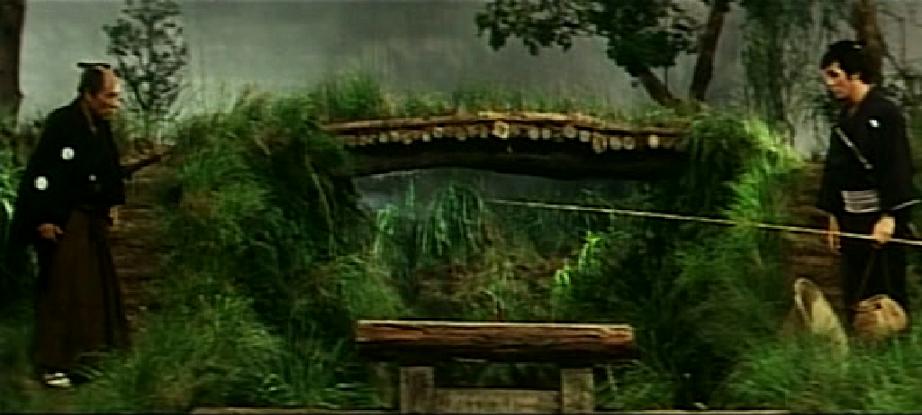
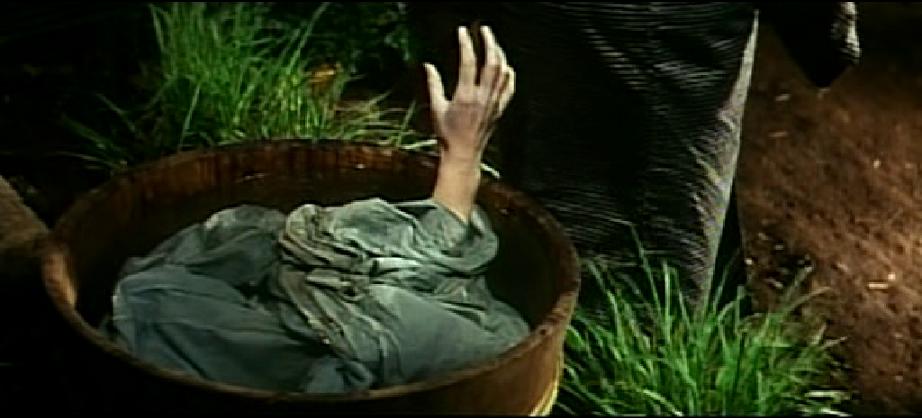
Shigenobu (Asao Matsumoto), a very busy and popular painter whose work is so good that many feel it brings them good luck to hang in their homes or businesses, must leave Edo for several weeks to paint a dragon mural at a temple. He's just taken Namihei (Akira Nakamura), a former samurai (uh oh!) who lost his position because of his interest in art, under his wing as a pupil and apprentice. Because Namihei seems kind and trustworthy, Shigenobu decides to leave his beautiful young wife Kise (Katsuko Wakasugi) and his newborn baby Mayotaro in his pupil's care, which turns out to be a huge mistake. Driven by his desire for Kise, Namihei threatens to kill her and the baby if she doesn't "submit" to him. Feeling she has no other choice, Kise complies with his wishes, but that's not nearly enough for Namihei, who promptly kills, kills and kills some more to get his way. He strangles the maid Hana (Machiko Mizuhara) when she discovers what's going on and then bullies elderly servant Shosuke (Hiroshi Hayashi) into helping him with future schemes.


When Shigenobu returns from his assignment, Namihei lures him into the woods, kills him and then throws the body into a lake. Immediately, a fireball emerges and begins to follow him wherever he goes and he has visions of ghostly Shigenobu threatening him. Under the circumstances, Kise refuses to marry Namihei, which only pisses him off further, and for some strange reason she's unable to produce breast milk because of her husband's death, so she follows one of the fireballs to a magical "Mother Tree," which produces milk for it instead. The ghosts of Shigenobu and the maid continue to appear and after Namihei tries to get Shosuke to throw the baby into the lake, the vengeful spirits finally give Namihei what he has coming to him. It all leads to a tragic ending.


Based on the story Kaidan chibusa-no-enoki by Enchô San'yûtei (adapted by Torao Tanabe), this is one of the weakest kaidan I've seen thus far. It's corny and predictable, the editing and continuity are frequently off, many shots are overlit and the performances are either forgettable or annoyingly melodramatic. One of my biggest gripes though is with the characters. Not only are they underdeveloped, but nearly everyone is weak and annoyingly comply with whatever the bully - who holds no sway or real power in the village - says. During the floating fireball sequences, you can frequently see the strings holding them up in unintentionally hilarious scenes of the heavy swinging his sword around in a fury like some kid with a stick trying to bust open a pinata. The film begins on a lovely note though, with fireworks, paper lamps floating in the river and such. Too bad it's all downhill from there.


Just off the top of my head, UGETSU (1953), THE GHOST OF KASANE SWAMP (1957), KWAIDAN (1964), ILLUSION OF BLOOD (1965) and BAKENEKO: A VENGEFUL SPIRIT (1967) are better examples of this particular subgenre. Director Kanodo also made the kaidan SEVEN MYSTERIES (1957) and GHOST OF THE GIRL DIVER (1960). They go on the back burner for now.

It has never been released in America.

★★

Thursday, May 31, 2012

Yotsuya kaidan (1965)

... aka: 四谷怪談 
... aka: Illusion of Blood
... aka: Yotsuya Ghost Story, The

Directed by:
Shirô Toyoda

Illusion of Blood is not unlike many other heavily moralistic Japanese 'kaidan' (ghost tales) produced during the 50s and 60s. It's set in post-war feudal times in an impoverished area where villagers are desperate for not only food and money, but also a semblance of basic human dignity in a world where the 'have nots' must degrade themselves on a daily basis in order to just survive. It involves a prideful former samurai and the ego associated with such a position as well as the pitfalls of letting pride get in the way of ones morals. And it - like dozens if not hundreds of Japanese productions from this era - is a revenge-oriented tale of a long-suffering, wrongfully killed person returning from beyond the grave to settle the score. This one was based on Nanboku Tsuruya's very popular play Yotsuya Kaidan ("The Yotsuya Ghost Story"), which was frequently performed in kabuki theatre but has also spawned no less than a dozen film adaptations, from as early as 1912. One of the definitive versions of the story was Nobuo Nakagawa's Ghost Story of Yotsuya (1959), but this one is also worth a look and has its own unique merits despite the familiarity.


Perhaps the chief drawing card here is lead actor Tatsuya Nakadai; one of the most respected and acclaimed Japanese film stars of all time. Prior to taking on this role, Nakadai had appeared as Unosuke the gunfighter in Yojimbo (1961), won many awards for his performance in Harakiri (1962) and had notable roles in numerous other films, including The Face of Another (1964) and the Oscar-nominated supernatural anthology Kwaidan (1964). His distinguished career hasn't faded much throughout the years (he'd become a favorite of Akira Kurosawa and appeared in 1980's Kagemusha, 1985's Ran and others) and he continues to act to this day. Here, Nakadai is given a good platform for his talents, giving an intense and well-modulated performance as the increasingly more unhinged samurai Iyemon Tamiya. After the death of a local warlord whom he used to work for, Iyemon has been eking out a sorry living in the slums, but poverty itself hasn't been enough to make him part with his prized samurai sword, which he refuses to sell. Iyemon is in love with Oiwa (Mariko Okada), but because of his lowly status as an umbrella maker, Oiwa's father (Yasushi Nagata) refuses to give him his blessing. In fact, he's been forcing Oiwa and his other daughter Osada (Junko Ikeuchi) into selling their bodies at a local brothel to help support the family.


Deciding he isn't going to let anyone keep him from Oiwa, Iyemon murders her father with his sword. While scouring the swamp looking for a place to dispose of the body, Iyemon runs across Naosuke (Kanzaburô Nakamura), who's in love with Oiwa's sister and has killed - and skinned off the face of - HER lover. Both men conspire together to conceal their crimes, makes it look like the work of vagrant thieves and go about their lives with the sisters. Oiwa moves in with Iyemon and eventually gives birth, but he quickly grows tired of her and the crying baby, whom he can barely support. Finding the responsibility of several other mouths to feed too much to handle, Iyemon starts sneaking out at night to romance young Oume Ito (Mayumi Ôzora), the spoiled daughter of one of the few wealthy man in the area. Oume's father (Eitarô Ozawa) promises Iyemon that if he marries his daughter he'll set him up with a nice position for another lord. The Ito family's evil nursemaid (Keiko Awaji), in conjuction with the wishes of Mr. Ito and his daughter, gives Iyemon some "special medicine" to give to his wife. The "medicine" ends up horribly disfiguring her face. Iyemon kills her, his baby and a servant boy, claims Oiwa ran off with the servant and then tries to go about his new life. But Oiwa's restless spirit has other ideas in store for all of those responsible for her death.


Though slow going, the writing and production values are competent and Nakadai does a good job pacing out his character's decent into amorality and mental deterioration; full-blown psychosis overwhelms his character by the very end. The primary characters are all strongly defined individuals and the entire supporting cast does well. There's little humor here; it's mostly grim, oppressive, murky, the lighting is consistently dark and the film doesn't play favorites (the innocent people die along with the guilty). The supernatural and horror scenes, relegated primarily to the final half of the film, are well done. One of the most startling effects takes place in the swamp, where Iyemon had disposed of the bodies of Oiwa and the servant (he'd nailed them both to a door and sunk them together). During one sequence, the door suddenly pops out of the water with Oiwa's bloated corpse on top and her face suddenly melts off to reveal the skull underneath. A few less-convincing effects (namely ones involving [stuffed] rats) don't harm the film too badly.


Never released in the U.S. on either video or DVD. However, the film was issued on DVD in the UK. The print is widescreen - though quite dark - and has English subs.

★★★

Wednesday, May 30, 2012

Vampire Cop (1990)

Directed by:
Donald Farmer

From the man who brought us CANNIBAL HOOKERS (1987) and SCREAM DREAM (1989) - it's OK to run away right now; I totally understand - comes this shot-on-video mixture of urban action/thriller, cop drama, horror flick and gratuitous overuse of slow motion. The first twenty-five minutes is an interestingly edited cluster of things to come. While the opening credits slowly roll out, we see people dancing in a club, a vampire making goofy strained faces and showing his fangs, the same vampire standing valiantly in foggy silhouette, a nightmare-plagued blonde writhing in bed, a teen girl getting forced at gunpoint into a thugs car and various other things. At the club a "Hot Body" bikini contest is in full swing. Two of the girls; Nikki and Danielle, agree to go back to the hotel with an older guy for 300 bucks apiece. Before the guy can even get going (but after one girl takes her top off and the other hops in the shower), there's a knock on the door. In marches German crime boss / drug dealer / pimp Hans Geiger (Terence Jenkins), who's pissed his two girls are freelancing. He shoots Danielle dead and then forces Nikki back onto the street.


Geiger and his henchman Kurt (Phil Newman) attempt to make a drug deal with an undercover agent. When they discover who he is, they shoot him dead and end up in a car chase with two other cops; Newhouse (Don Tilley) and Mr. Vampire Cop himself, musclebound blonde William Lucas (Ed Cannon). Things end with Kurt and Newhouse dead and Lucas vowing revenge against the crime lord. Meanwhile, teen runaway Traci (Morrow Faye) - a girl who was almost raped until Vampire Cop came to her rescue and killed the guy - goes to reporter and TV hostess Melanie Roberts (Scream Dream star Melissa Moore) for help. Melanie allows her to stay in her home while she's investigating the case and a string of unsolved murders where people are turning up dead with strange, bat-like bite marks on their necks are just beginning. Melanie eventually teams up with Lucas in hopes they can crack the case together. Naturally, the two end up falling in love too, though it takes her forever to put two-and-two together. Hey, she's investigating what the press refers to as "The Vampire Murderer" and finds herself dating a man who refuses to leave the house during the day, works only at night, doesn't cast a shadow in the mirror and doesn't smoke, drink or even eat!


This is a very slight improvement over the director's previous films in that it has an actual storyline, numerous locations, decent videography and a couple of actors with charisma and the ability to recite their dialogue without coming off like they recently received a lobotomy. Hunky Cannon is pretty amateurish as the title character, but Moore looks great and is appealing as our heroine, Jenkins does a great job as the bad guy and R.J. McKay is fun as one of his henchmen. There's also a fun role for "special guest star" Mal Arnold as a police lieutenant who ends up getting chainsawed. You may remember Mr. Arnold as deranged Egyptian caterer Fuad Ramses in Herschell Gordon Lewis' seminal gore flick BLOOD FEAST (1963). Can't say I'm familiar with most of the rest of the cat, but most at least seem like they're at least trying to act.


Not that this film doesn't have major problems. In fact, it's loaded with them. Farmer seems inept in the ways of continuity and making sure everything that needs to be filmed actually is filmed (notice how many times shots of police cars and exteriors of houses are spliced into the middle of scenes). Slow motion is constantly used for no good reason and we even get flashbacks to things we just saw a scene earlier but put in slow motion. I also had a big problem with how sloppy the Vampire Cop was. He bites many people - including the main bad guy - and then just leaves them there so that they'll return as vampires (and naturally be harder for him to defeat). You'd think he'd be a bit smarter after having lived on the fringes without being detected for over 100 years. Several characters who are bitten transform into vampires and are never seen again. And speaking of never seeing characters again, Geiger's henchman AND even the main character miraculously just disappear in the middle of the big finale, leaving out heroine alone with the crime boss! The last scene rips off the final scene in THE HOWLING.


Farmer financed the film and also wrote it. Tim Ritter (TRUTH OR DARE?) was an associate producer. For some reason, it was filmed in three different cities in three different states; Pensacola, Florida, Atlanta, Georgia and Los Angeles, California).

★1/2
Related Posts Plugin for WordPress, Blogger...