.
.
.
Showing posts with label razzie nominee. Show all posts

Friday, July 21, 2023

Island, The (1980)

... aka: Dødens farvann (Waters of Death)
... aka: Freibeuter des Todes (Privateer of Death)
... aka: Fruktans ö (Island of Fear)
... aka: Het Eiland der Verschrikking (The Island of Terror)
... aka: Les zombies de l'île sanglante (Zombies of the Bleeding Island)
... aka: L'île sanglante (The Bloody Island)
... aka: Rémségek szigete (Island of Horrors)

Directed by:
Michael Ritchie

Big things were expected from The Island back in 1980. For starters, it was another terror-on-the-high-seas concept based on a best-selling novel by Peter Benchley, whose previous novel Jaws became the basis for the #1 highest grossing film of the entire previous decade. Jaws producers David Brown and Richard D. Zanuck returned and Benchley was even able to adapt his own book. Second, The Island had a production budget of 22 million dollars. While that sounds like peanuts for a major studio release these days, it was quite a large budget back then, equivalent to over 90 million dollars when adjusted for inflation. For a reference point, consider the budget of The Empire Strikes Back, the top grossing film of 1980, was 18 million dollars, and the budget of The Shining, which rather famously took forever to be planned, cast and filmed due to Kubrick's meticulous nature and demand for massive sets to be constructed, was 19 million. Throw in a director who'd made several surprise hits the previous decade, a score from the ever-reliable Ennio Morricone, a well-known cast headlined by Michael Caine and a plot touching on the then-topical Bermuda Triangle myth and what do you get? Well, in this case, a financial bomb that received scathing reviews and the worst kind of press imaginable.

Upon release, The Island debuted at #4 at the box office and sunk pretty quickly after that. Critics lambasted the acting, the plot, the often-laughable dialogue, the bloated production and (most especially) the level of violence. Several of the actors (including Caine) refused to discuss the movie or help promote it. The film was also included in the very first Razzie Awards ceremony, receiving nominations for Worst Actor and Worst Director. And, in some strange way, already knowing much of the above going in and setting my expectations accordingly actually helped my enjoyment of this one somewhat.


A boat full of old rich guys get slaughtered somewhere in the Caribbean but there's no sign of the boat, wreckage or any bodies later. If this were an isolated incident, New York newspaper columnist Blair Maynard (Caine) probably wouldn't think much of it but, in just three years' time, 600 ships and several thousand people have vanished in the same area according to Coast Guard records. When John asks for funds from his editor to go to Florida to investigate, he's greeted with skepticism ("Bermuda Triangle bullshit!") but manages to talk him into it. Afterward, Maynard learns that his ex-wife has slipped town with her new boyfriend and left their 12-year-old son, Justin (Jeffrey Frank), in his care for the weekend. Maynard decides to take Justin along with him to Florida, figuring after he asks a few questions and snoops around they may have time to swing over to Disney World.


Upon arrival in Miami, Maynard charters a plane from the sketchy Stark (Brad Sullivan), whose half-burnt face red flags how successfully he's pulled off his previous flights, to get them to the barely-populated island of Navidad located deep within "the asshole of the Western world." Stark manages to get them there... barely. The plane blows up soon after skidding down the runway with the wheels still up, prompting local cop Westcott (Zakes Mokae) to arrest the pilot until he can be compensated for the damages. The following morning, Maynard and Justin are able to charter a boat from Dr. Windsor (Frank Middlemass) to go fishing. While out on the ocean, the two run across a young girl floating in the water and, next thing they know, they're being attacked, knocked out and awakening somewhere else entirely.

The island of the title is an uncharted one lost in a sea of over 1200 others that's populated by a fairly large group of dirty, rotten-toothed buccaneers who have somehow managed to avoid civilization for the past 300+ years. Of course, they're also the ones who've been responsible for the rash of disappearances; attacking various boats, pillaging their goods, killing most of the adults and kidnapping the children to add to their ranks. Due to the amount of inbreeding over the years, most of the pirate population is infertile, so they must replenish their numbers by kidnapping whatever children they can get their hands on, as well as some of the more youthful adult females to use as "breeding stock."


The pirates (played almost exclusively by British character actors) speak broken, sometimes incoherent English with some Spanish words and some seemingly made-up words sprinkled throughout their banter, often making their gibberish a real headache to get through. The society has a majority-rule democratic governance of sorts, as well as a guide book of laws they call "Covenant". The book claims that that "A child shall lead" them and pirate chieftain John David Nau (David Warner) starts to suspect that child may be Justin because he shares a last name with the man who killed Blackbeard and thus may be one of his descendants. Justin is promptly separated from his father and goes through a torture / brainwashing regime conducted by Hizzoner (Colin Jeavons).

Meanwhile, Caine's character has to make amends for his past actions. Prior to blacking out, he had shot and killed one of the pirate men and is now required to take that man's place. That also means taking over husbandly duties and impregnating the now-widowed Beth (Angela Punch McGregor). After he's nursed back to health, Caine is shackled in the woman's hut, walked around on a chain like a dog on a leash, gets a Vaseline handjob (!) and is basically treated like a sex slave. Maynard, a Korean War vet who possesses some survivalist skills, attempts several unsuccessful escapes and somehow manages to avoid being executed despite constant threats of such. Developing feelings for him, Beth becomes somewhat of an ally and helps save him multiple times, but will he be able to escape and find a way to deprogram his son, who has now been turned against him?


I've seen some cinematic tonal nightmares in my day, but this about takes the cake! Part of the time it feels like a kid's adventure movie. The entire set-up of a busy career man and his estranged son trying to reconnect over holiday, which takes up most of the first half hour, has been used a number of times in various family movies. In addition, quite a bit of focus is put on the juvenile characters, there are dumb gags involving things like stinky feet, cartoon-like scalawags constantly acting goofy and mugging for the camera and out-of-left-field attempts at humor, including an embarrassing scene where the pirates attack a schooner transporting cocaine and have to do battle with some martial artist who makes kung fu movie "hee-ya!" noises as he fights (!)

Needless to say, none of the above blends well with the more adult-oriented content. There's nudity, sex, a high body count, slasher-style gore murders with hatchets going into heads, throats being slashed and an bloody axe disembowelment, kidnapping, drugs, and even jellyfish nipple torture. Sometimes the film seems like it wants to be taken seriously, at other times it doesn't, and there are many scenes where you have no clue what kind of tone they were even shooting for. That's especially obvious in a bit where the pirates slaughter an entire Coast Guard crew, which is set to heroic-sounding swashbuckling music and - I think - was supposed to be funny. I'm also not sure if the finale, featuring Caine mowing down nearly the entire supporting cast with a machine gun Rambo-style, is supposed to be hilarious or not, though it is.


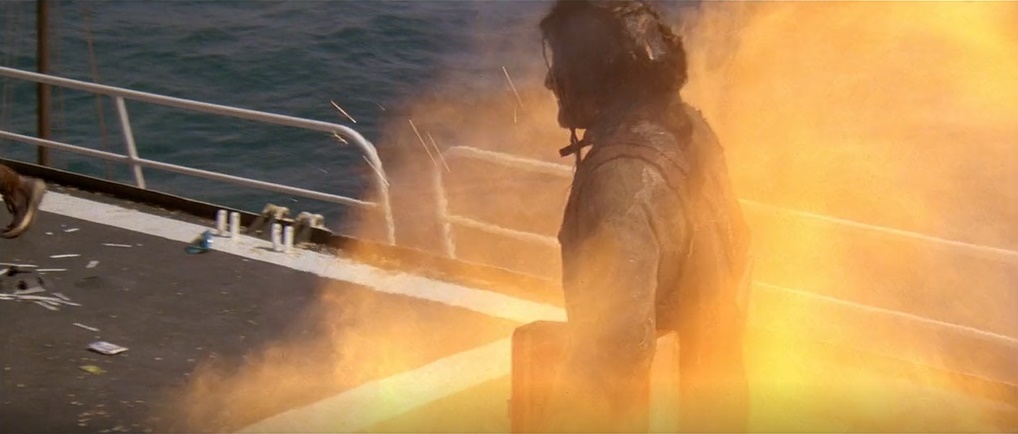


On the plus side, the Antigua and Barbuda locations are nicely-photographed by Henri Decaë, the production values are lavish and the art direction, costumes (from Ann Roth, who'd later win two Oscars), props and such are all good. The action scenes are proficiently directed and edited and the cast (also including Don Henderson, Dudley Sutton and Reg Evans as pirates) isn't terrible. So while this can certainly be considered a misfire, it's at least not a boring one.


As is the case with most other major studio films, this has been well-distributed on the global home video market ever since its 1981 VHS debut on the MCA label. Universal gave the film a DVD release in 2011 as part of their "Vault Series" and that was followed by a 2012 Blu-ray release from Shout! Factory. Both of these releases are bare bones with no notable special features, which I suppose is to be expected when it comes to a bastard stepchild movie that most of the key players would rather forget.

★★

Saturday, February 20, 2016

Deadly Blessing (1981)

... aka: A Bênção do Anjo Negro (Blessing of the Black Angel)
... aka: Hämnd från andra sidan (Revenge from the Other Side)
... aka: La ferme de la terreur (Farm Terror)

Directed by:
Wes Craven

This is an interesting film from Craven's big transitional period or, what I like to refer to as his B.F. (Before Freddy), period. After getting his feet wet in cinema helping to produce Sean Cunningham's obscure faux sex documentary Together (1971), which gave some their first look at future adult film superstar Marilyn Chambers, Craven took his first stab at directing the following year with The Last House on the Left (1972). The film quickly garnered a reputation as one of the most vile, graphic and shocking films made up to that point. Many critics felt it was beneath contempt, but a few (including, most famously, Roger Ebert) came to its defense. Though a profitable film that proved to have legs at the box office both domestically and abroad, the controversial House didn't exactly have Hollywood beating down Craven's door right away. Instead he ended up in the world of hardcore porn for awhile, directing The Fireworks Woman (1975) under the alias “Abe Snake,” editing other features and even appearing in small non-sexual roles. Because of the frequent use of aliases in adult films, the full extent of his career in hardcore porn may never be known. Craven himself had no qualms admitting his involvement but never went into much detail about it.

The director's connections with the adult industry came in handy once he was ready to shoot his next movie; The Hills Have Eyes (1977), as he was able to cheaply rent film equipment from a California porn producer. Like Last House (which was initially rated X and played theaters either unrated or in a heavily-cut R version), Hills faced ratings problems due to explicit violence and had to be trimmed in order to get an R rating. The gritty, bloody film received mixed reviews but did fairly well at the box office. Two noteworthy genre efforts in a row landed Craven the opportunity to direct the Linda Blair vehicle Stranger In Our House aka Summer of Fear in 1978. Released on Halloween on NBC, it was beaten in the ratings by rival network's Devil Dog: The Hound of Hell, but managed to be profitable, thanks in part to playing theatrically in Europe. It wouldn't be until three years later that Craven made Deadly Blessing, his fourth genre offering and his highest-budgeted movie to date at 2.5 million dollars. He likely got the gig because Stranger executive producer Max A. Keller (who also backed this film) was pleased with the work he'd previously done and because of the rising cult popularity of his previous films.


Strange things are afoot in a small farming community. The area is home to an ultra-strict religious sect called the Hittites, who are so by-the-book they “make the Amish look like swingers” and spend all their days farming the land by hand. Ex-Hittite Jim Schmidt (Douglas Barr) broke tradition, went away to college in the big city and returned with new wife Martha (Maren Jensen) in tow, which not only infuriated his father Isaiah (Ernest Borgnine) but also got him kicked out of the community and disowned by his entire family. As the young couple look forward to an upcoming child and celebration of their one year wedding anniversary, Jim is killed in a freak “accident” in a barn when a tractor crushes him. Now ostracized by nearly the entire community, who've labeled her an “incubus” (a devil who seduces the faithful), Martha has no one to turn to for comfort. Two of her friends from L.A.; Lana Marcus (Sharon Stone) and Vicky Anderson (Susan Buckner), show up in the nick of time to help her through the ordeal.


Martha is set to inherit the land and farm from her deceased husband, which doesn't sit too well with Isaiah and the rest of the Hittite community. Seeing how the Hittite's have already tried numerous times to drive out the only other non-Hittite's in the vicinity; white trash widowed waitress Louisa Stohler (Lois Nettleton) and her surrealist painter tomboy daughter Faith (Lisa Hartman), who knows what lengths they may go to get Martha out and get their hands on the land? The Hittite's also don't take too well to the sexual temptations the nice-looking, free-spirited city gals, who do things like answering the door in their negligee and jogging in short shorts and flimsy t-shirts minus a bra, are bringing to the devout menfolk. Jim's younger brother John (Jeff East) finds himself drawn to Vicky, but since he's set to be married to a "sound woman;" his uptight cousin Melissa (Colleen Riley), Isaiah forbids him from even talking to her. When he doesn't listen to orders, daddy starts beating him with a stick, calls him “a stench in the nostril's of God!” and banishes him from the home.


With all of the bitterness, hostility and religious / sexual repression going on, someone's bound to snap and that's exactly what happens. Mentally-stunted “retard” voyeur William Gluntz (Michael Berryman) is first on the killer's hit list after sneaking one too many peaks into Martha's windows late at night. His body is later strung up in the barn and, naturally, the sect blame the city girls and won't even allow the cops to perform an autopsy to find out the real culprit. In addition to the flesh-and-blood killer on the loose (who also likes to terrorize the ladies by doing such things as sneaking a snake into the bathtub and filling a milk carton full of blood), something supernatural appears to be going on. Lana starts having a recurring nightmare about an ashen-skinned man and spiders and eventually begins to think death itself is after her.


Look familiar? Craven recycled this same scene nearly shot-for-shot for his most-famous hit; 1984's A Nightmare on Elm Street, except instead of Freddy's glove emerging from the water we get...

This!


I grew up in a rural farm area not unlike the small town featured in this movie and saw Amish around all of the time. There were Amish furniture stores, Amish bakeries and we even had Amish buggy signs on most of the back roads. Now these people can be scary, especially to a child who doesn't know any better. All I knew when I was young was that they were solemn, seldom said anything and lived apart from everyone else in their own little sheltered, secretive world. The Amish children my age were very quiet and obedient and the adults always looked humorless and stern. When I got a little older, my girlfriend at the time's father actually helped the Amish. He'd drive them to McDonalds and Wal-Mart and the hardware store so I'd interact with them from time to time. It was then I realized they weren't so much scary as they were extremely guarded in regards to those outside their circle. There always seemed to be some whispered communal secret among them and they kept pretty much everyone, including my ex's father, at arm's length. Even through amiable faces and smiles, I still always felt an amount of coldness, disapproval and distrust underneath the surface.


Though the Hittites in this film aren't Amish and they make a point to explicitly say they aren't Amish, they may as well be in regards to how they're portrayed here. Either way, setting a horror film in this kind of hush-hush, repressive, ultra-religious environment was an excellent idea. Craven does a fine job with the atmosphere here and in authentically capturing the feel of this reticent community, particularly from an outsider's point of view. Some interesting things happen along the way and a few of the horror scenes deliver, but this lacks focus and that catches up to it by the end. The supernatural elements here are only present in a few scenes and one wonders why they're even here in the first place. And after a pretty good build up, the unintentionally funny finale goes completely off the rails with several surprise revelations (the most memorable being a silly sexual identity problem) and no less than four characters seemingly going off the deep end at the same exact time for various reasons. The studio imposed a new “shock” ending against Craven's wishes and it too is terrible.


The Omen-inspired score was by busy James Horner, who also did the music for The Hand and Wolfen this same year. Always shot from a low angle to appear more menacing, Borgnine bugs his eyes out with the best of them playing a hate-filled religious nut who does things like whipping a child's hands bloody with a switch for going into a barn. He received a Worst Supporting Actor Razzie nomination for his work. In her first major role, Stone looks gorgeous but clearly wasn't quite there yet with the acting, though she did end up on the poster. Very small roles are played by Larry Buchanan film regulars Annabelle Weenick and Neil Fletcher.

Always an easy to find / watch title, Deadly Blessing was shown on TV frequently throughout the 80s and 90s, has been issued on VHS and DVD numerous times and made its Blu-ray debut courtesy of Shout! Factory in 2013.

★★1/2
Related Posts Plugin for WordPress, Blogger...