... aka: Criminal History of Bizarre Women
... aka: History of Bizarre Crimes by Women in the Meiji, Taisho and Showa Eras
... aka: Love and Crime
... aka: Meiji, Taisho, and Showa Eras: Grotesque Cases of Cruelty by Woman
Directed by:
Teruo Ishii
True crime and "poison woman" films featuring treacherous and usually murderous femme fatales were very popular in Japan at the time so why not combine both? That's precisely what we have here with this particular production, which was actually a rather ingenuous concoction for its time. What better way to get asses into theater seats than the promise of gory, titillating and lurid reenactments of famous crimes? Interesting too is that this is an anthology film featuring four separate tales along with a framing story, which makes it one of the earliest omnibus-style films to tackle multiple true crime stories. A similar concept was later employed by Hong Kong's Shaw Brothers for their five part Criminals series in the late 70s and, of course, these can be seen as precursors to any true crime TV show featuring reenactments. Also making this unique is that the director sought out, and actually got an interview with, one of the reclusive subjects, who gets to tell her side of her own story as a dramatization of it plays out.
At the Tokyo Forensic Institute, police forensics examiner Dr. Murase (Teruo Yoshida) gets the surprise of his life when the latest corpse to show up on his slab is Yukiko - his wife! After performing the gory autopsy over the opening credits, Murase discovers Yukiko had sex prior to committing suicide... and it clearly wasn't with him. Hoping to gain some insight into what may have happened, he gathers together old criminal case files involving female murderers, and these are what comprise the bulk of the running time. The film sporadically returns to Murase and he also narrates portions of the stories.


First up is "Toyokaku Inn Case," which is based on a 1961 incident that led to the first woman being sentenced to death in Japan after the war. Chiyu Saito (Mitsuko Aoi) owns a hotel with her husband, Kosuke (Kenjirô Ishiyama), whom she suspects is having an affair since he disappears so frequently. She's correct in her assumption. Hubby has grown sick of, in his own words, his "old hag of a wife" and has been sleeping with a beautiful younger woman instead. Chiyu has been voicing her suspicions about his adultery to her assistant, Kinue Munakata (Rika Fujie), all this time, as well as relaying her future plans for the hotel; namely her plans on selling it and opening up a brothel instead.
Unbeknownst to Chiyu, her friend and confidant Kinue is her husband's secret mistress and she's been using some of the things Chiyu has told her to further drive a wedge between the couple. While Kosuke is planning on leaving his wife and kicking her out, Kinue suggests they murder her instead. In fact, she promises to help him. With help from gigolo Shibuya (Takashi Fujiki), Kinue does the deed and then the two reveal to Kosuke that they are lovers. Blackmailing the new widower, they're able to get their hands on some money to build an expansion onto the hotel. As the business increases in value, the cold-blooded Kinue decides she wants it all to herself, leading to several more murders.
Though a full length expansion on this case would no doubt be a lot more interesting (same can be said for all of the other featured stories), there's plenty to keep one's interest here, including lots of nudity, sex, sex right next to a decomposing body, a topless cat fight, a poisoning, a bloody axe murder and a maggoty corpse plastered up behind a wall. There's quite a lot packed into just 20 minutes!


In 1936, Sada Abe, a former prostitute then employed as a restaurant apprentice, strangled her married boss / lover to death in bed during an erotic asphyxiation session. She then carved her name on his arm, removed his genitals and carried them around with her for days until she was tracked down and arrested by the police. A nationwide media circus and trial followed, and she was eventually convicted of murder and mutilation of a corpse and sentenced to ten years in prison. After serving six, she was released and capitalized on the public's interest by penning an autobiography and appearing in a one woman stage show. She then was able to blend back into society using an alias and lived out the remainder of her days mostly in anonymity, becoming the subject of many best-selling books and popular movies along the way.
"Sada Abe Incident" features a multiple flashback structure and very scrambled time frame, cutting between a courtroom scene where a pitiable Sada (Yukie Kagawa) recounts her bizarre tale and a series of flashbacks showing her at various stages in her life. She became an out-of-control teen after being raped, was sent to a geisha house to work as a servant at age 16 by her father, where she was raped yet again by a sweaty old pervert (who was nice enough to at least get his wife's permission first), and then became a sex worker being used and discarded by various men while she herself used and discarded various men. Hey, it's a dog eat dog world out there.
We also get reenactments of her intense relationship with restaurant owner Kichizo Ishisa (Eiji Wakasugi), the man she'd later murder, as well as the murder itself ("No one will touch him anymore!"), which isn't as grisly as it could have been all things considered. In its brief time, this segment does both a good job relaying the main facts in the case as well as capturing the insane passion shared by the couple prior to the murder, which began with nonstop sex marathons lasting days before descending into kinkier stuff. That's followed by several vignettes of other disgruntled women, perhaps "inspired" by Abe, who remove their lover's junk with scissors.
This segment is especially noteworthy in that the director managed to track Abe herself down and has the Dr. Murase character conduct a brief interview with her (shot on a bridge from across a busy road), which is edited in with the other footage. In her interview, Abe claims her lover wanted to die, asked her to kill him and died happy, insists she did nothing wrong, doesn't understand the public's fascination with her and says that we only fall in love - truly fall in love - with a single person in our entire life and Kichizo was that person to her. Abe disappeared shortly after filming this interview and her whereabouts remained unknown, though it's reported that she passed away sometime in the early to mid 70s.
While I believe this is the first film to tackle Abe's story, it's also one of the least watched. The Nikkatsu production A Woman Called Sada Abe (1975) and the infamous In the Realm of the Senses (1976) are both much better known and more popular. The latter, directed by Nagisa Ôshima, became a notorious, oft-banned film due to its inclusion of explicit sex, and was an art house hit around much of the world upon release. There were numerous later Abe films as well, including ones produced in 1998, 1999 and 2011, as well as a French-produced documentary about her in 2017.


Next, in an ill-conceived break from the female-centered murderers, we take a look at a male one: little-known Japanese serial killer Yoshio Kodaira. After having served in the Japanese military, where he reportedly engaged in various war crimes (including raping and murdering Chinese civilians), Kodaira returned to Japan, where he raped and murdered at least seven women between 1946 and 1947, and also engaged in necrophilia with some of the corpses. The victims were mostly impoverished young women who were lured into the woods with promises of jobs / food. After his apprehension and trial, Kodaira was sentenced to death and was hanged in 1949.
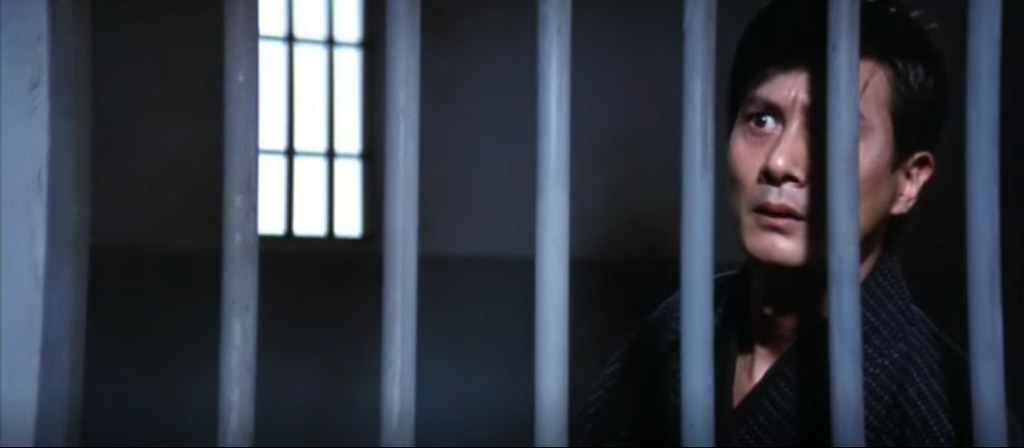
As this segment opens, a sweaty and grotesque Kodaira (Asao Koike) has already been apprehended and is recounting his crimes to police during his interrogation. His first murder occurs at a military factory in Kanto, where he uses a bombing as an opportunity to get a young woman alone, then rips off her clothes and strangles her to death. Next up is a starving woman he lures into the country and yanks into the woods. To try to avoid being killed, she offers herself up to him willingly, but he strangles her until she passes out and has sex with her unconscious body. When she wakes up and wants to leave, he kills her and goes in for round two. A third victim is also shown being killed during a rainstorm.
After a steady stream of brief murders, the next is shown in greater detail as Kodaira befriends and grooms a poor, fatherless teen named Ryuko (Yumiko Katayama). He gives her food, promises her work and even goes home with her to meet her mother but, despite developing a relationship with her over the course of a few months, she's eventually lured into the woods and beaten, raped and killed just like any other random victim. This murder was to be his ultimate undoing, as Ryuko's mother knew his identity and was able to report him to the police.
Stylistically, this is perfectly fine. Ishii shot it in grainy black-and-white; an apt choice to make this resemble b/w newsreel footage indicative of the WWII era, some of which is also edited into the segment. This also sticks fairly close to the real case, though it's too short to cover all of the crimes and a few other details, namely Kodaira's first victim actually being his father-in-law over a decade earlier, have been altered. With that said, thematically this feels sorely out of place. Despite the narrator's silly attempt to find a connection between it and the other stories ("Do women's bodies turn men into madmen?"), this doesn't really have any business being in a film about murderous women.


Finally, we return to the killer female theme in a segment set during the mid-19th century that covers murderess Takahashi Oden, who was the last woman in Japan to be executed by beheading. Against her wishes, Oden (Teruko Yumi) is set up in an arranged marriage to Naminosuke (Shin'ichirô Hayashi), whom she doesn't love. To make matters worse, her new husband is struck down with leprosy and becomes hideously deformed. Despite that, he can't keep his hands off of his beautiful bride and keeps forcing himself on her. She eventually takes on another lover, a criminal named Tomekichi, who murders Naminosuke after he catches the two of them together.
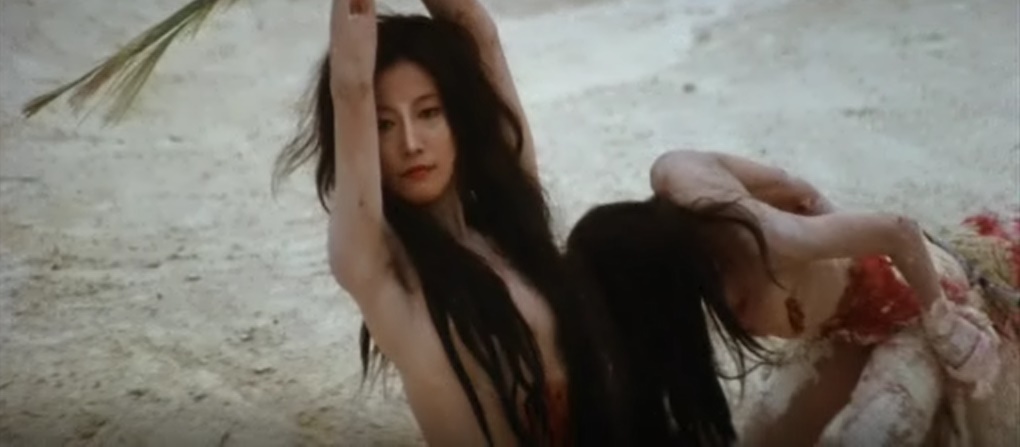
The lovers then flee to the city where Tomekicki continues on in his criminal ways and sells Oden to a brothel. There, she meets another man and plots to run off with him. A series of murders and betrayals follow until Oden is finally captured and beheaded. There are some very gruesome moments in this one plus a generous helping of nudity from the lead but it tries to cover too much ground in too little time (just 10 minutes!) so we never can get a handle on any of the characters. A feature length version of this same story had been filmed back in 1958 as Dokufu Takahashi Oden (titled Wicked Woman in English) by Nobuo Nakagawa, and would be retold yet again in the 1983 softcore film Koyamu / Crimson Night Dream.


While this certainly has its problems with pacing and the script, as 99% of all anthologies do, good production values, competent acting, some clever directorial and aesthetic choices, nearly nonstop sex and violence and plentiful eye candy provided by at least a dozen gorgeous Japanese actresses keep things highly entertaining throughout. If you're wanting more in-depth versions of any of the true stories, you can always check out one of the other film versions or, better yet, read up on them. However, if you can accept this on its own terms, as being the exploitation film it clearly is intended to be, it delivers in spades for its target audience.


Unlike with many of the director's other films, I couldn't find evidence this was ever officially released outside of its home country. Toei gave it at least one VHS and one DVD release in Japan, which are the only releases that I'm aware of.
★★★