.
.
.
Showing posts with label Sergio Martino. Show all posts

Wednesday, August 30, 2023

Libido (1965)

... aka: Libido Terror

Directed by:
"Julian Barry Storff" (Ernesto Gastaldi and Vittorio Salerno)

Made just one year after Mario Bava's seminal Blood and Black Lace (1964), this modestly scaled b/w psychological thriller with few location changes and a very small cast is now typically considered one of the earliest giallo films, though I personally don't think it really qualifies as such. This has far more in common with suspense films like Diabolique and, perhaps most especially, early 60s Italian Gothic chillers than it does later gialli. There's (thankfully) no police investigation going on, rampaging psycho killer attacking naked Euro starlets, elaborately-staged gory death scenes or excessive attempts at visual style present in this one, though the links between it and what would come later are still quite obvious.

This low budget production surprised even its makers by becoming an international success, which prompted many of the key players to venture into other twist-laden murder mysteries and police procedurals. Though not credited on the film itself (or on IMDb or other websites for that matter), the producers were Luciano Martino and Mino Loy, who'd go on to make dozens of later giallo films, many of which were directed by the former's brother, Sergio Martino, who worked as the production manager here under the alias "Serge Martin." Co-director Gastaldi would go on to an incredibly prolific career, seemingly writing or co-writing every other Italian genre script over the next two decades. He'd not only write most of the Martino films, but also worked with Mario Bava, Riccardo Freda, Umberto Lenzi, Antonio Margheriti and others. So, if only by association, I can see why this usually gets thrown on giallo lists despite really not being one itself.


Giancarlo Giannini makes his film debut (billed as "John Charlie Johns") as the dour Christian Carro, who's on the verge of inheriting a remote seaside castle after his father's passing. He travels to the castle along with his wife, Helene (Dominique Boschero), family lawyer Paul Benoit ("Alan Collins" / Luciano Pigozzi) and Paul's much-younger wife, Brigitte (Mara Maryl, who was married to Gastaldi and also receives a story credit here), for a protracted stay to take inventory of the castle's belongings and get everything in order.

Paul has been tasked with executing the will to the letter, per the father's instructions. Said instructions include not allowing Christian much say in what goes on until he reaches his 25th birthday in 3 months and completing some restoration work on the castle tower despite Christian's insistence on it just being a big waste of money. After all, he merely wants to sell everything and wipe his hands of the place and all of the bad childhood memories associated with it. Christian's late father, whose large portrait adorns one of the walls, was something of a sexual sadist who may or may not have murdered some of his lovers in a mirror-filled kink room, and Christian may or may not have witnessed one of those murders.


The neurotic, chain smoking, mentally unstable Christian now fears he may have also inherited his father's penchant for sadistic sex. In addition to that, there's the looming question about just how the father died, or even if he died. Supposedly, he committed suicide by jumping off a cliff, but there were no witnesses to his death and a corpse was never found. This leaves Christian wondering whether or not he's losing his mind when strange, seemingly otherworldly things start occurring in the castle. His late father's rocking chair rocks all by itself, his favorite skull pipe is found smoking and a haunting music box melody, one that makes him recall a particularly troubling event from his childhood, is heard. He also sees a figure that resembles his father lurking the grounds.


Is this a haunting? Is Christian going insane? Or, in the vein of the aforementioned Diabolique, is there some kind of conspiracy afoot? It's established from the get-go that the two male leads strongly dislike one another. Due to a stipulation in the will, Christian has to be of sound mind (and alive, of course!) to collect his inheritance or else it falls into Paul's hands, which opens the door for some greed-fueled gaslighting. After catching his wife and Paul having some private conversations, Christian suspects she may also be involved. As for Helene and Christian's marriage, it's a strange, cold and apparently sexless union that finds the two of them sleeping in separate bedrooms at night and not showing the love, affection and care that a young, healthy married couple would normally exhibit.


In a nice reversal on formula, the film's most intriguing character turns out to be the second female lead, who possesses all of the characteristics of someone who's going to be written (and killed) off in no short order but proves to be more essential to the plot than it first appears. A bubbly blonde Monroe-esque airhead, Brigitte spends most of her screen time trying to seduce the men and cavorting around in short dresses, lingerie and, best of all, a skimpy little bikini with cat face cups for the top! However cute she may be, she also strongly resembles the same woman Christian has visions of his father murdering and her mere presence seems to be exacerbating Christian's descent into madness, which may or may not be the intended effect. Having this sometimes silly character around also helps get us through the sluggish first half otherwise dealing with three serious, solemn and depressive-acting characters.


Despite taking place in present day, the Gothic trappings are laid on as thick and heavy as any other period-set Italian Gothic from this time, with its large, darkly-lit castle setting and the usual thunder claps, howling winds, footsteps in the dark, creaking floorboards, candle-lit strolls, sudden lightning flashes illuminating the dark, muddy footprints found along corridors, etc. The proceedings are competently, crisply photographed by Romolo Garroni, though the direction is not very visually imaginative. This takes awhile to reveal its modest pleasures, too. While the first hour is strictly average, the twist-filled finale is highly enjoyable and boosts the score up a notch.


I could find no evidence that Libido was ever given a U.S. theatrical release. If there was, it was a minor one, though there was an English language dub prepped at some point. Some sources claim this was given a small release in the UK in 1967, though I couldn't verify that either. I also couldn't find a single legitimate home video release here in the States prior to the Severin Blu-ray, which was released just last year. Severin's release comes with English and Italian audio tracks (the latter with optional English subs) as well as a lengthy interview with Gastaldi.

★★1/2

Saturday, June 26, 2021

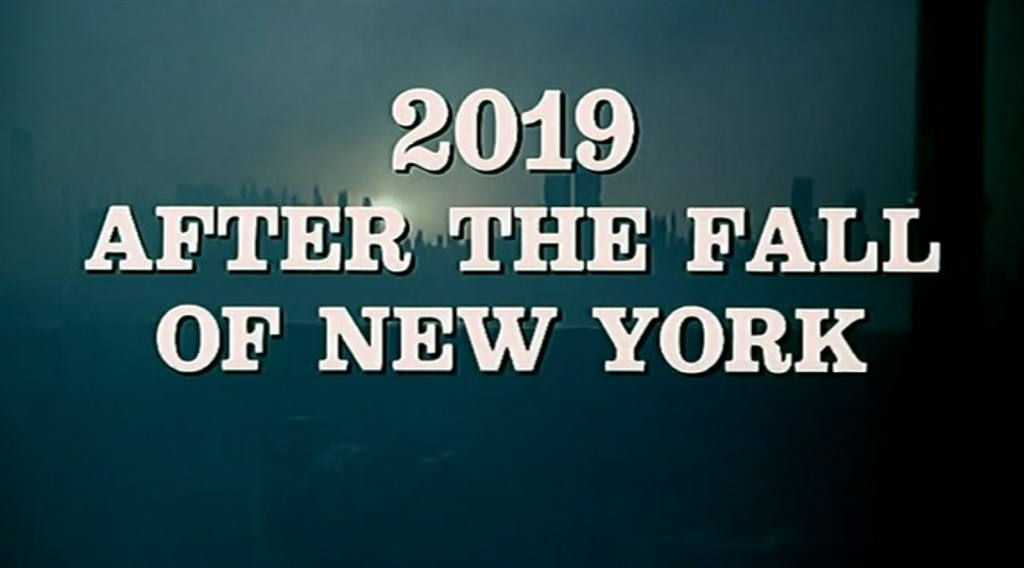
2019 - Dopo la caduta di New York (1983)

... aka: After the Fall of New York
... aka: Fall of New York, The
... aka: Fireflash
... aka: New York - 2019
... aka: 2019: After the Fall of New York
... aka: 2019, escape de Nueva York II (2019: Escape from New York II)
... aka: Vlucht uit New York (Flight from New York)

Directed by:
"Martin Dolman" (Sergio Martino)

Thanks to the success of Mad Max (1979) and its first sequel, the even more successful and influential The Road Warrior (1981), slightly sci-fi post apocalyptic films became all the rage in the early 80s. And when I say slightly sci-fi, I mean films that take place on a futuristic planet that's been ravaged to a degree, usually by environmental damage caused by war, but still contains plenty of remnants of what once was. This is a bleak future where most buildings are wrecked and spray painted, most people look like they haven't bathed in awhile, many others have been reduced to anarchist savagery (or have been turned into mutants), resources are extremely limited, corpses litter the ground just like any other piece of garbage and the planet has been reduced to some kind of industrial scrap metal desert wasteland. There may be running vehicles, but they all look like they've just been through a demolition derby and nearly everything about life is grim, dreary and depressing.

Many countries made these films in the 80s. While New Zealand contributed Warlords of the 21st Century aka Battletruck (1982), Filipino director Cirio H. Santiago made at least a half-dozen films in this category and there were even some fairly big budget U. S. theatrical films of this stripe, like the awful Steel Dawn starring Patrick Swayze. However, Italy became the #1 country when it came to 80s Mad Max rip-offs. Why? Well, because they never let a popular idea rest until they were first able to pummel it into complete irrelevance! In just the first few years after the success of the second Max, there was the trio of Enzo G. Castellani's 1990: The Bronx Warriors (1982), Escape from the Bronx (1983) and Warriors of the Wasterland aka The New Barbarians (1983), Joe D'Amato's dingy duo of Endgame (1983) and 2020 Texas Gladiators (1984), Giuliano Carnimeo's Exterminators of the Year 3000 (1983), Romolo Guerrieri's The Final Executioner (1984) and a number of others. This one has been inspired just as much by John Carpenter's Escape from New York (1981) as it was George Miller's films.


Twenty years have passed since the nuclear holocaust has reduced the planet to a "garbage-strewn radioactive desert." Responsible for all that were the Euracs, a monarchy of European, African and Asian nations. As a result of extremely high radiation levels, the human species is on a fast track to extinction as no human child has been born ever since the bombs were dropped. New York City has been turned into essentially a huge garbage dump being controlled by a Eurac military force, who've been steadily exterminating mutants and ill humans while simultaneously kidnapping the healthier ones to use in genetic experiments.

Somewhere in the Nevada desert, Parsifal (Michael Sopkiw) is some kind of semi-celebrity (at least to desert-dwelling punk kids) who gets by in life by participating in races-to-the-death for money. After winning his latest race, he's tranquilized by some men, kidnapped and flown off to Alaska. There, the former "Pan American Confederacy" President (Edmund Purdom) is in hiding and hoping humans can make a comeback in a galaxy far, far away from Earth (and far, far away from the Euracs). Rumor has it that there's one last remaining fertile woman hidden somewhere inside hostile NYC. Believing Parsifal is the only man capable of pulling off the mission successfully, the President wants him to sneak in, find the girl and then deliver her to him. In return, they'll give him a seat aboard their spaceship when they abandon Earth and start a new society on one of several habitable planets located in Alpha Centauri.


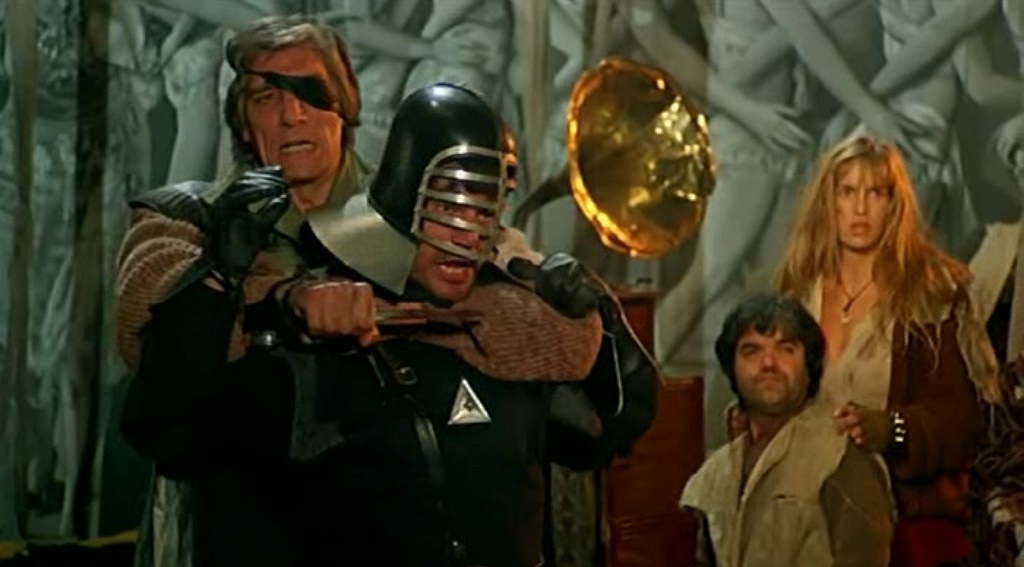
Parsifal finds himself unable to reject such a fine offer. Well, actually, he kind of has no other choice as they'll just execute him if he doesn't comply. He's set up with two helpers / traveling companions: Bronx ("Vincent" / Paolo Maria Scalondro), a former history professor who has a score to settle with the Euracs since they slaughtered his entire family and cut off his arm (which has been replaced by a robotic claw) and the eye-patch-wearing strongman Ratchet ("Roman Geer" / Romano Puppo). The three ride their motorcycle to Manhattan and are able to access the city via a hidden, rat-infested underground tunnel. Once there, trouble awaits around every turn, if not from the crazed mutant citizens then from the horse-riding Eurac guards and higher-ups.


Our heroes are first held prisoner by a filthy group of rat-eating mutants (the "Needle People") led by Japanese actor Hal Yamanouchi, who regularly execute dwarfs because they remind them of children. Among that clan is a hot blonde named Giada (Valentine Monnier), whom Parsifal automatically assumes is the fertile woman because, uh, she's hot, I guess? Before he can find out for sure, Eurac soldiers barge in, sink a battle axe in the leader's head and kill many of the other men. Though Ratchet manages to hide, Parsifal, Bronx, Giada and some of the other ladies are abducted and hauled off to the Experimental Center. There, the bald Eurac Commander (Serge Feuillard) rightly suspects Parsifal and Bronx are Pan-American spies and tries to torture them into confessing. Instead, he ends up getting his eyes gouged out and his captives escape. The Commander then orders Anya (Ana Kanakis) and his guards to hunt them down, with orders to capture Giada alive and kill the others.


While this was clearly bankrolled to cash in on several other then-popular films, and thus borrows many elements from said popular films, this somehow manages to transcend all that through sheer creativity. Besides, just because you're ripping off certain aspects from other films doesn't mean you can't put your own creative spins on those aspects. Just ask Quentin Tarantino. He's made a career of it. And this is, surprisingly enough, a film of some technical merit outside of just being a trashy cash-in. It's really not poorly made, shot or edited, there's plenty of fast-paced action throughout, the characters are strangely endearing, exterior shooting locations are well-chosen, some (though not all) of the art direction and costumes are good, there are lots of fun (though seldom convincing!) miniatures and the "Oliver Onions" (Guido De Angelis and Maurizio De Angelis) synth score is great.

Helping matters along nicely are a slew of interesting oddball characters. There's a commune of sewer-dwelling dwarfs led by "Shorty" ("Louis Ecclesia" / Luigi D'Ecclesia) and a clan of hairy-faced monkey mutants led by the swashbuckling (!) Big Ape (George Eastman), who's desperate to plant his "seed." Thankfully for the sex-mad simian, Melissa (Alessandra Tani), the real last fertile woman on Earth, and a virgin no less, is eventually discovered. She's been kept in a state of "hibernation" in a glass case just like Sleeping Beauty by her scientist father, who stuck her in there before the war so she wouldn't be contaminated and thus could conceivably be used to repopulate once it was safe to do so.


We also get an ultra-high-pitched sonar that causes ears to bleed and then death, multiple decapitations with a boomerang-like sword, car chases, car crashes, laser shoot-outs, a futuristic update of the old rack torture device, a backstabbing cyborg, a robot clown with a giant glowing eyeball on top of its head, rats chewing off a face, eating corpses and (unfortunately) actually get skewered and a giant replica of Picasso's Guernica at the Eurac headquarters. There's a good deal of horror grue in this one, as well, including a gory disembowelment, a face getting blown right off, eyes gouged out, eye transplant surgery, slashings, shootings and much more. On another note, is it actually possible to dislike Sopkiw? This is one guy who is so amiable and effortlessly charming that he can give mediocre line reading after mediocre line reading and you still love him, anyway.


A French / Italian co-production, this was filmed in Italy, New York City and the Arizona desert (subbing for Nevada). Co-scripted by Ernesto Gastaldi , this also features James Sampson as a mutant trumpet player and Jacques Stany as a Eurac officer. It was first released theatrically in the U. S. in 1984 under the title After the Fall of New York and made its VHS debut the following year courtesy of Vestron Video, using the same title. Later DVD (from Media Blasters, Shriek Show) and Blu-ray (from Code Red in the U. S., 88 Films in the UK) releases usually tacked the 2019 back to the beginning.

★★★
Related Posts Plugin for WordPress, Blogger...