.
.
.
Showing posts with label Ramón Obón. Show all posts

Sunday, September 6, 2020

La mansión del terror (1989)

... aka: Hasta que la muerte nos separe (Till Death Do Us Part)
... aka: Mansion of Terror, The

Directed by:
Ramón Obón

Hugo Stiglitz (in a ridiculous poofy wig that doesn't match his beard) stars as Orlando, a well-to-do, turn-of-the-century pianist obsessed with a theater actress named Griselda (Luz María Jerez). Griselda's recently been cast as the female lead in a small production of Othello. Orlando makes sure to attend every single one of her showings (where he gets to see her being strangled on stage every night), sends her flowers nightly and makes his romantic intentions pretty obvious as he intently watches her from his balcony seat. Late one night at a trolley station, he approaches Griselda and, despite his intense and persistent nature (and the fact he initially creeped her out), charms her into having dinner with him. He then invites her to attend one of his performances. The two develop a mutual admiration for each other's talent and become lovers. Soon enough, Orlando is presenting her with expensive jewelry and asking her to become his wife. Griselda is initially apprehensive and has no interest in giving up her career for marriage and family. However, she ends up caving in and the two have an impromptu wedding on the theater stage in the presence of Griselda's friend / roommate Emilia (Lizetta Romo) and the rest of the Othello cast.


Orlando takes Griselda to his home, a secluded but well-kept mansion, located deep within the desert. She almost immediately regrets her decision as the ice cold maid Tencha (Dacia González) gives her dirty looks, almost completely refuses to acknowledge her and clearly doesn't want her to be there. Not just that, but she hears voices coming from the cellar, hears Orlando arguing with someone upstairs and then has a vision of a blonde woman being strangled by someone wearing a wedding gown while she's in the middle of trying to make love to her new hubby. Was it a ghost? A hallucination, perhaps? The next morning, she finally meets Orlando's mother, Eloisa (Rosita Quintana), who's surprisingly bubbly and friendly and eases her mind by letting her know that the mansion is now also her home. She gives her a tour of the estate, including of her beloved greenhouse.


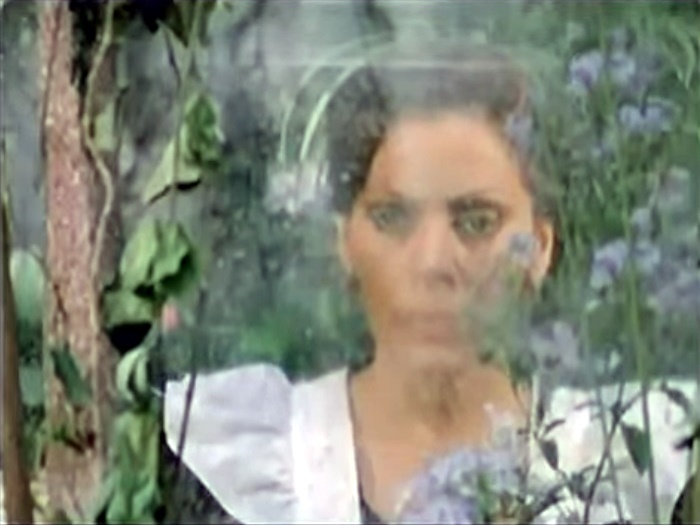


The relief doesn't last long, however, as Eloisa casually reveals that Orlando was previously married, something he never bothered telling her. The family may even keep a portrait of her on the wall and a weird shrine for the dead woman, with her wedding gown as the centerpiece, in the home, though it's also claimed that the woman is a relative. According to Eloisa, the woman in the portrait is her sister, she went crazy and then had to be locked up in an institution. She also looks an awful lot like Orlando's new wife. When Griselda confronts her hubby about her, he shouts at her, clutches his head as weird sci-fi sounding music plays, almost strikes her with a lash and then storms off. Griselda then begins seeing a wedding gown-clad figure lurking around the mansion grounds, which leads her to an abandoned, overgrown old church filled with creepy religious statues that's unfortunately never used again after this one brief scene.

While she's in the bathroom washing her hair, our heroine is vicious attacked by the bride. She pulls her hair, wrestles her to the floor and slices her up with a wire before Griselda's able to lock her out of the room. Meanwhile, Orlando starts mentally deteriorating into a piano key-pounding, migraine-suffering maniac and the two older ladies are both harboring their own dark secrets. There are character revelations, black-and-white flashbacks, nightmares and ghostly visions, plus a corpse hidden under the floorboards in the cellar.


By late 80s genre standards, this is incredibly tame, old-school, talky, slow-paced and non-exploitative. In other words, it's something that could conceivably be shown on television with just a few minor trims. It's also one of those movies that doesn't quite have the budget to effectively realize its period setting (though effort is at least made with the costumes, hair, vehicles, sets, etc.) nor is it fully able to achieve much in the way of gloomy Gothic atmosphere because the bulk of it takes place in a pristine, brightly white, sparsely decorated house. That said, this is competently directed, written and shot. There's decent camerawork, stylish touches using colors and lens flares and, most importantly as this is a dialogue-driven film, a strong cast who's able to sell it. Jerez is strong in the lead and gets solid support from veterans Quintana and González. Top-billed Stiglitz is OK but gets overshadowed by all three of his female co-stars.

This was the directorial debut of Costa Rican-born Obón, who had previously written or co-written around 100 (!) other films, including The Empire of Dracula (1967), MADAME DEATH (1969), The Perverse Doll (1969), PANICO (1970), The Whip Against Satan (1979) and a number of Santo adventures. He was clearly heavily-inspired by a number of Hitchcock films here, most notably Rebecca (1940). There's also a bit of Flowers in the Attic in here, especially at the end.


I'm not sure what the original release title for this one was. It's listed on most websites as Hasta que la muerte nos separe ("Till Death Do Us Part"), though I was only able to track down a later VHS release utilizing that title. The original theatrical lobby card calls it La mansión del terror ("The Mansion of Terror") so that's the title I'll be using here. Like many other late 80s Mexican films, this has never been available in English.

★★1/2

Monday, October 31, 2016

Pánico (1970)

... aka: Panic

Directed by:
Julián Soler

We first see a nameless young woman (Ana Martín) staring blankly out of a window. She hears her baby crying, goes to the bassinet and pulls back the sheath to reveal that there's no baby there. This woman is clearly not right in the head, something further illustrated by the fact she thinks a baby doll is the real thing. As she's holding it, she's startled by a strange woman (a very intense Ofelia Guilmáin) in a purple dress staring her down from the side of her house. She drops her baby, it breaks and then she stuffs the remains inside a pipe and flees into the woods with the madwoman in hot pursuit swinging a knife around. As the frightened young woman keeps going, she spots three men standing around and either fantasizes about or flashes back to a time when she was gang raped. A baby doll rises from a pool of blood but she can't pull it out. The camera keeps panning up and down trees and doing 360 degree swirls at the sky. This almost entirely dialogue free 17 minute experimental piece (titled "Pánico") has some effectively creepy moments and several good startles and is a fittingly bizarre opening to this above average but seldom-watched three-story anthology.


Story #2, "Soledad" (or “Solitude”), opens with two men; the emotional Carlos (Joaquín Cordero) and his more level-headed friend Abel (José Gálvez), just finishing up burying the latter's wife (Susana Salvat). Unlike most of the rest of their village, they didn't get out when they should have as the yellow fever struck. Although it's too late for the wife, the men decide to take off down a stream by canoe to put as much distance between themselves and the plague as possible, eventually hoping to find a town that's not been effected. During their long and exhausting trip, both men have flashbacks. Abel only has bad memories of his wife and how she was stripped of her beauty as she lay on her deathbed. Carlos, however, remembers her being both beautiful and passionate; probably because he was having an affair with her behind Abel's back that his friend still has no clue about. While the two are lost in thought, their canoe capsizes and is washed downstream. Now they're forced to camp out and walk.


The swamp they're stuck in is rough and unforgiving terrain, something the gruff and hard-working Abel is accustomed to but not so much the weaker and more guilt-stricken Carlos. Carlos becomes paranoid they're going to die there, finally admits his affair, starts hearing his dead lover calling to him and soon is begging Abel to put him out of his misery already. Instead, Abel's the one who gets a knife in his back after a scuffle in quicksand. Carlos buries the body and now is left all alone in the jungle trying to survive, which isn't easy considering he's not only falling apart mentally but physically as well thanks to very likely being plague-infected himself. And there's the small added issue of Abel's corpse not wanting to stay buried.

Running 40 minutes, this is bleak, dark, slow and moody, with an outstanding central performance from Cordero, several effectively chilling moments and excellent use made of sound, setting and natural lighting. The solitude of the title, as well as the grim situation both men find themselves in, is driven home by filming this in a heavily-shaded forest where speckles of shadow heavily intrude into every frame as if constantly closing in on the protagonists.


After two completely serious and depressing tales, the third segment (“Angustia” / Anguish) finally offers up a bit of humor and levity. Having worked tirelessly for three long months, scientist Tiberius Hansen (Carlos Ancira) has just created a powerful, long-lasting narcotic that would make for an excellent surgical anesthetic. With just a few drops of this potent stuff, a patient can be put into a cataleptic state and have their bodily functions slow to a death-like rate while still retaining their cognizance. Just imagine what it'd be like taking even more of the stuff! Well Tiberius is about to find out since his pesky lab cat has knocked an entire beaker of his formula over onto his coffee mug. Soon after drinking it, Tiberius keels over onto floor. Hearing a noise, his wife Melody (Alma Delia Fuentes) rushes into the lab only to find him motionless and unresponsive.

A doctor (Aldo Monti) is called in, does an examination and pronounces Tiberius dead. He doesn't even give the body a chance to get cold before signing the death certificate and trying to get Melody to make burial arrangements. Seems like he, as well as Tiberius' good friend Elias (Eduardo MacGregor), are secretly excited there's a sexy new single woman on the market. But there's something strange about the corpse. His eyes won't stay closed. The doctor chalks that up to rigor mortis, but Melody's cousin Vilma (Pilar Sen) would rather be safe than sorry and recommends they slit his wrists. Melody passes on her suggestion. After all, she doesn't want her hubby's corpse to be desecrated. Tiberius (whose thoughts we hear as a voice-over) is certainly relieved. However, he may end up being buried alive if the drug doesn't wear off in time.


An amusing spin on Poe's The Premature Burial, this features some very funny moments, a rather morbid (yet amusing) conclusion and clever camera shots, like a “corpse” POV as various characters unsuccessfully try to close Tiberius' eyelids. Even more cleverly, it traces the scientist's slow awakening period through his cat, which has fallen into a similar dead state after lapping some of the formula off the floor. However, unlike the scientist, it managed to crawl under a table and hide to avoid detection.


A nice surprise, this obscure anthology manages to pull off what few other horror anthologies have: Presenting numerous stories that all work about equally well while each offering up something different content-wise, visually and tonally. Even most of the more famous films of this type can't say that. The first story, albeit somewhat predictable, takes an arty, imagery-based psychological approach. The second, while perhaps too slow going for some viewers, is all about creating mood and atmosphere. And the third is a black comedy that doesn't completely forget the genre during its final act. Clearly filmed on a very low budget and it often shows, but Soler and screenwriter Ramón Obón put real care and imagination into this one and the actors put in solid if not exceptional work.


IMDb currently has this listed as being released in 1966, though a date on a tombstone (and numerous other more reliable sources) says in was made in 1970 and played in theaters in 1972. It was released on VHS here in the U.S. in 1987 on the Esco-Mex label.

★★★
Related Posts Plugin for WordPress, Blogger...