.
.
.
Showing posts with label Morris Ankrum. Show all posts

Tuesday, October 26, 2021

How to Make a Monster (1958)

... aka: Der Satan mit den tausend Masken (Satan with a Thousand Masks)
... aka: La batalla de los monstruos (Battle of the Monsters)

Directed by:
Herbert L. Strock

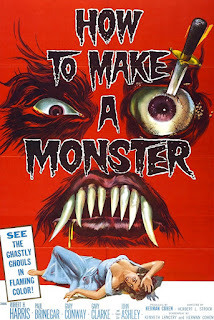
Veteran make-up artist Pete Dumond (Robert H. Harris) has spent decades fine-tuning his craft for American International Studios, whipping out one impressive monster design after another. And, unlike a lot of other people in show business, Pete still enjoys his job since he frequently gets to work with eager, energetic and far less jaded teenagers which in turn helps keeps his enthusiasm up. However, the studio has just been bought out by NBN Associates and they want to make some changes. New studio execs John Nixon (Eddie Marr) and Jeff Clayton (Paul Maxwell) come barging into Pete's workshop letting him know that they'll no longer be needing him or his faithful, slow-witted assistant Rivero (Paul Brinegar). After all, according to them, "Monsters are finished... the horror cycle is over!" Pete retorts that they said the same thing twenty-five years ago before his werewolf creation saved the studio from bankruptcy. Still, the new big brass want to revamp the entire studio's image. Instead of monster movies, they want to focus on upbeat musicals, comedies and flyweight "escapist" films. After Pete finishes up his work on AIP's latest Teenage Frankenstein vs. Teenage Werewolf opus, he's to clear out and find work somewhere else. They offer to give him a whopping week's worth of severance pay for compensation, but Pete basically tells them to stuff it.


The irate make-up man, who feels like he's now in a fight for not only his livelihood but also his life, devises a plan. Since he's skilled with various drugs and chemicals that he's experimented with over the year, he gets to work creating an all-new formula. His "foundation cream" will be infused with this chemical so that it goes directly into the pores of whoever has it applied to them. Just how does it work? Well, it "blocks the nerve synapses" to "paralyze the will" and thus will "have the same effect chemically as a surgical prefrontal lobotomy." Combined with hypnosis, whoever wears the make-up will be passive and obedient to Pete's will. In other words, they'll be perfect instruments for revenge!

Young, hungry and naïve (i.e. dumb) Larry Drake (Gary Clarke), who's been cast as the werewolf in the current film, stops in for his make-up, where Pete plants the seed in his mind that whenever they finish making this monster movie, he'll have an impossible time finding work himself. Larry then allows Pete to apply his concoction to his face. He sends him out to kill John and then return to the workshop, after which he releases him from his hypnotic trance and he remembers nothing. However, later on he doesn't quite feel himself. Pete even uses the cream on himself when a night watchman (Dennis Cross) gets a little too big in the britches and hopes to impress the new owners by helping find John's killer.


Tony Mantell (Gary Conway), a young, hunky and (recurring theme here) none-too-bright young actor who's been cast as Frankenstein, also inadvertently gets in on the action when Pete sends him after the other studio executive. That's three murders in no short time, all corresponding with the studio shake-up. The press have a field day with the murders while the owners try to decide whether or not to shut the studio down for awhile and the investigators on the case, led by Captain Hancock (Morris Ankrum) and detectives Thompson (Walter Reed) and Jones (John Phillips), try to piece all of the clues together. The fact Pete and Rivero have been keeping long hours at the studio automatically puts them on the suspect list and, with Rivero being kind of weak and flaky, Pete starts to fear he'll eventually crack and give them both away.


This has middling scores on both IMDb and Letterboxd, but I quite liked it. Though not without its flaws, I found this not only fun and entertaining but also rather praiseworthy as an influence on self-aware / post modern / meta horror, which became a more popular (and overused) angle much later on. This also offers some very good make-ups from Phillip Scheer (though he's basically recycling most of his designs from earlier films) and a fantastic central performance from Harris, who's able to inject some pathos into his otherwise villainous character to keep him from becoming too one-dimensional. Pete even has a shrine in his home decorated with replicas from such fine creature features as IT CONQUERED THE WORLD (1956) and INVASION OF THE SAUCER MEN (1957), there's an amusing plug for the upcoming HORRORS OF THE BLACK MUSEUM (1959) and it's also a pleasant surprise when the film suddenly switches to color in the last ten minutes.

Most interestingly, this is filled with analytical, surprisingly perceptive and sometimes humorous commentary on the the horror genre, its importance and how it is perceived (and quite often misunderstood) by the public at large. Studio heads look down on the genre, as if their brainless movies (which they insist be filled with "pretty girls" and "gorgeous gals") are any more reputable. Detectives wonder if horror films and Pete's monster creations could provoke violence from any "weirdies" in the audience. The young actors cast in the horror films take the roles for their big break but still fear being typecast. And Pete, crazy as he turns out to be, has all kinds of valid points to make, from monster creations being art like any other form of art (true), that a good actor should be able to emote and / or make an impression even from underneath his / her make-up (also true) and the psychological positives that horror films provide the audience (true yet again).


The cast also includes Malcolm Atterbury as the studio's veteran security guard, Thomas Browne Henry as a nice guy director, Robert Shayne as a pissed off talent agent and "guest star" John Ashley as himself, doing a horrible musical number called "You've Got to Have Ee-Ooo" with some female dancers to show us what kind of garbage the new executives plan on cranking out. Sound effects editor Verna Fields would go on to win a much-deserved Oscar for editing Jaws.

In 1992, Ed Wood's widow Kathy came forward with claims that "presenter" / executive producer Samuel Z. Arkoff stole the entire idea for this film from her husband; a claim that Arkoff denied. Both the story and the screenplay are credited to Herman Cohen (also the producer) and "Kenneth Langtry" (Aben Kandel). Arkoff returned to executive produce a cable TV "remake" in 2001 that bears little actual relation to this original film.


This was double-billed with Roger Corman's Teenage Caveman (1958) during its theatrical run. It has since been given numerous home video releases: MCA / Universal distributed it on VHS, Lions Gate released it on DVD (they paired it with Strock's The Blood of Dracula) and Scream Factory released a Blu-ray in 2020.

★★★

Friday, May 6, 2016

Invaders from Mars (1953)

... aka: Gli invasori spaziali (The Space Invaders)
... aka: Invasion vom Mars (Invasion from Mars)
... aka: L'attaque des martiens (Attack of the Martians)
... aka: Les envahisseurs de la planète rouge (Invaders from the Red Planet)

Directed by:
William Cameron Menzies

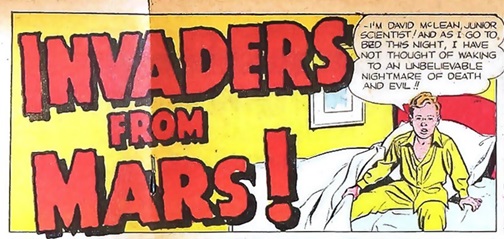
13-year-old David MacLean (Jimmy Hunt) has a great interest is science and astronomy, something he's picked up from his scientist father George (Leif Erickson), who works as an engineer at a rocket manufacturing plant. David's so dedicated to studying the stars that he sets his alarm for 4am just so he doesn't miss the chance to get a clear look at the Great Nebula. Afterward, he's awoken by a loud humming noise and bright lights and spots what he thinks is a spaceship landing beyond the sand dunes near his home. He wakes up his father and tells him about what he'd just seen, which has George heading out to the dunes on his own. By morning, he hasn't returned. Concerned, his wife Mary (Hillary Brooke) phones the cops. Two officers show up and go to the dunes, only to be swallowed up by something under the sand. Both George and the officers eventually turn up, though when they do they're not quite the same. The once kind and loving George is now extremely irritable, cold and short-tempered, even going so far as to slap his son to the ground for no reason. He also seems to be in some kind of strange plot with the two policemen. David notices that both his pops and the officers have small, needle-like puncture wounds on the back of their necks.


More people in town are tricked into going to the sand pit and return not quite the same as before. A little girl named Kathy (Janine Perreau) falls in and returns home only to set the basement on fire with gasoline. After George takes Mary up to the dunes, poor David finds he really has no one to turn to. That is until the taken-over police chief throws the boy in the slammer and another officer calls in psychologist Dr. Pat Blake (Helena Carter), who becomes an unlikely ally and saves David from having to go home to his parents when his mother tries to insinuate he got his alien invasion ideas from “reading those trashy science fiction magazines.” Pat is friends with astronomer Dr. Stuart Kelston (Arthur Franz) and takes the boy to the observatory where he works. After David recounts his story and the astronomer and Pat get some solid evidence of what's going down at the sand pit, Kelston calls up the military and troops are soon on their way led by the surprisingly open-minded Colonel Fielding (Morris Ankrum).


After young Kathy is found dead, an autopsy reveals not only that she'd suffered from a cerebral hemorrhage but also that she's had a small crystalline gadget attached to the base of her brain, which the subterranean aliens use to control their victims. They not only give out orders using the device but also can terminate their slaves in a second's notice. Anyone who'd disappeared down the sand pit thus far, including David's parents, the police chief, two officers and an army general, have undergone the procedure and now must be found and taken to a brain surgeon to have them removed. The military then descend into a series of dark caves the malicious space visitors have carved underground in an effort to stop them.


Invaders is one of the most famous low-budget sci-fi flicks from its decade and it's easy to see why this one scared the hell out of the Baby Boomer generation. This is not only told from the viewpoint of a child but it's fashioned specifically to both capture the feel of a child's nightmare (and a child's vivid imagination) and deal with common childhood fears (like not being able to trust adults), which is precisely why it struck a particular chord with the youth of the 50s and 60s. The first 20 minutes or so brilliantly capture the feeling of being trapped in a bad dream, which is brought full circle at the end with a bookmarking scene that brings us right back to where we started. This feel is further accentuated by expressionistic, vacant sets, taller-than-normal doorways, exaggeratedly long halls and other off-kilter touches to give the film the feeling of unreality.  All of this was clearly by design for Menzies, who was also the production designer and had previously won several art direction Academy Awards.


The creature design is also memorable. The “Invaders” of the title are led by just one master alien; a silver, pint-sized being with tentacles that's kept in a glass globe. Though small, it looks very serious like it really means business and, since it doesn't speak, its intentions for Earth and its denizens are left ambiguous. This alien design clearly went on to influence the look of Belial in the Basket Case series. Doing most of the alien's dirty work and hard labor are a bunch of tall mutant (amusingly pronounced “mu-taunt” by the cast) slaves, which are basically tall men in baggy suits with giant plastic cups over their eyes. The spaceship they've traveled in is just like many of the other sets and almost a blank canvas colorfully lit up with green and blue and with the walls casting large, ominous shadows.


This isn't without some major flaws, though. After a really strong start the dull mid-section drags and it's downright sloppy at times in regards to how it incorporates stock footage and recycles shots. Some sequences manage to be poorly directed, poorly shot and poorly edited, including a bit where a couple of alien-possessed humans attempt to assassinate a scientist. That said, this is still a minor classic of its day (with all of the expected cold war themes) and still worth seeing, particularly for its odd and unique visual presentation.

Filmed on a budget of less than 300,000 dollars, this was rushed into production to beat the upcoming 2-million-budgeted THE WAR OF THE WORLDS (1953) to theaters. That it did, by three whole months, and it became the first color alien invasion film as a result. This also deserves a lot of credit for helping to develop the popular concept of aliens taking over human bodies. Invasion of the Body Snatchers (1956) usually gets credit for that, but this film did it first and also did it several years before Jack Finney's Body Snatchers novel was published in 1955.


There are some noteworthy differences between the 78-minute U.S. and 83-minute British releases of this film, most importantly the latter attempting to dress up the sets and altering the ending, which essentially ruins the director's entire vision in the process! This was done because British censors found the original ending not upbeat and positive enough for their liking. Some of the original actors were even called back to shoot new footage specifically for the British release (including a longer and talkier scene at the observatory where they discuss UFO cases) months after production had wrapped. Stick with the U.S. version if possible, though the 50th Anniversary "Special Edition" DVD from Image contains both prints.


The cast also includes William Phipps and Milbur Stone, plus uncredited appearances by a pre-Leave It to Beaver Barbara Billingsley as a secretary, Bert Freed, Peter Brocco, Robert Shayne and Richard Deacon in his film debut. In theaters, it played both as a standalone feature and (later) as part of a double bill with This Island Earth (1955). Tobe Hooper offered up a big budget remake in 1986, which was both critically panned and a financial flop.

★★★
Related Posts Plugin for WordPress, Blogger...