.
.
.
Showing posts with label Juan López Moctezuma. Show all posts

Tuesday, December 27, 2022

La mansión de la locura (1973)

... aka: Dr. Tarr's Torture Dungeon
... aka: Edgar Allan Poe: Dr. Tarr's Torture Dungeon
... aka: Edgar Allan Poe's The System of Doctor Tarr and Professor Fether
... aka: House of Madness
... aka: Mansion of Madness, The
... aka: System of Doctor Tarr and Professor Feather, The

Directed by:
Juan López Moctezuma

Prior to this, Moctezuma produced Fando and Lis (1968) and El Topo (1970) for Alejandro Jodorowsky, and that surrealist bent has carried right on over to this Edgar Allan Poe adaptation, which was based on his 1845 lunatics-taking-over-the-asylum short story "The System of Doctor Tarr and Professor Fether." The director isn't the only Jodorowsky connection either. The film's producer (Roberto Vizkin), cinematographer (Rafael Corkidi), editor (Federico Landeros) and other crew members were also carried over from the aforementioned Jodorowsky films, as well as some of the cast members. Apparently a lot of them were also involved in some kind of experimental theatre group at the time. 

Though a Mexican production made by a mostly Spanish-speaking cast and crew, this was filmed entirely in English. Of the four primary stars, one is Mexican, one is French and two have been drafted in from America. And though set in 19th Century France, the entire movie was filmed in Mexico. Certainly sounds like the makings of a very strange brew and this film lives up to that promise, though not always in a good way.
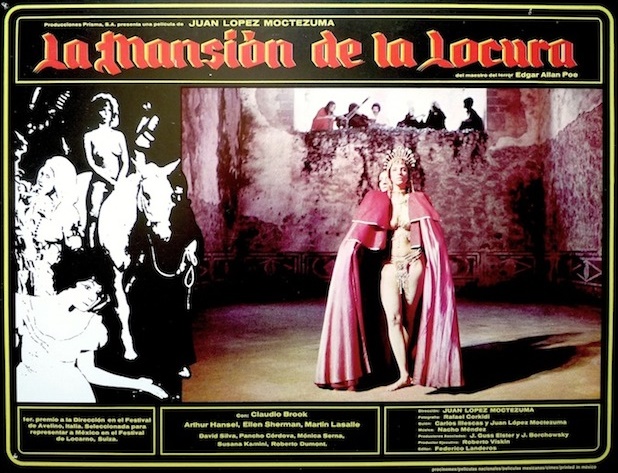

Journalist Gaston LeBlanc (Arthur Hansel), who was born in France yet raised and educated in the United States, has landed a gig writing an article about a remote French sanatorium's novel way of treating its patients. This not only gives him an excuse to visit his homeland but also an opportunity to explore subject matter that fascinates him. You see, when he was very young, too young to actually remember it, his mother was killed and her family accused his father of murdering her, which led to his incarceration. He ended up living out the rest of his days locked away in a madhouse. Accompanying him on the carriage ride is acquaintance Julien Couvier (Martin LaSalle), who claims to be "terrified" of mentally deranged people but is willing to show his friend around, and Julien's cousin, Blanche (Mónica Serna).

Upon arriving at the tunnel entrance of the grounds, Julien is surprised to see posted armed guards blocking the entrance. There never used to be any guards before. When another guard shows up, they're finally allowed to pass and then encounter two nuts, one dressed up as a monk and the other like some reject from a community theater production of Alice in Wonderland. The latter shouts the various names of the devil before being chased off. Do they just let the patients run amok at this particular asylum? It's certainly starting to look that way.


Because they're scared of the asylum, Julien and Blanche drop Gaston off at the entrance and then bid him adieu. As soon as he's on the grounds, Gaston realizes that, yes, the disturbed patients are indeed allowed to freely wander, as are a variety of barnyard animals. He meets up with the eccentric asylum director, Dr. Maillard (Claudio Brook), who gives him a grand tour and tries to explain the methods to his madness. He claims the patients are like his children and the asylum is their playground. Maillard has been using a radical new technique called a "soothing system" to run the place, which allows patients the opportunity to constantly work on different "inventions" without interference. One has made a storm generating machine. Another, a metallic womb uniting man with the universe. As for the patients of "great warmth," they're stuffed into pipes to help with the establishment's heating system. The energy then generated is crystallized into a miraculous drug that kills inactiveness and keeps the patients' violent tendencies at bay.

Needless to say, Gaston is rather perplexed ("The more you say, the less I understand"), but Maillard assures him the techniques have been developed and fine tuned by the celebrated, world famous duo of Doctor Tarr and Professor Fether. Embarrassed, Gaston confesses to have never heard of either, though they're no doubt both extraordinary men. Further into the bowels of the establishment they go, where Gaston meets Mr. Chicken, a man who lives the life of a rooster, including doing the chicken walk, eating only corn and constantly clucking. From there, it's down into the asylum's dark, dingy and rat-infested dungeon, which is only accessible through a confusing labyrinth of underground tunnels. There, Gaston discovers the asylum is not all fun and games. A starving, deranged, Dante-quoting old man is tied to a rack, and other prisoners are scattered about, either shackled or locked in cells.


About the only thing keeping Gaston there is that he's started to fancy Maillard's beautiful, harp-playing niece Eugénie (Ellen Sherman). He fears her life may be in danger, especially after she performs a sacred Javanese dance where she seductively strokes a phallic conch and then tries to use the shell to stab Maillard. When Gaston accuses Maillard of being an impostor, he's locked up in his room and threatened with permanent imprisonment in the dungeon. There are revelations about the true identities of both Maillard and Eugénie as Gaston plots to escape.

As all of that is going on, it turns out that Julien, Blanche and their coachman Henri (Jorge Bekris) didn't make it far beyond the asylum gates before getting buggy-jacked by a group of bandits. The men are beaten, Blanche is raped and all three get tied up and dragged deeper into the forest. Julien manages to sneak away but is forced to hop around on one leg as cartoonish music plays. Later developments involve an attempted human sacrifice atop of pile of grapes and apples, a plot to "cleanse" our heroes by fire, a priest (David Silva) and priestess (Susana Kamini) who oversee a newly-invented religious sect, someone dry-humping a lamb carcass and a trio of tarred and feathered performers doing an interpretative dance accompanied by atonal, distorted chicken screeching. Ay ay ay.


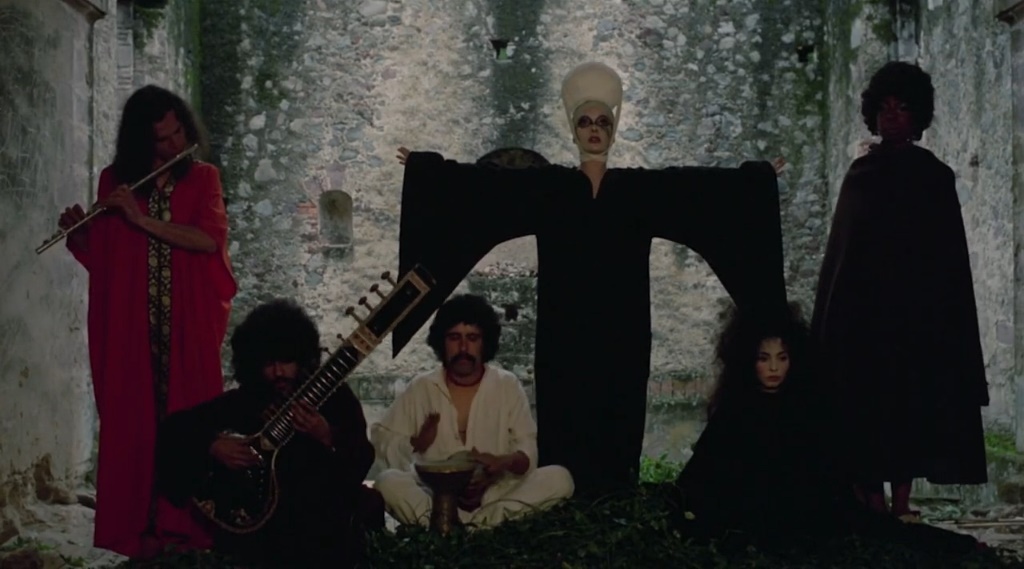


No doubt this is trying to make a political statement with the smug, megalomaniac doctor-dictator ruling over his self-professed "kingdom," sometimes barking out orders from a throne made out of bones. Those who abide by his rules are rewarded with freedom and perks like music or a lavish feast while those who oppose him are killed, imprisoned (either in a large cage or in decorative glass boxes) or banished to the dungeon where they'll wither away and die. Naturally there's a revolution brewing from the 'have nots' of the establishment. 

Frequent jarring tonal changes, the talk-heavy script, pseudo-campy overacting and the extremely dreary, depressing setting and intentionally drab photography constantly at odds with the whimsical, lighthearted music and absurdist would-be "comic" content make this difficult to sit through.


There's some nudity (including that old surrealist standby of a naked woman riding around on a horse indoors for no good reason) but minimal violence. The best thing going on here is clearly the costume design and art direction. British surrealist painter / writer / sculptress Leonora Carrington, who lived out most of her adult life in Mexico, supervised both. Rather interestingly, Carrington spent time in an asylum herself after suffering from a psychotic break in her early 20s, and wrote about her experiences and harsh treatment in her memoir, Down Below. Her son, Gabriel Weisz, also worked on the production design.


A slightly cut version with the original English audio track played in U.S. theaters under the title Dr. Tarr's Torture Dungeon in either 1976 or 1977. The Spanish-language version, which had been released first (years earlier actually), had to be re-dubbed. This made its American home video debut courtesy of Magnum in 1985, then fell into public domain hell for a number of years with a subpar print (presumably culled from the VHS) distributed on all kinds of gray market labels. Mondo Macabro, who'd also handled the director's ALUCARDA (1977), saved the film with a proper restored DVD release in 2005. Extras on it include essays, a trailer, an interview with Guillermo del Toro (who counts Moctezuma as an influence) and a 1977 text interview with the late director, who passed away in 1995.

★★

Monday, March 11, 2019

Alucarda, la hija de las tinieblas (1977)

... aka: Alucarda
... aka: Alucarda: The Daughter of Darkness
... aka: Inferno, The
... aka: Innocents from Hell
... aka: Mark of the Devil 3
... aka: Mark of the Devil Part 3: Innocence from Hell
... aka: Pieklo (Hell)
... aka: Sisters of Satan

Directed by:
Juan López Moctezuma

After the death of both of her parents, the pretty, fair-haired Justine (Susana Kamini) is sent to live at a convent / orphanage with some nuns. Though the Mother Superior (Birgitta Segerskog), her compassionate, motherly novice Sister Angelica (Tina French) and the others all seem pleasant enough at first, something seems a little off about this place. For starters, the nuns aren't much for non-religious decor and the uncommonly drab, dark and primitive convent seems little better than a cave. And then there's the choice of nun attire, which sees them wrapped from head to toe in what appears to be dirty bandages that are stained brown and red. We're left to use our imagination as to where all those stains came from. Justine is taken to the nearly barren bedroom (two beds and a cross) where she'll have to live out the rest of her teenage years and meets her new roommate Alucarda (Tina Romero), who we're first introduced to emerging out of the shadows Dracula-style.

Alucarda is a friendly and inquisitive, though intense, clingy and death-obsessed, girl who always dresses in black and likes to venture out in the forest to find "secrets." She doesn't have much use for the nuns or the church and just happens to be at the convent because her mother died shortly after giving birth to her. Despite her bizarre behavior, the lonely Justine quickly grows close to her. On an outing in the forest, the two run away from their group and meet a hunchback gypsy (Claudio Brook), who warns them that demons haunt the woods and then tries to sell them amulets to ward off the evil. After running away, the two end up at a large, abandoned temple / crypt. Venturing inside, Alucarda is struck by the feeling she's already been there before. She unwisely opens a coffin, hears voices "coming from the past" and then all hell breaks loose.


Upon returning to the convent, Justine passes out during a brimstone and hellfire sermon. Alucarda keeps hearing those deep demonic voices, becomes hysterical, spins around, pulls her hair, starts screaming about Beelzebub and Asteroth and vows to get revenge on the church for all she feels they've taken away from her. Next thing we know, the hunchback is appearing in their room, stripping the girls naked, cutting their breasts and making them lick each other's blood. They're then whisked off to some kind of Satanic orgy with the gypsies where a goat-headed demon makes an appearance. Sister Angelica has visions of what's going on, attempts to intervene with prayer, sweats blood and levitates but it doesn't seem to do much good.


Alucarda and Justine only get worse; interrupting bible class with blasphemous proclamations about doing as many evil deeds as they can and chants of "Satan! Satan! Our lord and master!" Afterward, Justine grows seriously ill and inconsolable, and goes into hysterics at the mere sight of a cross, while Alucarda verbally and physically assaults Father Lazaro (David Silva) and talks of her blood pact with her friend. After a group flagellation and consulting a book on similar incidents compiled by the Vatican, Lazaro becomes convinced the girls are possessed by either a demon or by Satan himself. He orders an exorcism which, in this film, requires more than constant prayer and bible readings. Both girls are chained to crosses, Justine is stripped naked and then poked repeatedly with a metal needle in various spots until she bleeds to death.

Before they can move on to Alucarda, widower Dr. Oszek (Brook again) barges in and rescues her. He takes her back to his home, where she quickly becomes attached to his blind teenage daughter Daniela (Lili Garza). Back at the convent, Justine's body disappears and the nun who was in charge of watching over her body is found burned to a crisp and then miraculously returns to life and must be decapitated. Bearing witness to this, Dr. Oszek has a change of heart about what occurred there. He joins the priests and nuns in trying to locate both Justine and Alucarda, who's run off somewhere with Daniela.


What surprised me most about this one is that underneath all of the blood, incessant screaming and full frontal nudity lies a curiously conservative film. The doctor outsider, a man of reason and science, looks down upon the superstitious nuns and priests and finds their customs "pure rubbish" and "a primitive expression of ignorance" yet his interruption of their holy ritual and lack of spiritual belief leads to wholesale death and destruction plus manages to put his own daughter's life in danger. The convent's inability to exorcise (i.e. immediately kill) the two wayward girls who go against tradition ultimately leads to the fiery destruction of the entire convent.

Can't say I agree with the common sentiment that this film is making some kind of anti-religious statement or is a negative critique on religious extremism. In fact, it appears to be quite the opposite. Sure, the nuns are portrayed as seemingly unhinged fanatics prone to bug-eyed hysteria but, ultimately, their hyper sensitivity to evil and paranoia is completely justified. And, sure, the priest scares a bunch of little girls into crying fits with threats of "burning in hell forever" and "everlasting torture" and warns Alucarda that "liars rot in hell for eternity," but seeing how the Satanic evil is real and he's merely trying to protect them, why shouldn't he scare them straight? Even the convent's decision to kill both girls is proven to be the correct option seeing how both are murderous and irredeemably evil, even beyond the grave in one case. If anything, this film condones such extreme behavior from religious sects.


This got me thinking: Is it even possible for a film to be both pro and anti religion? It's certainly possible for a movie to be anti organized religion yet pro spirituality, or for a film to be pro religion and still highlight its flaws and hypocrisies, or how easy it is to abuse for personal gain. But if you're going to present things like Satan, demonic possession, miracles and the supernatural power of religious iconography as real, and position an educated man of science, two young lesbians and non-Christian gypsies as destructive threats, it seems to me that you've already picked your side. So does it even really matter that these hyper-religious folk are weird and repressed, traumatize kids and whip themselves bloody? Not really. It's pretty much all for show and shock.


Regardless of how one feels about the religious aspects, the film has atmosphere and visual merit and is still worth seeing for those reasons, plus a few others. There's strong (histrionic) acting from the leads, bizarre costume design, atmospheric sets (particularly creepy / cool is a wall with a crucified Christ set in front of a bunch of creepy stone faces), a great synth-heavy score and the occasional potent religious-horror imagery. References to both Stoker's Dracula (the girls swear their oath of loyalty next to a casket containing the body of Lucy Westenra) and Le Fanu's Carmilla (the whole lesbian angle) are also thrown in, though this certainly doesn't qualify as an adaptation of either.

Alucarda slowly gained a following in the U.S. thanks to multiple VHS releases (under new titles like Innocents from Hell and Sisters of Satan) and enthusiastic reviews in genre publications like Fangoria (who deemed it a "lost horror classic") and Psychotronic (who called it the best film of this type since Ken Russell's The Devils [1971]). It garnered additional attention after a 2003 DVD release from Mondo Macabro and when a few famous fans, like Quentin Tarantino and Guillermo Del Toro, came forward to sings its praises.


Moctezuma also made the Poe-inspired The Mansion of Madness aka Dr. Tarr's Torture Dungeon (1973), Mary, Mary, Bloody Mary (1975) and To Kill a Stranger (1982); each of which was filmed in Mexico but shot in English and received a U.S. release (something really not all that common). Prior to directing, helped to produce Fando and Lis (1968) and El Topo (1970) for Alejandro Jodorowsky.

The company Fame Home Video released this on VHS as the bogus sequel Mark of the Devil Part 3 to follow their releases of MARK OF THE DEVIL (1970) and MARK OF THE DEVIL PART II (1973). They followed that up with Mark of the Devil Part 4, actually the Paul Naschy film Horror Rises from the Tomb (1973), and Mark of the Devil Part 5, which is Tombs of the Blind Dead (1971). All of the tapes falsely boasted that they were banned in either 19 or 31 countries and several of them feature scantily-clad American Scream Queen Michelle Bauer on the front cover. The unrelated Mark of the Devil 666 (1995) was an ultra-low budget, shot-on-video American film.

★★1/2
Related Posts Plugin for WordPress, Blogger...