.
.
.
Showing posts with label Joachim Fuchsberger. Show all posts

Thursday, June 14, 2018

Der Fan (1982)

... aka: Blood Groupie
... aka: Fan, The
... aka: Trance

Directed by:
Eckhart Schmidt

Teenager Simone (Désirée Nosbusch) is obsessed with internationally-famous pretty boy New Wave pop star 'R' (Bodo Staiger). She wears his t-shirt, has posters of him on her walls and listens to his music all day, every day, analyzing each of his lyrics. She writes to him frequently and meets the mailman at the post office every single morning expecting a letter back. It has yet to arrive. She fantasizes about him kissing her but makes do with a life-sized decal of him on her bedroom wall for the time being. Even though they've never met, she thinks they share a bond and he writes his music just for her. As for all of the other women who show up with him in magazines? Well, they're only after his money but he already knows that, sleeps with them and then shows them the door. That's because he's biding his time waiting for someone just like Simone. She is the only one who truly understands him, truly loves him and can truly make him happy. If only he'd write her back.


Simone's obsession has already crossed the boundary into unhealthy and is causing her all kinds of problems in real life. She keeps ditching school, refuses to do her homework and refuses to take tests. She doesn't get along with her parents and barely acknowledges them. She completely ignores her former boyfriend. She even attacks the postman (Klaus Münster) because she has it in her mind that he's hiding R's response letter back to her. Either that or her mother (Helga Tölle) has confiscated it. In one of her letters, she asks 'R' to blink at her during a live TV variety show performance as a signal to her but her father (Jonas Vischer), who keeps threatening to send her to a boarding school if she doesn't shape up, switches the channel before he's even through singing. If only everyone wasn't conspiring to keep them apart.

The troubled girl has even worked out a worst case scenario in her head. If he refuses to acknowledge her and / or she's unable to find him, she plans on jumping from a tower with a note written to him so he'll be forced to at least think about her from time to time and thus she'll always remain a part of him. But that's only if she somehow can't get to him. No longer trusting anyone, she secretly gets her own P.O. Box and decides to wait one more week for the letter. If it doesn't come she's decided to  finally "take action" and go after what she wants. Needless to say, a letter doesn't arrive.


Now with plans to go all the way to Munich, Simone runs away from home. She gets a ride from a lecherous old man but ditches him when he tries to rape her in the back seat. Finally making it to the city, she starts watching the activities outside of a TV station every day. There, actors, singers and other celebrities pull up in fancy cars to be greeted by fans seeking autographs. Sometimes the celebs even select a fan and take them into the studio so they can watch the taping. Simone shows up there every day hoping 'R' will come back to perform on "Top Pop." She finally gets her wish. 'R' does show up and her first reaction to a face-to-face with him is to pass out.


Simone's taken into the studio, where she receives a surprising amount of attention from the singer. At first, we think he pities her or thinks it's cute she was so overwhelmed by him or he's just being a decent person, but the truth soon comes to light. To him she's just another groupie. They come there all the time. And he takes them to wherever he happens to be staying, has some fun and is then on his merry fan. After his mannequin-themed music video wraps, he gets into an argument with his manager, his PR man and his miserable-looking secretary April (Simone Brahmann), who seems to be secretly in love with him, and runs off with Simone. He takes her to a flat owned by a friend, where the two have sex and Simone confesses her undying love and dedication to him. He reacts to that by immediately trying to bolt; throwing her a bone by telling her he'll "try" to come back and see her in a few months and "try" to call her. We all know how that would work out. This time, however, he's picked the wrong girl.


A slow-building shocker, this isn't for an instant gratification audience as it makes one wait until the last 30 minutes for the more overt horror sequences. However, everything leading up to that is just as - if not more - interesting. This makes for a neat contrast to other movies dealing with celebrity and the music industry, which are almost always told from the perspective of the artist. Typically, the fans themselves are portrayed as vapid, brainless, shrieking nuisances on the sidelines so it's refreshing seeing a movie told entirely from the other perspective... even if that perspective also happens to be twisted! We get to hear Simone's thoughts and fantasies throughout (warped as those may be) in a voice-over, as well as what motivates her as she searches for a way to keep 'R' with her forever.


The director has stated this was meant to draw parallels between unhealthy celebrity worship and how Germans are still haunted by, and thus still infatuated with, Hitler and National Socialism. These two themes are frequently merged, like when a shot of the music star is superimposed over a picture of Nazis saluting Hitler, but they're also not overt nor forced upon viewers. Ignoring them altogether we're still left with a dark, fascinating little film about obsession and teenage isolation.

Staiger, in what appears to be his only film role, was likely cast because he actually was the lead singer of a moderately successful New Wave / synth-pop group called Rheingold, who also do all the music for the film. The songs are available on the band's 1982 MiniAlbum Fan Fan Fanatic. Nosbusch went on to have a successful acting career in Germany and even appeared in a few English-language films and TV shows using the name "Desiree Becker." The actress, who was 16-years-old at the time of filming, ended up taking the director to court to try to force him to remove some of the nude shots of her but was unsuccessful. Former krimi star Joachim Fuchsberger also appears very briefly on a TV set.


There were home video releases in the UK (on VHS and DVD, and both cut), Germany, Netherlands, Japan (it became a favorite of real-life cannibal Issei Sagawa!) and some other countries but this eluded the U.S. for decades. That all changed in 2015 when Mondo Macabro finally released it uncut on DVD and Blu-ray. It's uncut and comes with German and English audio tracks, two essays (one about the film and one about German New Wave music) and a 20-minute interview with the director.


Director Schmidt would go on to make other genre films like Das Gold der Liebe (1983; "The Gold of Love"), Loft (1985) and E.T.A. Hoffmanns Der Sandmann (1993; "The Sandman"). None of these were officially released in America nor as widely distributed as this one.

★★★

Tuesday, June 23, 2015

Face of Fu Manchu, The (1965)

... aka: El regreso de Fu-Manchú (The Return of Fu Manchu)
... aka: Fu Manchu 1
... aka: Fu Manciù A.S.3: Operazione Tigre (Fu Manchu A.S.3.: Operation Tiger)
... aka: Ich, Dr. Fu Man Chu (I, Dr. Fu Manchu)
... aka: Mask of Fu Manchu, The
... aka: Sax Rohmer's The Face of Fu Manchu

Directed by:
Don Sharp

Chinese super villain and criminal mastermind Fu Manchu was the centerpiece of a series of early 20th century novels (starting with 1913's The Insidious Dr. Fu-Manchu) by British author Sax Rohmer. Film-wise, the character first saw life in 1923 as a British serial starring Irish actor Harry Agar Lyons. Since the books were very popular, Hollywood soon took an interest and Paramount cast Swedish-born Warner Oland (who'd soon go on to play Chinese-American detective Charlie Chan in a long series of films) in the role. On the back of the success of their first release, 1929's The Mysterious Dr. Fu Manchu, Oland was able to reprise the role several more times over the next few years. In 1932, Boris Karloff famously took over the part for MGM's The Mask of Fu Manchu (1932), which proved to be rather controversial in its day due to dialogue like “Conquer and breed! Kill the white man and take his women!” and what many perceived as a racist portrayal of Asians as untrustworthy criminals bent on world domination. Because of that and an increasing bout of what many historians would later call “Yellow Peril” (an irrational fear of Asians) due to the tumultuous world climate at the time, the character was retired a number of years, only being dredged back up in the 1940 serial Drums of Fu Manchu starring German émigré Henry Brandon and the 13 episode TV series The Adventures of Dr. Fu Manchu (1956) starring New York native Glen Gordon.


Notably, none of the early cinematic or television Fu Manchu's had been played by an actual Chinese actor but instead Caucasian ones often having to wear special make-up to give them an "Oriental" appearance. This 1965 incarnation carries on in that tradition by casting internationally-known horror superstar Christopher Lee, whose recent passing really does sting, in the part. Lee, who'd made his name through Hammer but never let that keep him from venturing far away from Bray Studios to take on other projects in other countries, plays the part in a humorless, stone-faced manner, (thankfully) doesn't even bother with an accent and reportedly spent many hours in the make-up chair every day to get the appropriate look for the role. Producer Harry Alan Towers (who also scripted under the pseudonym “Peter Welbeck”) arranged for a memorable publicity campaign, which found Lee traveling around Europe and helping to select winners of various beauty contests who would appear in small, non-speaking roles in the follow-up film. None of that helped to turn this well-produced film into a box office hit, but apparently Towers had enough faith in the character to keep the series going for several more years.

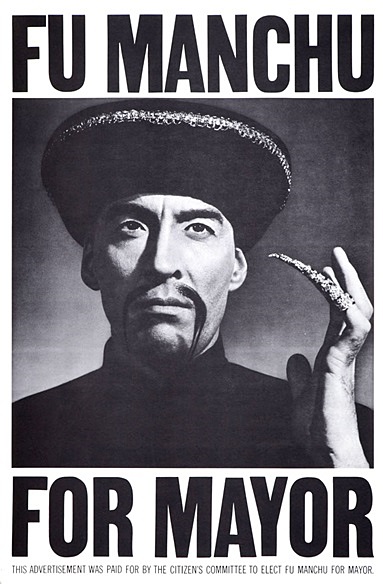
Used as a gag promotional tool, the flyer circulated around New York City during
election time, prompting some voters to cast write-in votes for Fu Manchu!


Things open in Imperial China as a suspiciously calm Fu prepares to lose his head after already being found guilty of attempting to create an underworld empire bent on world domination and committing various other crimes “almost without number.” After the axe swings and the head rolls (er, well, lands in a basket), Scotland Yard Commissioner Nayland Smith (Nigel Green), whose tireless efforts led to the capture of Fu in the first place, breaths a sigh of relief. Not too long after, things still haven't improved in the least across Europe. In fact, they've gotten worse. Drug trafficking, murder and various gang activities are still on the rise. When a murder victim who's been strangled with a silken prayer scarf from Tibet, where Fu had lived and studied for a spell, turns up, Nayland suspects the “most evil and dangerous man in the world” may somehow still be alive. And he turns out to be correct. The executed "Fu" was actually just a look-a-like, who's been hypnotized to take his place.


Upon the disappearance of famous biochemist Professor Muller (Walter Rilla), Nayland, with help from his trusty, Watson-like assistant Dr. Petrie (Howard Marion-Crawford) begins to piece the elaborate puzzle together. He first meets up with the professor's personal assistant Carl Janssen (Joachim Fuchsberger, who took some time off from a long stream of German krimi to appear here) and Muller's daughter, Maria (Karin Dor). From them, he learns that the professor had been experimenting with an extremely rare and extremely potent flower called the Black Hill Poppy. A poison from the precious flower, which is found only in Tibet and called “The Seed of Life” by local monks, is so potent a few drops can kill thousands of people. The professor and Carl had been acquiring it through a black market drug operation, which is how Fu and his men were able to learn all about them and what they were up to.


Nayland and Carl pay a visit to the drug warehouse the professor was getting his supplies from and inadvertently tip off Fu and his men in the process. Fu, whose secret headquarters (which extend far under the Thames River) are located inside the warehouse through a secret passageway hidden behind a bookcase, then puts out hits on both Nayland and Carl. Because the kidnapped professor refuses to cooperate in Fu's evil schemes, Manchu instructs his daughter Lin Tang (Tsai Chin) to arrange for Maria to be kidnapped to prod the professor along. After the formula is complete, Fu lets everyone know he means business by contaminating the village of Fleetwick; instantly killing all three-thousand people living there. He announces over the radio that if his demands are not met within a few days, he'll launch a follow-up attack and claim 10 thousand more victims.


Based on the lukewarm reception of these movies, this was more enjoyable than I expected it to be. While the first half tends to drag, the film improves significantly as it goes along. Good use is made of the Irish shooting locations and the production values are good enough to create a believable 1920s period setting via the art direction, costumes, props, cars, etc. The numerous fight sequences are choreographed efficiently for the time and there's also a pretty good car chase through the streets and country, which ends in one of Fu's henchmen trying to drop bombs on our heroes from an airplane circling above! Fu also has a neat little drowning chamber in his lair that expels victims right into the river where they'll no doubt be written off as suicides. Also included in one of the very first scenes is a cheeky direct reference to Yellow Peril; almost a built-in escape route to protect the filmmakers of any possible criticism!


As far as the cast is concerned, there may not be any particular standouts, but the combination of experienced British and German character actors ensures no weak links either. Pretty much everyone does their job very well. My only major gripe is with the finale, which should have been more exciting and suspenseful than what it is.


Fu's final words in the film are “The world shall hear from me again.” Audiences did indeed hear from him again and they didn't have to wait long with the release of THE BRIDES OF FU MANCHU (1966) the following year. It was also directed by Sharp, written and produced by Towers and featured Lee, Chin and Marion-Crawford reprising their roles (other major parts were re-cast). Three other sequels; the Jeremy Summers-directed The Vengeance of Fu Manchu (1967) and a pair of Jess Franco efforts; The Blood of Fu Manchu (1968) and The Castle of Fu Manchu (1969), rounded out the series. All of these made their way onto DVD eventually.

★★★
Related Posts Plugin for WordPress, Blogger...