.
.
.
Showing posts with label Ivan Cardoso. Show all posts

Friday, September 17, 2021

Sentença de Deus (1972)

... aka: God's Sentence

Directed by:
Ivan Cardoso

As some kind of tribal-sounding music plays, a bearded hippie FREAK wearing pants so low his ass crack and pubes are showing does a crazy dance near a lake. Another guy dressed in a cape then walks up to him holding a knife and a chicken. Uh oh. The knife guy slashes the chicken's throat and dribbles blood and feathers all over the dancing guy's back in a sequence the director said in an interview "still impresses the audience." Nope. The film then reverts to black-and-white and we see a woman lying solemnly on a table. At first I thought she was sleeping but then I realized there are candles around her so I guess she's supposed to be dead. Chicken blood guy then walks into the room, looks her over, pushes up her dress, climbs on top and starts having sex with her.

We then cut to another dirty hippie with a fluffier, fuller beard carrying around a child's coffin. We shall refer to him as CBG (Coffin Bearded Guy) as not to confuse him with CBBG (Chicken Blood Bearded Guy). CBBG crawls around in the cemetery, peaks over some bushes and then gets into some kind of fight with CBG, which ends with him being strangled. Sitting in front of a Brazilian flag, CBG is then shown smelling a woman's foot and sucking on her toes as some kind of (I think) patriotic Brazilian song plays. It's kind of hard to tell since I don't speak Portuguese. Apparently not killed, CBBG rips off his shirt and walks around with a ball and chain fastened to his leg. Someone still needs to get this guy a belt.


CBG, TG (toe girl) and SRGWSNP (some random guy who serves no purpose) then go up to CBBG, pull down his pants and stick a lit cigar up his ass. CBG gets his hand on another chicken, cuts its throat with a razor and then strangles TG to death. In front of an apartment building, CBBG whips out a pair of scissors, starts trimming his pubic hair and then cuts his dick off. CBG picks his nose and then another topless woman seduces him onto a sheet lying on the ground, pulls out a pair of scissors and stabs him to death. Fin.


I'm sure this 20-minute short is a deep and profound statement about something or other. I just never gave a hoot what and have no interest in finding out either. A few scenes are pretty gross, I guess, but I was much more offended by the incompetence of the direction, blurry (Super 8) photography, lighting and editing, not to mention annoyed by the fact I could never tell if this was some kind of amateurish parody of pretentious, cheap-shock "art films" or the real deal. (The director himself seems to take it seriously, so I think I have my answer.) And I don't care what anyone says, it's entirely possible to make your artistic statement, whatever that statement may be, without torturing and killing animals in the process.

Cardoso, who'd go on to make the documentary short The Universe of Mojica Marins (1978) and a number of other features and shorts, randomly inserts a Coffin Joe poster at one point. I'm beginning to think his (very good) THE SCARLET SCORPION (1990) was some kind of fluke.

NO STARS!

Friday, March 4, 2016

As Sete Vampiras (1986)

... aka: Little Shop of Terrors
... aka: Seitsemän vampyyriä (Seven Vampires)
... aka: Seven Vampires, The

Directed by:
Ivan Cardoso

A large shipping crate containing a purple, poisonous, Audrey-style carnivorous plant that doesn't talk but must be fed raw meat every three hours arrives in Rio de Janeiro from Africa. Botanist Frederico Rossi (Ariel Coelho) has it shipped to his greenhouse / lab, where his paranoid dancer / choreographer wife Silvia (Nicole Puzzi) takes an instant dislike to it and begins to worry about what it may do to her husband. Just in case something were to happen, Fred whips up an antidote for the plant's poison. Unfortunately, he doesn't even have a chance to try it out as the plant, which has numerous snake-like appendages with separate mouths, minds and appetites of their own, eats him. When he doesn't answer the phone, Silvia rushes to the greenhouse only to find what's left of her husband; ripped up clothes in the plant's mouth and an eyeball. One of the tentacles then chews up her arm and she flees. Because of the traumatic incident, Silvia withdraws from her dance classes, stops talking to her Marilyn Monroe-like best friend Clarice (Susana Matos) and becomes a bitter hermit who stays holed up in her country home. She's also been infected by the plant bite, which makes her age rapidly, but takes the last antidote and all appears to be well after. Well, maybe...


Two months later, a series of blood-draining murders being committed by a vampire-killer are being investigated by the local police force. Elsewhere, Silvia is visited by Rogério (John Herbert), a businessman friend of her late husband's, who shows up with a proposition. Since gambling's been banned, his night club is failing and about to close its doors for good. Silvia agrees to put together a show to help draw in a crowd. She auditions and hires some entertainers and a septet of beautiful young women to perform in something she calls “The Transylvanian Follies.” Opening with magician Fu Manchu (Wilson Grey), who does an amusing disappearing / pickpocket act, we're then on a graveyard set where a grieving man who's lost his love Nayara goes to a cemetery where a Satyr statue comes to life and leaves behind his flute. The man plays the flute and then we're treated to “The Dance of the Seven Vampires;” where seven topless ladies in capes and g-strings flash their fangs before Nayara sinks her fangs into the guy's neck. The show is a huge hit and revitalizes the club.


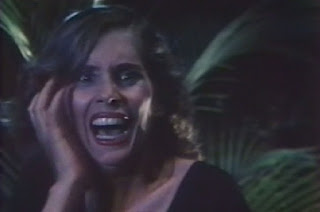

Rogério is in love with the beautiful main dancer, Ivete (Simone Carvalho), who's a gold-digger and refuses to reciprocate his love unless he signs over everything to her, which will leave Silvia out on her ass. As Ivete takes a long and thorough shower before the two, uh, consummate their contract, a masked maniac sneaks in and slashes Rogério's throat. The same masked maniac later shows up at a cemetery trying to kill Ivete, but she escapes and goes straight to comic book-obsessed private detective Raimundo Marlou (Nuno Leal Maia), who agrees to shadow her at all times for 100 dollars a day. Raimundo shows up at the club snooping around, but there's another murder and he can't be seen around there too much or else he'll blow his cover, so his secretary / love interest Maria (Andrea Beltrão) goes undercover there as a hat check girl. Hated by the flustered police chief (Bene Nunes) and pretty much everyone else he works with, dimwit Inspector Pacheco (Colé Santana) also wants to prove himself by cracking the case.


There are a lot of other characters who make up a huge roster of possible suspects. There's slutty old maid Rina (Zezé Macedo), who tries to coerce every man she encounters to screw her or else she'll cast a voodoo spell on them. Then there's creepy, bald, woman-hating doorman Silas (Felipe Falcao) who's frequently shown lurking around and shares some kind of mysterious meat with his cat. And Baron Von Dyck (Ivon Cury), a rich celebrity schmoozer who helps social climber wannabe actress Eliza Machado (Lucélia Santos) get a gig as one of the vampire dancer girls. And voyeuristic young stage hand Pedro (Pedro Cardoso), who has the hots for Eliza and spies on her through a peephole looking into her dressing room. And sleazy girlie photographer Luiz (Carlo Mossy), who attempts to blackmail the killer once he discovers his / her identity. You get the idea.


Director Cardosa clearly loves, and knows a lot about the history of, cinema. Maybe too much for his own good in this case. Seven Vampires doesn't so much have style as it does everyone else's style stuck in a blender and mixed to a bloody pulp. There are constant nods to 20s – 50s genre films, from expressionistic shadows to film noir / detective stories to old dark house mysteries to adventure serials, as well as a generous blood flow more in tune with 80s slasher flicks and loads of (sometimes full) female nudity that would be more at home in 70s Euro soft porn. There are bits of Raymond Chandler, Little Shop of Horrors, The Phantom of the Opera and Elizabeth Bathory in the plot and too-numerous-to-mention film and pop culture references. Alfred Hitchcock (in a clip from his Alfred Hitchcock Presents TV series) even makes an appearance re-dubbed to talk about how thrilling this movie is and, in another scene, the leading lady drives in the rain, hears voices in her head and Bernard Herrmann's theme music from Psycho is heard.


Going right along with the variance of influences, this doesn't completely commit itself entirely to any particular time, though it usually appears to be set sometime in the 1950s. Clothing styles change frequently, characters are seen driving around in vintage automobiles and there's a 50s-style singing group led by Bob Rider (Leo Jaime) and His Rhythm Sensation who perform an entire musical number. The 1957 Top 40 hit “Little Darlin” by The Diamonds (also heard in HELLO MARY LOU: PROM NIGHT II) is one of several “borrowed” songs on the soundtrack. Other elements of the film appear modern. Well, modern for the 80s. The film is all over the place as a result and a bit much to take in. Some scenes play out seriously, but there are also constant comedic moments that don't help matters because most of them aren't particularly funny (or clever).


In Brazil, this was a big hit in theaters, was nominated for numerous film awards and even spawned a comic book. The first Brazilian home video release was on the Phoenix Home Video label. It then somehow found its way into Japanese video stores of all places (courtesy of Sony Exc!t!ng) under the new title Little Shop of Terrors. Here in America, there was a later English-subtitled VHS release from Something Weird Video, but that's it as of this writing. In January 2014, Camp Motion Pictures (known primarily for releasing no budget 80s SOV horrors) announced they were going to release all of Cardoso's genre films (including this one) on DVD for the first time here in America. Not surprisingly, here it is now over two years later and that has yet to happen.


Other films in Cardosa's horrorography include the 27-minute Super 8 short Nosferatu in Brasil (1970), the 26-minute Coffin Joe documentary The Universe of Mojica Marins (1978), The Secret of the Mummy (1982), THE SCARLET SCORPION (1990), O Sarcófago Macabro (2005), The Werewolf of the Amazon (2005) starring Paul Naschy and A Marca do Terrir (2005; a compilation of Cardosa's early shorts).

★★

Saturday, June 6, 2009

O Escorpião Escarlate (1990)

... aka: Scarlet Scorpion, The

Directed by:
Ivan Cardoso

I went into this one expecting a horror-comedy (judging by the director's track record and the poster art proclaiming him a "master of terror"), but instead got a delightful, highly-stylized, sometimes hilarious and always affectionate comedy about the importance of radio programming in Brazil back in the day. There's the occasional nod to vintage horror and sci-fi films in here, enough for it to earn a place on this blog, but don't expect anything terrifying here. It cleverly opens with black-and-white newsreel footage (very similar to the way Heavenly Creatures began) that covers everything from race car driving to "grass weed" (marijuana) trafficking to cable cars to celebrities such as Kim Novak, Janet Leigh, Zsa Zsa Gabor and Linda Darnell arriving in Copacabana. Movie going was more popular than ever in Brazil in the 1950s (the setting for this film), but what has really won the hearts of the country is the popular cliffhanger radio serial "The Adventure of The Angel," which features iconic crime-fighter "O Anjo" (The Angel). The show's writer and creator, Álvaro Aguiar (Herson Capri), has just signed a million dollar contract to continue his series and possibly bring the character to the big screen. Meanwhile, fans of the show, including fashion designer Gloria Campos (Andréa Beltrão), are gathering around their radios to hear the latest adventures of The Angel and envisioning the events in their minds, which are then shown to us as well-filmed and knowing recreations of vintage serials. The film jumps back and forth from the real world (shot in color) to the fictional world of "The Angel" (in black-and-white), with the two sometimes overlapping.

How fiction carries over into the real world here is that a serial killer is dressing up as the radio program's villain, "The Scarlet Scorpion," and going around killing people in the same ways depicted in the radio program. Gloria links the string of recent murders to the program and when her accusations blow up in the press, she's canned from her job. Thankfully, she quickly finds another at Radio Nacional hosting "The Angel Club;" a fan talk program where she answers letters and gives away gifts ("It's what American's call marketing!"). There she meets Álvaro and the two immediately fall in love. There are many other characters in this film, as well. Untalented voice actress Rita Mara (Susana Matos) is sleeping with the overweight station director Alfredo Maximo to try to get a larger role in the program. Guido Falcone (Nuno Leal Maia), an Italian opera singer with a white streak in his hair, is pissed because he's just been canned to make room for more Angel programming. Gloria's co-worker Paula (Isadora Ribeiro) is sleeping with a taken man (Mário Gomes) who she met while modeling wedding gowns to his future wife!

In the visualized program, The Angel is portrayed by the same actor playing the writer, while Doris the female reporter is at first played by actress doing the actual voice overs for the show, but then by the actress playing Gloria. It may sound confusing, but it's really not when you watch it. Other characters on the show include Angel's sidekick Jarbas (Leo Jaime), sadistic, exotic villainess named Madame Ming (Monique Evans, who was apparently a top Brazilian model) and Ming's bald, facially scarred, crippled henchman Limping Frog (!?) In one scene, the reporter is tied down to a table topless with a huge buzz saw aimed between her legs and threatening to saw her in two! Eventually she's taken to "The Palace of Torture" where she's put in some contraption that will impale her with spikes. Saw has nothing on this bad boy.

Did I mention that Angel has his very own completely awesome 50s-style theme song played four different times in the film (including over the opening and closing credits)?

There's also a great scene at a club called Night & Day where jazz singer Ivon Cury performs a Sinatra-like song and then Brigitte, a French entertainer, starts doing a harmless "Diamonds Are a Girls Best Friend"-style routine that quickly turns into a sexy strip show. What makes this interesting is that Brigitte is played by an actress named Roberta Close who before this film was better known as Luíz Roberto Gambine Moreira. Yes, the gorgeous stripper we all just saw was actually a pre-op transsexual. I'll admit it. I had no clue. I was just like "Wow, she's hot." Looking up more info online, I discovered Roberta was the first pre-op to pose for Brazilian Playboy, had a full sex reassignment surgery in 1989, did a layout for a men's magazine called "Sexy" and was eventually named the "Most Beautiful Woman in Brazil" in a reader's poll. After that she relocated to Europe, married a Swiss businessman and became a staple in European tabloids. And this woman isn't even known here in America.

From a production standpoint, this is very well done, with charismatic actors, a fun and always engaging story line, good music, some laughs, plenty of action and skin and excellent cinematography, art direction and editing. It should be better known than what it is. Something Weird Video used to distribute it (and still might) and there is a nice-quality subtitled print floating around out of there if you look for it.

★★★1/2
Related Posts Plugin for WordPress, Blogger...