.
.
.

Saturday, February 25, 2023

Knife for the Ladies (1974)

... aka: Cuchillo para damas
... aka: Jack the Ripper Goes West
... aka: Knife in the Dark, A
... aka: Lovløs dom (Outlaw)
... aka: Silent Sentence

Directed by:
Larry G. Spangler

Fusion horror westerns go back to at least the 1930s, but this peculiar cross pollination has never really become a formidable subgenre. While horror movies have almost always maintained a certain level of popularity, there's historically been an ebb-and-flow nature to the western's popularity with moviegoers. Meaning, if westerns only come out in small numbers nowadays, then horror-westerns come out in much smaller numbers than even that. Still, there are quite a few interesting and sometimes excellent films to be found here and the occasional film that hits, such as 2015's Bone Tomahawk, which I wasn't overly enthused about but a lot of other people seem to like. Interestingly, in what is considered a genre that mostly appeals to men, two of the very best horror westerns; Kathryn Bigelow's vampire film Near Dark (1987) and Antonia Bird's cannibal-themed Ravenous (1999), were directed by women. Also interestingly, a number of classic westerns which were never considered anything other than westerns are finally being recognized by film historians for their horror content decades after the fact, like the Clint Eastwood films High Plains Drifter (1973) and Pale Rider (1985).

Nearly every horror western I'm aware of has some kind of supernatural or fantastical bent, whether that be ghosts, vampires or monsters, which makes A Knife for the Ladies an anomaly itself. Set in 1882, this one's an even rarer serial killer film / whodunit / proto-slasher. While that was a cool idea in theory for 1974, the execution here is unfortunately rather ho-hum.


Three mysterious murders have rocked the once-peaceful and now-dying small town of Mescal, Arizona, which was once home to a thriving copper mine that is no more. As a result, the town has drastically reduced in population, opportunity and financial stability. The murders themselves may or may not be tied into this, especially seeing how the first victim was Travis Mescal (former NFL cornerback Peter Athas), a descendant of the town's founders who was found viciously stabbed to death. Two saloon gals, employed by the aptly named "Hooker's Saloon", soon followed. Alarmed by the recent slayings, bank president Simeon Hollyfield (John Kellogg) takes a trip to the city to recruit Detective Edward R. Burns (Jeff Cooper) to help. Burns is offered a 500 dollar reward, a recommendation and paid accommodations while in town. Measly compensation, but as Burns notes, "It's poor pay... but a rich challenge." He accepts.


Slovenly Sheriff Jarrod Colcord (Jack Elam), a "two-fisted bear of a man", isn't too happy that Hollyfield is about to bring a "fancy" detective in from the big city to do his job, so he starts slamming back whiskey shots and then organizes a torch-carrying posse of locals to go after Ramon (Phillip Avenetti), who's wrongly blamed for death #4 after a child places him at the scene of the crime earlier in the day. Saloon owner Virgil Hooker (Gene Evans) and a pair of no-good gunslingers; Lute (former Boston Bruins center Derek Sanderson) and Horace (former Oakland Raiders wide receiver Fred Biletnikoff), track Ramon down and then lynch him.

Burns arrives to a hostile reception from both Jarrod and many of the locals. He assigns Jarrod the task of finding Ramon's killers while he starts interviewing locals and snooping around. He pays a visit to the menacing Orville Ainslie (Richard Schaal), who runs the barbershop / mortuary and says things like "Dead is dead, I reckon" and "I suppose anyone's death is bad for business... except for mine." And then there's the widowed Elizabeth Mescal (Ruth Roman), mother of the first victim and now sole heir of the Mescal family dynasty. She believes the townsfolk blame her for the failure of the local mine, which has caused many to relocate elsewhere, and refuses to acknowledge the fact that her murdered son was anything less than pristine, even though he was well known around town for drinking, gambling and paying for the company of prostitutes.


All of the usual trappings of the western are here, right down to the stagecoaches, dusty town, gunfights and a heavy-handed moral getting shoved down our throats in unsubtle fashion (how they soft pedal lecture the little boy after his lies lead to a vigilante killing is more than just a little nauseating!), as are all of the usual trappings of the whodunit, most especially in the way this attempts to establish most of the central cast as suspects.

The end result is watchable, though middling. The murder scenes lack punch (and suspenseful build-up), the mid-section is a slog to get through and the film is visually flat and unimaginatively directed, but the shock finale may be worth waiting for. It's downright jarring and surprisingly perverse considering how tame the film had been up until that point! The performances here are extremely uneven, ranging from pretty good to terrible. Schaal and Roman fare best here, though the relationship that develops between Cooper and Elam's characters has its minor charms, as well. The cast also includes Diana Ewing (known to Trekkies as the memorably-attired Droxine in the 1969 Star Trek episode "The Cloud Minders") in an underdeveloped role as Elam's niece and Henry Kendrick (who also appeared in the 1988 horror western Ghost Town) as a doctor.


Settings are convincing as this was filmed at the Old Tucson movie studio and theme park, which was built in 1939, slowly added to over the years and also served as the setting for a load of other western films and TV shows like Gunfight at the O.K. Corral, Rio Bravo, Three Amigos, Tombstone and Little House on the Prairie. Knife was one of over 400 productions shot there over the years. Many of the buildings and much of the movie memorabilia housed at Old Tucson was lost in a 1995 fire, which was rumored to have been started by a disgruntled former employee out for revenge. Attempts to rebuild what was lost were unsuccessful and it finally closed down for good in 2020.


Director Spangler also made The Soul of Nigger Charlie, a blaxploitation western starring Fred Williamson that was also filmed at Old Tucson, The Last Rebel, yet another western and a vehicle for football star Joe Namath (Spangler must have had a thing for pro athletes or something) and, for a change of pace, the hardcore porn film The Life and Times of the Happy Hooker. Co-writer Seton I. Miller had won an Oscar for co-scripting Here Comes Mr. Jordan (1941).


This received VHS releases in Australia (Video Classics), Spain (Continental Home Video), Sweden (Svenska Walthers Video) and the UK (Iver Film Services), though I'm not aware of any U.S. home video releases until a TV edit (reduced down to just 51 minutes and re-titled Jack the Ripper Goes West) popped up on some of those cheap budget DVD packs in the early 2000s. In 2018, this finally received an uncut (87 minute) Blu-ray release from Code Red.

★★

Sunday, February 19, 2023

Astro-Zombies, The (1968)

... aka: Astro-Zombies - Roboter des Grauens (Astro-Zombies: Robots of Horror)
... aka: Space Vampires
... aka: Space Zombies

Directed by:
Ted V. Mikels

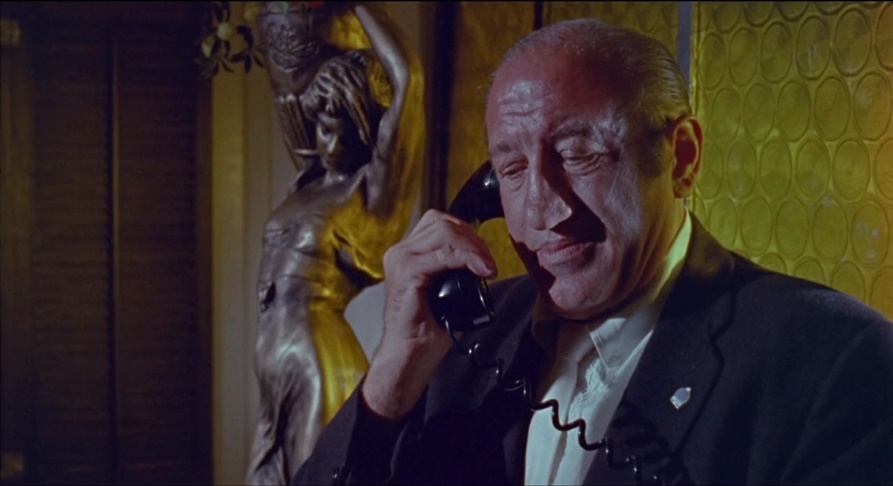
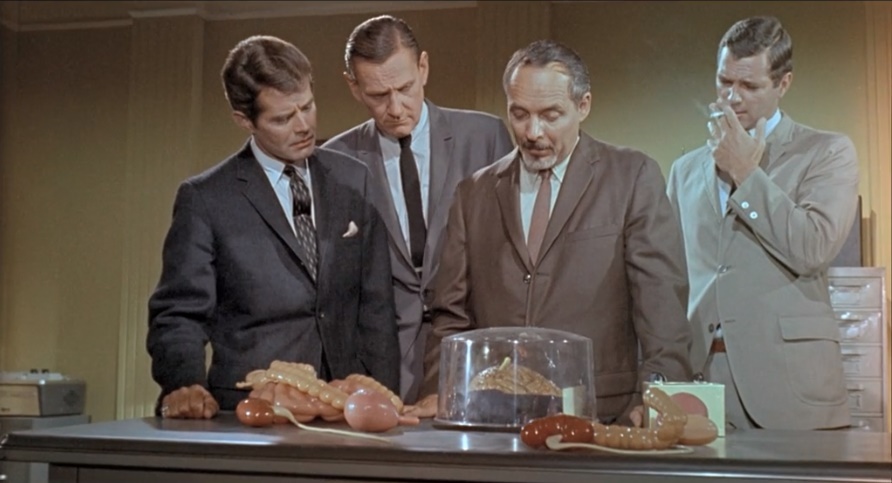
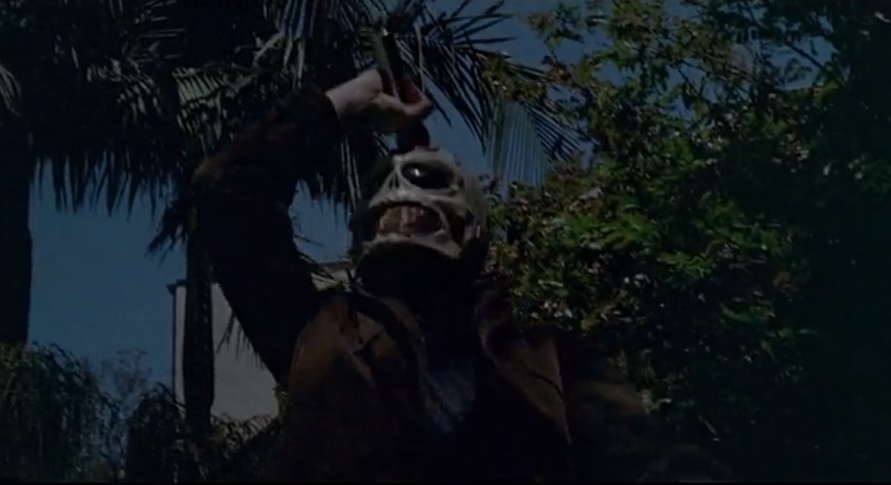
A woman killed in her garage by a masked fiend brandishing a gardening tool is but one of many recent "mutilation murders" in the Los Angeles area over the past six months. C.I.A. chief Mr. Holman (Wendell Corey) calls Dr. Eric Porter (Tom Pace) and Chuck Edwards (Joseph Hoover), from the C.I.A.'s "subversives division," into his office to try to get the bottom of things. Eric has spent the last few months undercover as an assistant to Dr. DeMarco (John Carradine), a brilliant scientist who'd already been tossed out of the government aerospace research center for his unorthodox experiments with organ transplants and "thought wave transmissions through radio frequencies" but has been continuing his work elsewhere. Dr. Petrovich (Victor Izay), a former colleague of DeMarco's, is called in to provide additional insight into just what DeMarco has been up to. It's Holman's belief that a foreign government may be interested in stealing DeMarco's research and using it for their own nefarious purposes. Either that or DeMarco is already willingly working with a hostile foreign country. The dialogue is so hopelessly muddled it's actually difficult to tell.


Elsewhere, DeMarco is busy in his basement lab creating what he calls "astro-men" while his loyal, mute hunchback helper Franchot (William Bagdad) is occasionally sent out to acquire victims (from car crashes and such). Whenever fresh corpses are procured, they are immediately strapped to a table and have some kind of a metal cap placed over their head, which is plugged into a machine that's hooked up to some kind of computer system. After a switch is flipped, they're then drained of all blood, placed in a "thermal freeze vault" to keep cellular deterioration from occurring and then must go through a "synthetic heart transplant." And that, along with specially-programmed computer chips and other attached gadgets and doodads, is how you create astro-men!

Carradine is handed a bunch of rambling, pseudo-scientific dialogue to "explain" the process, which is so needlessly complex it only succeeds in making viewers mentally check out. This wire goes there and this switch turns on that and that won't work without this special microchip or attachment and that transmitter operates this but not that... on and on it goes. I didn't have a clue what he was talking about most of the time!


Other victims are claimed, both by a rogue astro-man, one of whom sneaks into Petrovich's lab and stabs his assistant Lynn (Janis Saul) to death before harvesting her organs, as well as foreign spies, who make short work of any C.I.A. agent who happens to be closing in on them at any given time. The latter are led by cult star Tura Satana (Faster Pussycat! Kill! Kill!), who plays a "Dragon Lady"-type spy named - you guessed it - Satana, and is after Carradine's secrets when she isn't putting lit cigarettes out on people's faces or nonchalantly unloading her gun into them. 

With her voluptuous body, pasty white face make-up, large fake eyelashes, thin drawn-on eyebrows, bright red lipstick over a tight mouth and amazing gown selections with slits in all the right places, Satana cuts quite the memorable figure here. Though her actual performance isn't quite up to par with her Russ Meyer film appearance, she's still clearly one of the most interesting aspects of the production. As for the Japanese-American actress' little spy ring, which includes Dominican Rafael Campos (LADY IN A CAGE) as the switchblade-happy Juan and stocky Italian Vincent Barbi as the barely-coherent Tiros, I'm not sure what organization or country they are supposed to represent exactly.

Joan Patrick co-stars as Janine Norwalk, who happens to be DeMarco's former assistant who also happens to be Petrovich's current assistant who also happens to be Dr. Porter's girlfriend who also happens to be a primary target of the escaped astro-man because he happens to have been a patient of hers prior to being transformed into an astro-man. Small world, eh? Janine eventually agrees to set herself up as bait to lure the zombie back to the lab but things don't go quite as planned.


While a few of the scenes are admittedly entertaining or unintentionally funny, and there's some camp value here, it's not quite enough to send this into SBIG territory. The film mostly just comes off as cheap, slow, directionless and incoherent. The plot is poorly developed and difficult to follow, the bad guys' motivations are murky at best, the film is flat out ugly to look at most of the time and there aren't nearly enough scenes featuring the titular creatures. Not that the astro-zombies are much to look at (it's just some guy wearing a cheap rubber mask), but at least the few scenes with it / them attacking people inject some much-needed action into this otherwise lifeless film. Most disappointingly, and despite the title, there is only one "zombie" in the film until the very last scene when there are a whopping two. They're also not from outer space.


You know what's not a good use of screen time, talent or we - the viewers' - time? Having to sit and watch a static shot of Carradine's wobbly hands fumble around with some kind of computer for three minutes, which consists of him removing two screws from a panel, pulling out a box, unscrewing the box, putting some kind of microchip inside, screwing the box shut again, sliding the box back into the computer, shutting the panel again, tightening the two screws again, hitting a button and then unscrewing the two screws on the panel again, pulling the box back out again, unscrewing the box again and removing the microchip! In what universe is that not boring as fuck?

There are endless similar scenes that go on for far too long (people driving around, walking, talking...) and are completely pointless. Around three to four minutes are also set aside to show a body paint-covered topless dancer performing her bongo drum-accompanied routine in a club, which is a welcome diversion as it's at least pleasant to look at.


Carradine never once gets to leave his cheap lab set and his performance is further hampered by the indecipherable gibberish he's forced to spout. Just a decade earlier, top-billed Corey had been acting in major studio films for the likes of William Wellman and Alfred Hitchcock, so this was quite the fall from grace for him, though not a surprising one going by the anecdotes I've read about his real life. A lifelong alcoholic, he made an unsuccessful bid for Senator in 1965 but was defeated in the Republican primary and ended up passing away from cirrhosis of the liver just six months after this film was released at the age of 54. Unlike Carradine, who at least tries, Corey gives your standard don't-wanna-be-here paycheck performance and his two scenes are long, drawn out and extremely dull.

The budget was just 37,000 dollars. Mikels also co-scripted, edited (using his real name Theo Mikacevich) and produced, plus has an uncredited cameo as the drum player. Wayne Rogers, later of M*A*S*H fame, co-wrote and was the executive producer. Roger had previously collaborated with Mikels on the softcore film Dr. Sex (1964). In 1982, the punk band Misfits released a song titled "Astro Zombies" inspired by the film (and on their album Walk Among Us), so at least something good came from all this.


After its 1968 theatrical release, 1971 theatrical re-release and its run on TV as part of an AIP syndication package, this well-distributed title turned up on home video countless times. It was released no less than three different times on VHS by Wizard under three different titles, starting with its original title in 1981, then Space Vampires in 1985 and then again as Space Zombies in 1986. Wizard also recycled footage from this to pad out their compilation tapes Filmgore (1983) and ZOMBIETHON (1986). Additional VHS releases from Mad Monster Video, Troma Team and other companies followed. In 2000, it made its official DVD debut courtesy of Image, and then was put out on Blu-ray by Kino Lorber in 2016. Some of the earlier releases of the film had been cut to remove some of the minor gore (including a machete decapitation) and the dance scene. The full running time of the uncut version is 92 minutes.


Over thirty years later, Mikels returned with the extremely cheap sequel, Mark of the Astro-Zombies (2004), which featured Satana again, along with cult stars Liz Renay and Brinke Stevens. That was followed by Astro Zombies: M3 - Cloned in 2011, with Satana (in her final film role; she'd pass away the following year) and Francine York, and Astro Zombies M4: Invaders from Cyberspace in 2014, which featured Beverly Washburn, of Spider Baby fame.

★
Related Posts Plugin for WordPress, Blogger...