

Directed by:
Tommy C. David
Larry Santiago (segment removed)
Pablo Santiago
Felix Villar
If we're to believe many sources, it was the British film Dead of Night (1945) that helped to popularize the horror anthology format. However, there are quite a few glaring problems with that assessment. Firstly, Germany made a number of popular horror anthologies way back in the silent era like Eerie Tales (1919), Destiny (1921) and Waxworks (1924); to name a few. Second, Dead of Night did not seem to spawn any immediate imitators. Had the film actually made this format popular, there would have been an explosion of similar films shortly after its release. Instead, there are only a couple of anthologies here and there throughout the entire decade of the 50s. (This, by the way, is no slight on Dead of Night itself, which is an influential film in its own right. I'm just putting things into perspective here.) A much larger crop of these didn't emerge until the 60s and 70s. Typically, Hammer and Amicus are singled out then for boosting their popularity, yet the groundwork was clearly laid out for them already with a pair of prior box office hits: Roger Corman's Tales of Terror (1962) and Mario Bava's Black Sabbath (1963).
One country that almost always gets entirely left out of the conversation is the Philippines. There was Katotohanan o guniguni? / "Truth or Illusion?," Mga alamat ng sandaigdig / "Legends of the World," Pagsapit ng Hatinggabi / "The Arrival of Midnight" and this one released in 1960, plus Mga daing sa libingan / "Cry from the Grave" and Konsiyerto ng kamatayan / "Concert of Death" released the following year. All six of these (and there may be others I don't even know about) predate the 1960s wave of US / UK / European anthologies by several years. But it doesn't stop there as anthologies have sustained their popularity to this very day in the Philippines. The Shake, Rattle & Roll film series, for instance, has become one of the most enduring franchises in Filipino film history, spawning fifteen entries to date.
Unfortunately, none of the 1960s Filipino anthologies are likely to have ever made it out of the country and the Philippines did about as good a job preserving their older films as Thailand. In other words, not a very good job at all. Most of these are lost and likely gone forever. Gabi ng lagim appears to be the lone survivor from the list of 60s titles above and is, in fact, one of the only surviving purely Filipino genre films from this entire time period. Even so, it didn't fully survive. The only available print is missing one of its stories: the opening tale directed by Larry Santiago and starring Ramon Revilla and Cecilia Lopez. We actually get to see a brief snippet of this removed scene (plus credits) before it suddenly just cuts to the second story. I'm not sure what happened here or why it was removed.


Up first in this reduced 73 minute print is the segment is from Felix Villar, who'd go on to co-direct DEVIL WOMAN (1974) and its sequel BRUKA, QUEEN OF EVIL (1975). A coffin washes ashore near a cemetery, the lid flies open, birds fly out, it explodes in smoke and a caped vampire count (Tony Gosalvez) emerges. He resurrects a beautiful young woman named Melissa (Myrna Delgado) and sends her in the direction of a village where she can have access to all the fresh blood she desires.
Claiming to be ill and in need of a quiet, relaxing place to stay away from the city so she can recover, Melissa shows up at the home of Mang Ambo (Francisco Cruz); a poor, hard-working widower. Also living in the home are his children; teenage daughter Lita (Cielito Legaspi) and younger son Enteng (Vic Santiago). A couple of hired hands; Celso (Amado Cortez), a pathological liar trying to woo Lita with tall tales about how he'll be rich once a wealthy relative of his in Manila dies (any day now...), and idiot Kiko (Dencio Padilla), a klutz, drunkard and glutton, are also always hanging around.


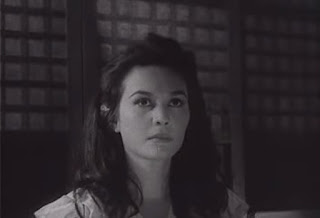

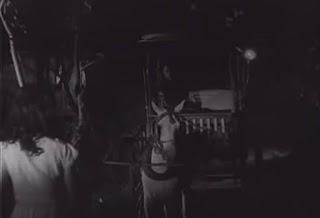


Despite being cold, aloof, antisocial and, well, dead, Melissa's looks soon attract the attention of both the village mayor, who offers to marry her, and Kiko, who's delusional enough to believe he can court the mysterious beauty. However, Melissa is almost always holed up in her bedroom; only emerging at midnight to wander outside. Of course, she's been feeding on human victims all that time. After claiming three male victims, she finally sets her sights on getting the virginal blood of Lita and then plans on heading off to the next village with the vampire count.


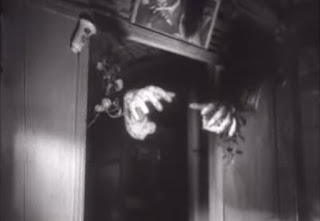
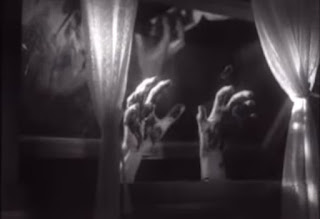
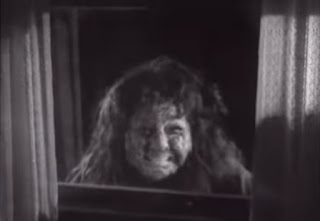
Tale #2 (directed by Tommy C. David) starts with a crazy, disfigured old hag hobbling through a cemetery, digging up a grave (with her bare hands!) and then instructing the revived inhabitant of the coffin - Arnulfo - to "avenge the wrongs done to us!" A young woman named Carina (Yolanda Guevarra) then wakes up screaming in her bed, awakening her husband Nanding (Jose Romulo) and child in the process. Whew. It was just a dream. Or was it? Carina feels as though something is pulling at her legs and looks down to find them covered in blood, but it's not her blood as she's not cut. The blood leads up to a rocking chair, which starts rocking all by itself. And then the lights go out. And a window opens. Seems we have a haunting on our hands... by hands!
A pair of disembodied hands appear in a doorway and a voice announces itself as Arnulfo. The ghost claims he had his hands chopped off before being murdered and Nanding was involved. Nanding is able to drive the spirit away with prayer but that's only a temporary fix, as is bringing in a spiritualist to help. Accused of a murder he did not commit, what Arnulfo really wants is to get his hands on the real murderer; a lowlife named Rafael (Paquito Diaz), and restore his once-good name in the process. Rafael runs some kind of criminal / prostitution ring and is such a nice fella that, in addition to murder, he also pimps out his own girlfriend. After both are visited and terrorized by the ghost (who usually just shows up as hands but sometimes appears as an armless ghost), Rafael and Nanding go to the cemetery only to find Arnulfo's casket empty. Nanding eventually learns of Arnulfo's innocence and attempts to help the ghost seek justice.




Finally, we get a (supposedly) comic haunted house tale from Pablo Santiago. Seven teenage boys (played by members of the Lo' Waist Gang) are dropped off at a spooky old mansion that belongs to one of their grandfathers. They plan on spending the night and searching for a treasure rumored to be hidden inside while they're there. The doors open by themselves to let them in and then slam shut once they are (never a good omen, eh?) and they're scared by cobwebs, cockroaches and a spooky drama program they accidentally play on the radio (this anthology is actually based on a DZRH radio serial of the same name).
The boys dance, walk around holding hands and scream like girls (!?) An old school ghost in a white bed sheet holding a skull shows up and then disappears, as does another ghost. One guy "accidentally" strangles himself and they finally locate a treasure chest but a reanimated corpse is inside. After failing to scare the ghosts away with a cross, they flee the house. There's an extremely predictable Scooby Doo twist at the end as to the identity of the ghosts, which involves a young Fernando Poe Jr. (THE BLACKSMITH). Filled with terrible slapstick gags the Three Stooges would have rejected, this at least amusingly comes full circle and links itself up with the previous stories. The rest is mostly useless.


While none of these tales are anything special, the first two are entertaining enough and have their own perks. The first has a likable cast and, once she gets going, an energetic female vamp. The second story wastes no time jumping right into the ghost stuff and and is filled with highly variable but fun special effects. As for the last story, best I can say is that it's much shorter than the other two. I've read it was a Philippine tradition to stick a lighthearted comedy segment at the end of otherwise-serious horror anthologies, so that probably explains why it's there. I'd imagine if this final segment had been cut instead of the first one the film would have been all the better for it.
Apparently a box office hit in its home country at the time, advertisements for later films from the same producers boast about this one's success. I'm not aware of any home video releases, not even in the Philippines. In 1980, there was a follow-up of sorts: Gabi ng lagim ngayon ("Night of Horror Today"), which was also based on the radio serial.
★★


